In a pair of research papers published on arXiv, Xanadu Lead Quantum Scientist Danial Motlagh and co-author Matthew Pocrnic have demonstrated an algorithmic technique that reduces the non-Clifford gate cost of Quantum Read-Only Memory (QROM) by nearly 4-fold compared to long-standing industry benchmarks.
QROM is the foundational subroutine used to load classical data (like molecular Hamiltonians or financial matrices) into fault-tolerant quantum algorithms. Because table lookups account for most of the Toffoli gate overhead in practical applications, reducing QROM costs directly shrinks hardware runtimes and qubit requirements.
Xanadu achieved this ~4-fold reduction using two core innovations:
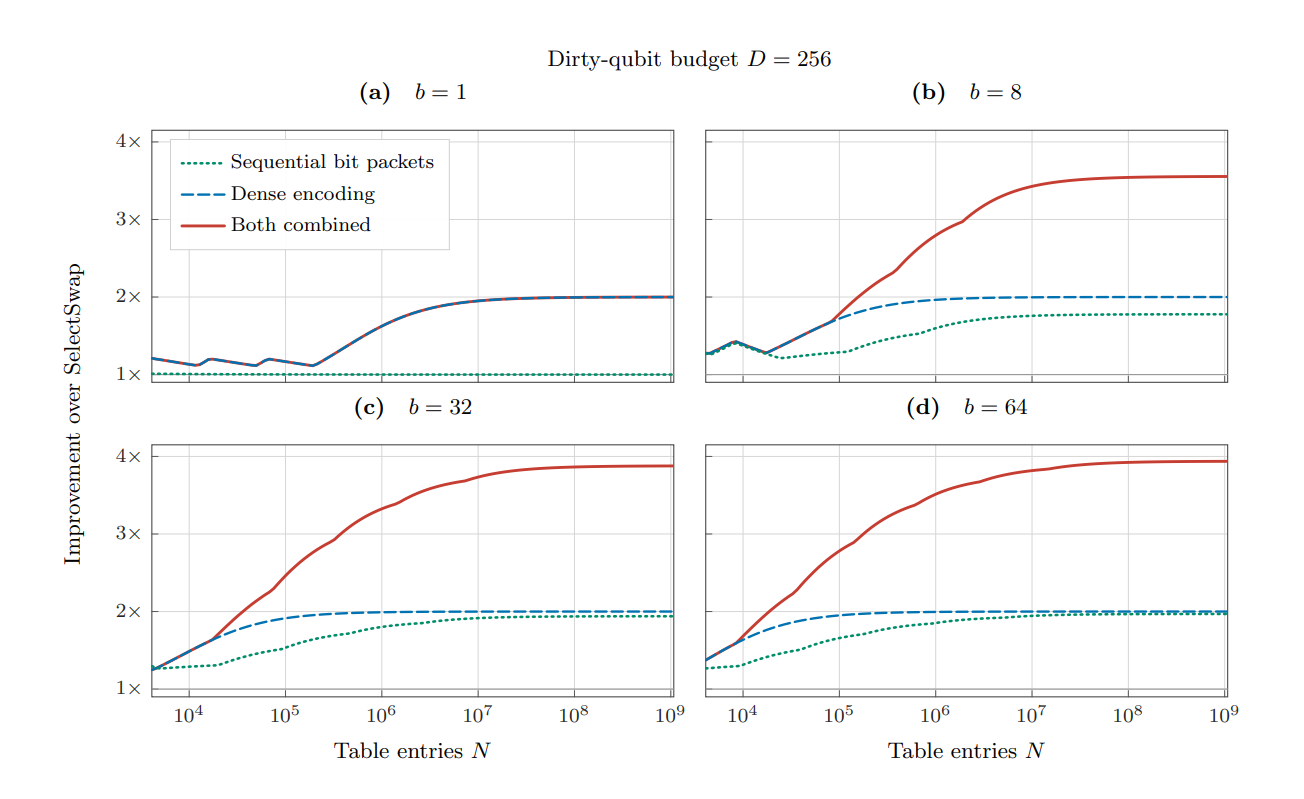
1. Sequential Bit Packets and SelectCopy (May 2026): By replacing controlled swaps with copies and overlapping consecutive data passes, the leading Toffoli gate cost was cut in half, matching clean-qubit performance while using borrowed “dirty” workspace qubits (arXiv:2605.20334).
2. Dense Encoding in Z and X Bases (October 2026): The new construction temporarily writes two classical bits onto a single dirty qubit simultaneously using both its Z and X Pauli bases, doubling the data loaded per pass (arXiv:2610.02321).
For standard 32-bit data entries (b = 32), combining dense encoding with sequential bit packets delivers a 3.9-fold Toffoli gate reduction over traditional SelectSwap architectures, representing a 75% savings in table-loading overhead.
| [ Key QROM Parameters & Metrics ] | ||
|---|---|---|
| Parameter | Name | Definition & Operational Meaning |
| • N | • Table Size / Entries | • The total number of classical data entries to load into the quantum computer. |
| • b | • Bitstring Length | • The width of each classical data entry in bits (e.g., b = 32 bits per number). |
| • λ | • Block Size | • The number of table entries loaded simultaneously during one pass. |
| • Dirty Qubits | • Borrowed Workspace Qubits | • Ancillary qubits borrowed in unknown states that are restored to their original state afterward. |
| • Toffoli Count | • Non-Clifford Gate Cost | • The primary metric of quantum execution cost. Lower counts reduce runtime and error-correction overhead. |
What This Discovery Means in Plain English
Loading large lookup tables into a quantum computer is like reading a thick dictionary line by line. For years, quantum algorithms used a method called SelectSwap, which shuffled data through borrowed memory qubits in slow, single-line passes. Xanadu first overlapped the end of one pass with the start of the next to cut the workload in half, then introduced dense encoding to write two pieces of data onto a single borrowed qubit at once using both its Z and X quantum directions. Combined, these shortcuts reduce the required quantum gates by nearly 4-fold, cutting the hardware overhead for complex chemistry and physics simulations by up to 75%.
Review the May 2026 paper on arXiv here, examine the October 2026 dense encoding paper on arXiv here, and read developer commentary in Danial Motlagh’s announcement here.
In GQI Portal
The players behind the news
The team that writes QCR tracks every company, deal and technology in the GQI Factory, GQI's verified database of the quantum industry. Next up: every story linked to its players, coming to QCR's paid plans.
- Players Companies and institutions across the quantum industry, by segment.
- Scorecards How the players compare on hardware, software, funding and more.
Newsletter
QCR Alerts in your inbox
The latest reporting and analysis from Quantum Computing Report. Free, unsubscribe any time.