

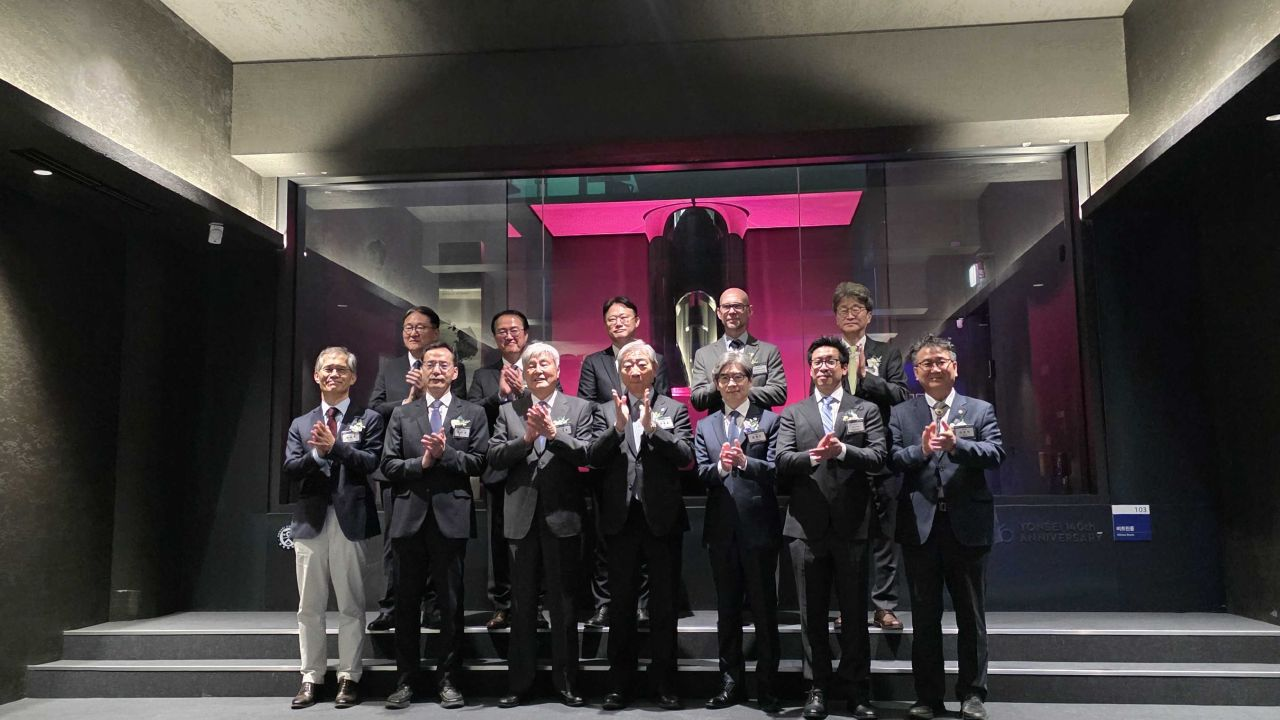
South Korea’s Yonsei University and IBM have completed the on-premises installation and online activation of the latest IBM Quantum Nighthawk r2 processor within the IBM Quantum System One at the Songdo International Campus Quantum Computing Center. Replacing the 127-qubit IBM Eagle processor originally commissioned in 2024, the installation marks the world’s first deployment of IBM’s Nighthawk architecture at an on-premises client facility outside the United States.
| Yonsei IBM Quantum System One: Hardware Architecture Evolution | ||
|---|---|---|
| Platform Dimension | Previous Baseline (IBM Eagle) | Upgraded Architecture (IBM Nighthawk r2) |
| Qubit Layout & Topology | 127 physical qubits (Heavy-hexagonal lattice) | 120 programmable qubits within a 458-physical-qubit square lattice (including tunable couplers and reset elements). |
| Circuit Execution Throughput | ~4,000 circuits per second | > 100,000 circuits per second (~25× throughput acceleration enabled by fast active qubit reset). |
| Depth & Gate Complexity | Depth-limited by two-qubit error propagation | Accurate observable estimation demonstrated beyond 7,500 gates (satisfying IBM’s 2026 technical roadmap target). |
| Primary Research Focus | Initial benchmarking and condensed matter physics | Yonsei Bio-Quantum Initiative (mitochondrial electron transport chain mutations and Leigh Syndrome modeling). |
The upgrade transitions the Songdo facility from the heavy-hexagonal layout of Eagle to IBM’s dense square-lattice geometry. By incorporating 218 tunable couplers alongside dedicated fast-reset auxiliary circuits, Nighthawk r2 suppresses idle crosstalk and dramatically curtails the shot-repetition cycle time. The resulting execution speed of 100,000 circuits per second provides local researchers with the sample collection rates needed for high-depth variational algorithms and scalable error-mitigated workflows without incurring prohibitive cloud queue overheads.
Since commissioning the original System One, the Yonsei research community has generated over a dozen peer-reviewed studies on IBM hardware, including a 104-qubit analysis of error-mitigated quench dynamics in Heisenberg spin chains published in Physica Scripta, alongside a 44-qubit hybrid quantum-classical simulation of the pyridine–Li+ complex detailed on arXiv utilizing Qunova’s Hi-VQE Qiskit Function. Under the expanded partnership, the Nighthawk r2 installation will primarily support the Yonsei Bio-Quantum Initiative, applying hybrid quantum-classical workflows to complex cellular kinetics, neurodegenerative disorders, and industrial materials discovery.
Further deployment details are available in the Yonsei–IBM Joint Announcement here and executive commentary on Jay Gambetta’s LinkedIn Post here; readers can also review QCR’s preview of the initial upgrade agreement in Yonsei University to Upgrade On-Premises IBM Quantum System One to Next-Generation Nighthawk QPU here.
In GQI Portal
The players behind the news
The team that writes QCR tracks every company, deal and technology in the GQI Factory, GQI's verified database of the quantum industry. Next up: every story linked to its players, coming to QCR's paid plans.
- Players Companies and institutions across the quantum industry, by segment.
- Scorecards How the players compare on hardware, software, funding and more.
Newsletter
QCR Alerts in your inbox
The latest reporting and analysis from Quantum Computing Report. Free, unsubscribe any time.