
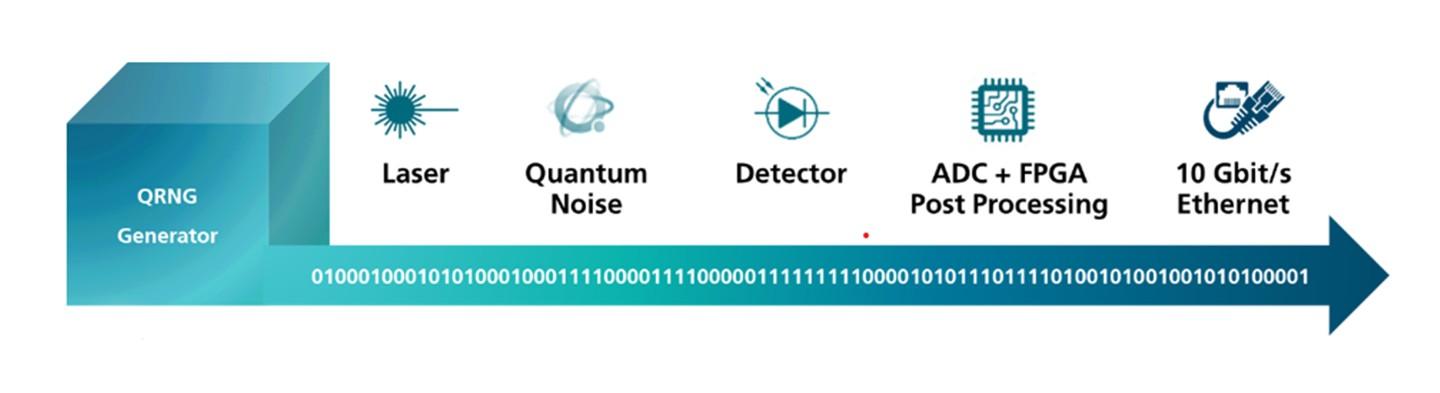
The Fraunhofer Institute for Photonic Microsystems IPMS has announced the development of Q-Dice, a high-performance Quantum Random Number Generator (QRNG) engineered to deliver true random numbers at data rates exceeding 4.1 Gbit/s. Moving beyond traditional, deterministic software algorithms that can introduce structural predictability vulnerabilities, the system isolates true mathematical entropy by executing precise physical measurements of quantum vacuum fluctuations—the spontaneous, unpredictable variations in electromagnetic energy that occur in empty space. The architecture provides an unbiased cryptographic foundation designed to future-proof communication networks against both classical and quantum computing threats.
In-House Competencies and Technical Architecture
To ensure rigorous quality control and long-term operational stability, Fraunhofer IPMS maintains all core manufacturing, engineering, and system integration competencies in-house at its Data Communication and Computing facility in Dresden, Germany. The end-to-end development cycle spans four primary technical pillars:
- Laser and Optical Front-End Design: Constructing stable, low-noise quantum stimulation fields to generate reproducible vacuum fluctuation signals.
- Analog Front-End (AFE) Sensing: Deploying highly sensitive, ultra-low-noise detection circuitry capable of isolating infinitesimal electromagnetic variations.
- High-Speed Data Acquisition: Leveraging fast analog-to-digital converters (ADCs) paired with Field Programmable Gate Array (FPGA) processing cores to extract raw entropy and handle algorithmic post-processing.
- System Integration: Packaging the hardware into high-throughput computing racks equipped with standard 10 Gbit/s Ethernet connectivity downlinks.
Regulatory Compliances and Dual Deployment Models
Led by Dr. Alexander Noack, Division Director of Data Communication & Computing, the Q-Dice platform was explicitly developed to meet the most stringent regulatory baselines governing modern microelectronics. The generator’s random bit output has been fully validated through internationally recognized testing suites, including the NIST SP 800-22 framework and the German Federal Office for Information Security (BSI) AIS 20/31 standards. It has achieved a physical security classification of PTG 3 (Physical True Random Number Generator) and an Evaluation Assurance Level of EAL 3, certifying its readiness for deployment within critical government, military, financial, and telecommunication infrastructure.
Fraunhofer IPMS is commercializing the technology through two distinct operational delivery methods:
- Q-Dice Hardware Appliance: A plug-and-play, 19-inch rack-mountable system designed for physical integration directly inside localized corporate data centers and high-throughput enterprise infrastructure.
- Online QRNG on Demand (Entropy-as-a-Service): A cloud-linked, API-driven software service that allows researchers, developers, and systems integrators to purchase and securely stream quantum-generated true random numbers over the web, eliminating on-premises hardware overhead during early application prototyping phases.
The underlying physical noise engine serves as the baseline technology for a variety of state-funded secure identity initiatives, including the integrated CBQD (Chip-based quantum random device) project and the Quant-ID (Quantum Secure Identities for a Digital Future) consortium. These initiatives focus on developing high-speed Post-Quantum Cryptography (PQC) validation keys and secure user authorization protocols. Fraunhofer IPMS has launched a public pilot program inviting industry partners, commercial vendors, and quantum network integrators to co-develop custom hardware form factors and validate real-world edge deployment cases.
The official, synchronized product release detailing system throughput limits and hardware validation standards can be reviewed through the Fraunhofer IPMS Press Center here. For a comprehensive breakdown tracking the underlying vacuum physics, signal extraction architectures, and current EU-backed chip development research timelines, examine the Fraunhofer IPMS Quantum Communication Index here.
June 22, 2026
