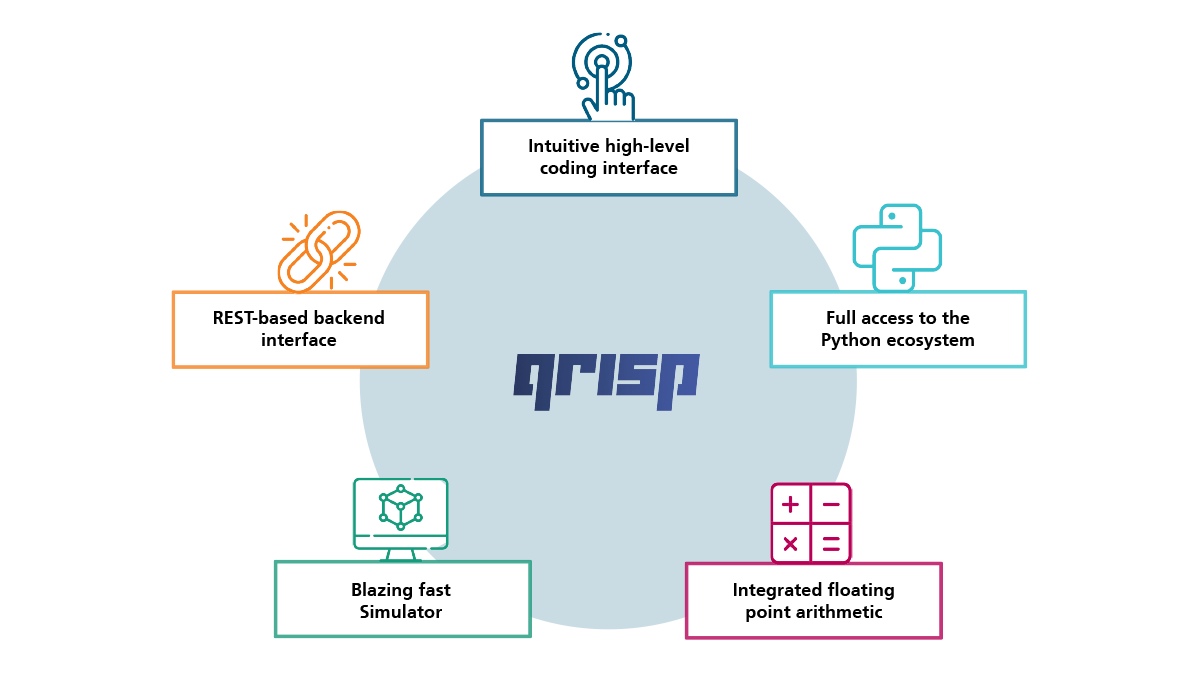
The Eclipse Qrisp developer community has integrated Eclipse Qrisp with the NVIDIA CUDA-Q platform for hybrid quantum-classical computing. Originally initiated by the Fraunhofer Institute for Open Communication Systems FOKUS and managed under the Eclipse Foundation, Eclipse Qrisp serves as an open-source, high-level Python framework designed to abstract away low-level gate-by-gate assembly and manual qubit management. The integration, developed by a research team including Dr. René Zander, Matic Petrič, Prof. Dr.-Ing. Nikolay Vassilev Tcholtchev, and Sebastian Bock, establishes a unified workflow where developers write code using high-level programming constructs and execute them directly via NVIDIA CUDA-Q’s GPU-accelerated simulation engines and hardware backends.
[ High-Level Python Code ] ──► [ QuantumVariables / Types ] ──► [ Automated Qubit Recycling ] ──► [ NVIDIA CUDA-Q Engine ]
Automated Resource Management and Functional Data Types
The structural foundation of Eclipse Qrisp centers on the QuantumVariable data type, which is systematically orchestrated by a QuantumSession tracking layer to handle backend interactions without developer intervention. The language introduces a specialized typing system that encapsulates functional abstractions, including QuantumFloat for arbitrary precision arithmetic, QuantumModulus for modular mathematics, alongside QuantumBool, QuantumChar, and QuantumString variants. These structured variables are aggregated into a QuantumArray class supporting standard indexing, slicing, and reshaping configurations.
By employing an automated uncomputation module, the platform automatically disentangles and recycles underlying hardware qubits once a variable’s execution lifecycle ends. This modularity allows separate domain routines to share identical physical quantum registers without intertwining the core codebase, minimizing the total physical footprint required for deep algorithmic procedures.
Hybrid Compilation Architectures and Structural Comparison
The integration combines Eclipse Qrisp’s expressive compilation layer with the low-latency execution pipelines of NVIDIA CUDA-Q. For complex applications—such as molecular chemical dynamics, portfolio optimization, or machine learning pipelines—the framework leverages native JAX integration alongside specialized Catalyst and Jaspa tools to provide real-time hybrid algorithm control. This connection routes the synthesized circuit blueprints straight into classical compiler infrastructures based on LLVM/MLIR architectures.
The software allows developers to compress long, explicit gate descriptions into concise mathematical logic. For example, executing a standard integer multiplication loop requires extensive physical register tracking when compiled via traditional gate-level software development kits like Qiskit Aer, whereas Eclipse Qrisp processes the calculation directly using native arithmetic overloading:
- Gate-Level Approach (Qiskit): Requires explicit allocation of dual
QuantumRegisterblocks, separate output registers, classical readout tracks, and manual invocation of anRGQFTMultipliercircuit before running a hardware transpilation pass. - High-Level Approach (Qrisp): Allocates a fixed-width
QuantumFloatpair, assigns numerical array bounds directly, and evaluates the system using a standard multiplication operator (res = a*b) while the compiler automatically infers optimal circuit configurations.
This architectural abstraction enables the implementation of deep routines, such as Shor’s algorithm via Montgomery reduction or complex Block Encodings for quantum linear algebra, while maintaining compatibility with major hardware backends including IQM, IBM Quantum, Quantinuum, and Rigetti.
The technical specifications, documentation, and operational tutorials can be reviewed on the Eclipse Qrisp Project Page here, with organizational integration updates hosted by Fraunhofer FOKUS in the official newsroom announcement here and detailed within their Quality Engineering Technology Portal here.
June 23, 2026

Leave A Comment