
Author: Doug Finke
-
-
Quantum Elements, USC Publish a New Quantum Monte Carlo (QMC) Method for Noisy Circuit Simulation
Quantum Elements and USC have published a new Quantum Monte Carlo (QMC) method in Physical Review Letters (PRL) that significantly reduces the computational power needed to simulate noisy quantum circuits. This algorithm, detailed in their paper “Real-Time Sign-Problem-Suppressed Quantum Monte Carlo Algorithm for Noisy Quantum Circuit Simulations,” efficiently models noisy quantum-circuit behavior by suppressing the quantum “sign problem.” The method’s practicality was confirmed through a collaboration with Harvard and AWS, where a QMC-accelerated digital twin simulated a complex quantum circuit, completing a task in about an hour that would otherwise require tracking an exponentially larger number of density-matrix entries.
-
DOE Launches “Quantum Genesis” Initiative
The U.S. Department of Energy (DOE) launched “Quantum Genesis,” an initiative to deploy a fault-tolerant quantum computer by 2028, integrating it with national supercomputing ecosystems. This program follows executive orders for American leadership in quantum information science and aims for systems with 150-250 logical qubits and ultra-low error rates, with a press release available on the DOE website.
-
-
-
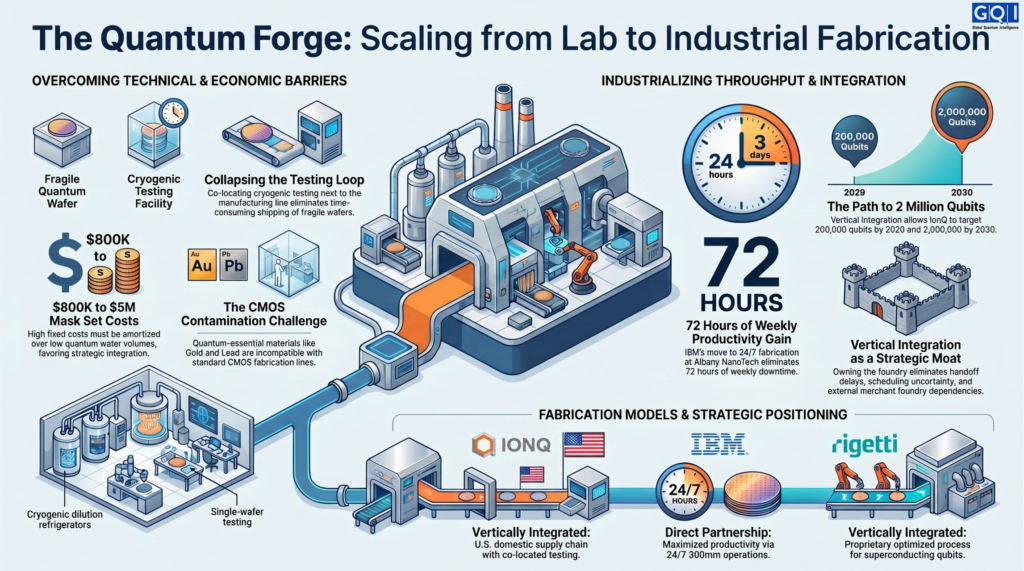
Manufacturing Throughput, Iteration Speed, and the Economics of Fabrication
Moving to standard CMOS wafer manufacturing is very helpful for certain modalities but not all. The real competitive advantages come from fabrication throughput—measured in wafers per hour (WPH)—and cycle time (i.e.
-
-
-
President Trump Signs Two Executive Orders on Quantum Technology
President Trump signed two Executive Orders to solidify American leadership in quantum technology. The first, “Securing the Nation Against Advanced Cryptographic Attacks,” mandates federal agencies’ transition to Post-Quantum Cryptography to defend against advanced cyber threats. The second, “Ushering in the Next Frontier of Quantum Innovation,” focuses on fostering commercialization, domestic manufacturing, and scientific discovery through initiatives like QC-ADDS, quantum sensor development, supply chain security, and workforce development, while also expanding counterintelligence efforts to protect quantum research.
-
Podcast
Podcast with Helmut Katzgraber, General partner at 55North
Yuval Boger interviews Helmut Katzgraber, general partner at 55North and former quantum leader at AWS.
-
-
-
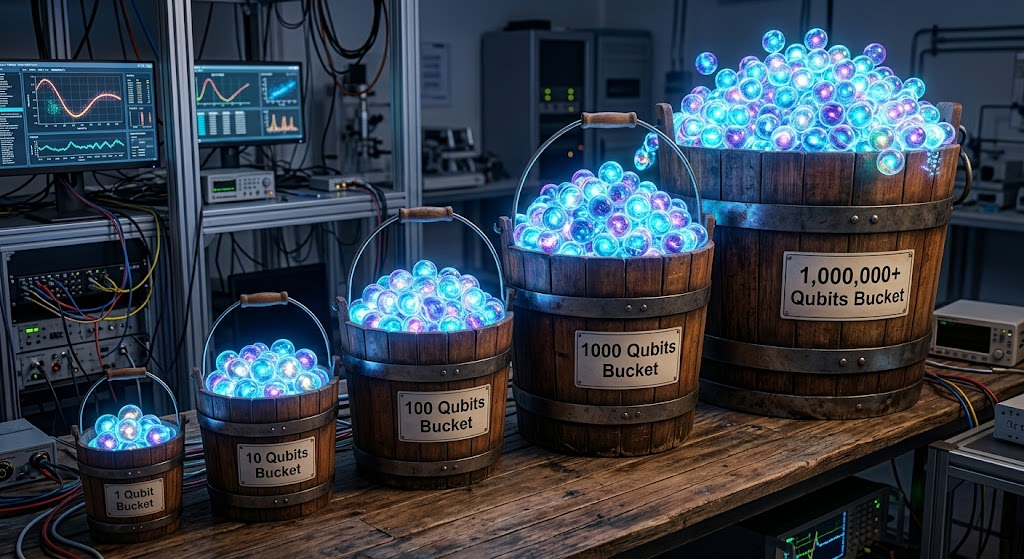
How Many Qubits Does a Quantum Computer Need?
Guest post by Zeynep Koruturk, Dr.
-
-
-
Oxford Quantum Circuits Expands to Barcelona with €92 Million ($98M USD) Global Manufacturing and R&D Hub
Oxford Quantum Circuits (OQC) is investing €92 million ($98M USD) to establish its first EU facility in Barcelona, creating 210 jobs and serving as its primary global hub for superconducting quantum hardware. This expansion follows a £260 million Series C funding round and aims to scale OQC’s Quantum Computing as a Service (QCaaS) offerings, solidifying Barcelona’s position in the deep-tech and quantum ecosystem.
-
-
-
Diraq Expands U.S. Infrastructure Operations with Palo Alto, California Headquarters
Diraq, an Australian quantum hardware company, has opened a U.S. office in Palo Alto, California, with plans for further expansion in the U.S. The company utilizes silicon spin qubits fabricated with standard CMOS processes, allowing for high-density integration and operation at a higher temperature than superconducting qubits, thus reducing cooling complexity. Diraq aims to deliver a quantum computer by 2029 and achieve utility-scale performance by 2033, supported by a $38 million funding investment under the Chips and Science Act.
-
Boeing Advances Its Space-Based Quantum Networking Project with Successful Q4S Lab Tests
Boeing has successfully completed ground testing for its space-qualified Q4S payload, a significant step in developing a space-based quantum network. The payload, designed to enable entanglement swapping, demonstrated leading performance in lab tests while adhering to strict size, weight, and power constraints for spacecraft. This achievement moves Boeing closer to a 2027 launch for the Q4S mission, which aims to test quantum networking hardware in space and establish a global quantum internet.
-
-
-
IQM Deploys Its First U.S. Quantum Computer at Oak Ridge National Laboratory
IQM Quantum Computers has deployed Pathfinder, a 20-qubit system, at Oak Ridge National Laboratory (ORNL), marking its first U.S. installation and ORNL’s first commercially procured quantum computer. This on-premises deployment allows ORNL to integrate the quantum machine directly with its Frontier supercomputer, fostering hybrid quantum-classical research in materials, chemistry, and AI. This expands IQM’s North American presence and its global lead in on-premises quantum computer sales, ahead of its $1.8 billion Nasdaq listing.
-