Author: Mohamed Abdel-Kareem
-
-
A*STAR and NUS Researchers Achieve Qubit Compression for Bio-Molecular Docking on IBM Hardware
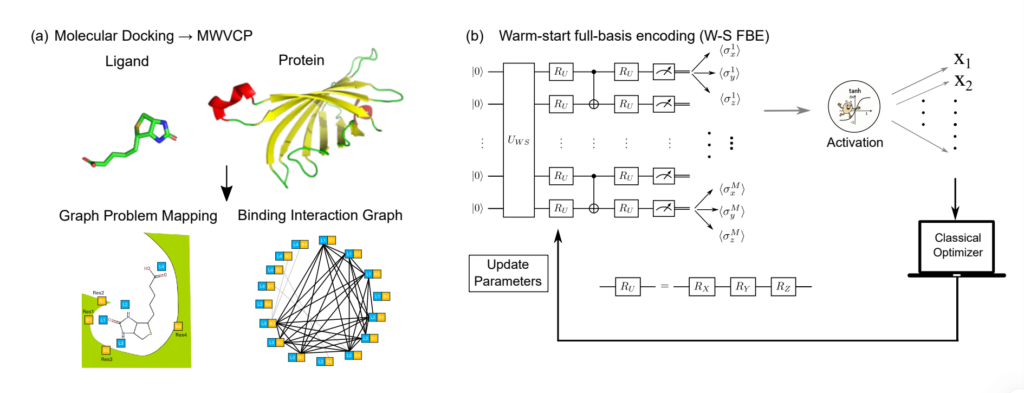
Researchers from Singapore’s A*STAR and NUS have developed a hybrid quantum-classical framework that significantly reduces the number of qubits needed for structure-based drug discovery. Their “Full-Basis Encoding” (FBE) method, published on arXiv, allows up to three decision variables per qubit, demonstrating efficient bio-molecular docking on IBM’s 156-qubit Heron r2 processor. This framework successfully recovered ground-truth clique assignments for protein-ligand complexes, outperforming traditional encoding methods.
-
NASA Awards Infleqtion $20M Follow-On Contract for Quantum Gravity Gradiometer Pathfinder Mission
Infleqtion has secured a $20 million follow-on contract from NASA, increasing their total funding to $40 million for the Quantum Gravity Gradiometer Pathfinder (QGGPf) mission. This contract advances the mission to its next stage of hardware integration, sub-system fabrication, and microgravity ground testing, aiming for a 2030 launch of a low-Earth orbit flight demonstration. The mission focuses on developing space-based quantum gravity sensors for high-resolution Earth observation.
-
Q-CTRL Demonstrates First GPS-Free Quantum Gravimetric Maritime Navigation in Coral Sea Field Trial
Q-CTRL successfully demonstrated the first GPS-free quantum-gravimetric maritime navigation system, Ironstone Opal, in the Coral Sea. This system achieved bounded 1-nautical-mile positioning accuracy without satellite signals, outperforming standard inertial backups significantly. Its “GravNav” technology, using atom-referenced drift correction and passive gravity map matching, offers a robust and unjammable alternative to traditional navigation systems, even in challenging marine environments.
-
-
-
EuroHPC Joint Undertaking Selects 13 European QPU Startups for Quantum Grand Challenge
The EuroHPC Joint Undertaking has selected 13 European quantum computing startups for its Quantum Grand Challenge, providing Phase 1 funding and a pathway to €30 million in EIB venture debt financing for each. This initiative aims to integrate various quantum hardware modalities into EuroHPC supercomputing centers, strengthening the EU’s technological sovereignty in high-performance computing.
-
Italian Council of State Rejects Region Appeal, Resetting €61.2M Campania Quantum Tender
The Italian Council of State has nullified a €61.2 million quantum computer tender for the University of Salerno, annulling IBM Italia’s contract. This decision, stemming from an unlawful bidding deadline extension, reinstates Tea Tek as the sole valid bidder. The Campania Region now has the discretion to either accept Tea Tek’s proposal or cancel the tender entirely.
-
University of Padova and ThinkQuantum Demonstrate 18-km Intermodal Free-Space QKD with Room-Temperature Detectors
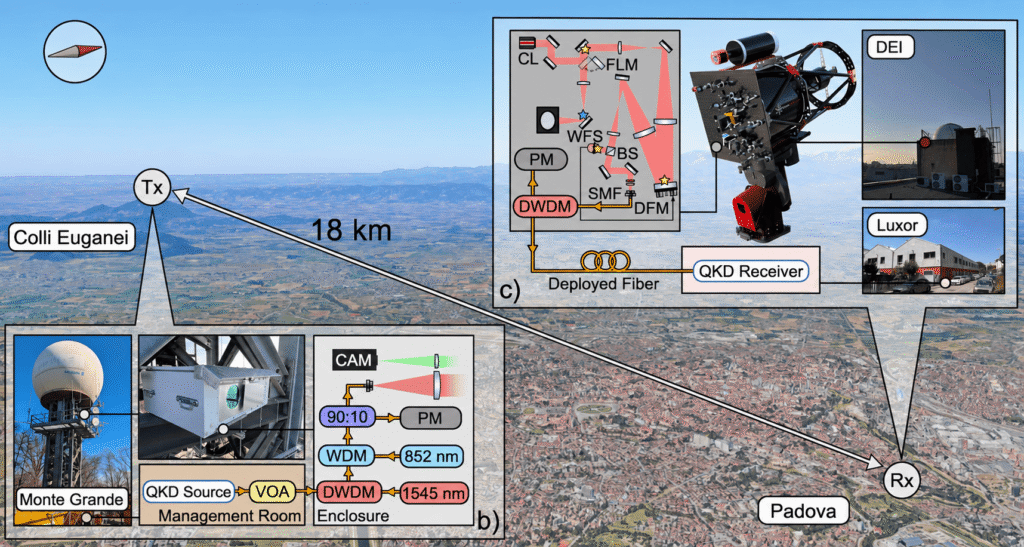
Researchers from the University of Padova, ThinkQuantum, and CNR-IFN successfully demonstrated an 18-km intermodal free-space quantum key distribution (QKD) system. The experiment, detailed in npj Quantum Information, utilized adaptive optics to overcome atmospheric turbulence and achieved secure key rates of ~200 bit/s with room-temperature detectors, aligning with future quantum communication infrastructure development.
-
SEALSQ Subsidiary IC’Alps Advances QASIC Roadmap for Custom Quantum-Resistant ASICs
SEALSQ Corp’s subsidiary, IC’Alps, is advancing its QASIC (Quantum-Resistant Application-Specific Integrated Circuit) platform, aiming to deliver a functional prototype by 2026. This initiative integrates hardware-accelerated Post-Quantum Cryptography (PQC) into custom silicon architectures for cybersecurity, medical, and automotive sectors. QASIC is part of SEALSQ’s broader post-quantum hardware strategy, leveraging IC’Alps’ expertise and a global foundry network.
-
CypherGenics Launches FASTKAT Platform for Post-Quantum Identity and Encryption
CypherGenics has launched FASTKAT, a post-quantum cybersecurity platform offering quantum-ready identity, authentication, and encryption. It utilizes a fully symmetric methodology to achieve 100x faster speeds than traditional PKI, making it suitable for low-power IoT/OT hardware and autonomous AI systems. The platform is backed by U.S. Patent No. 12,587,513 and led by Kent Kresa and William Arbaugh.
-
Quantum X Labs Launches “Qatacomb” Quantum-Native Security Research Initiative
Quantum X Labs has launched Qatacomb, a research initiative focused on developing quantum-native security architectures that integrate quantum mechanics directly into data protection, moving beyond classical algorithmic adaptations. This program will explore physics-rooted data protection, dynamic security adaptation, and hardware validation, complementing the company’s existing work in quantum computing, error correction, and sensing. Qatacomb aims to tap into the rapidly expanding quantum security market, projected to reach $9.8 billion by 2030.
-
Quantum eMotion Submits Quantum Entropy Source for NIST SP 800-90B Validation
Quantum eMotion has submitted its eCore-Q PCIe Quantum Entropy Module for NIST SP 800-90B validation, a crucial step for its use in high-security cryptographic infrastructure. This validation, assessed by Lightship Security Inc., is a prerequisite for FIPS 140-3 certification, opening doors for the module’s integration into regulated hardware for various sectors. This move enhances Quantum eMotion’s security portfolio and market access in North American defense, cloud IT, and critical infrastructure.
-