
Mohamed Abdel-Kareem

About Mohamed Abdel-Kareem

Mohamed Abdel-Kareem is a Quantum Intelligence & Data Expert at Global Quantum Intelligence (GQI), where he serves as a central architect of the firm’s "data factory." In this pivotal role, Mohamed spearheads the synthesis of global quantum developments, transforming raw industry data into the structured, high-fidelity intelligence that defines GQI’s market-leading research. He specializes in bridging the gap between technical quantum physics and data engineering, notably overseeing the integration of proprietary datasets that power the GQI LLM Analyst—a cutting-edge Retrieval-Augmented Generation (RAG) system. Mohamed’s expertise lies in the meticulous monitoring of investment trends, the extraction of nuanced insights from complex scientific announcements, and the management of strategic intelligence trackers. By maintaining a rigorous focus on technical accuracy and vendor neutrality, he ensures that high-level investors and global stakeholders receive the "ground truth" of the quantum ecosystem. His contributions are instrumental in empowering decision-makers to navigate market complexities with unbiased, actionable, and data-driven clarity, cementing GQI’s position at the forefront of quantum market research.

Qubic Closes Oversubscribed $2.5 Million Seed Round to Scale Low-Noise Cryogenic Amplifiers

2026-06-23T11:09:15-07:00

Canadian quantum hardware company Qubic has closed an oversubscribed seed financing round totaling $2.5 million USD ($3.5 million CAD). The investment was led by deep-tech venture firm Two Small Fish Ventures, with participation from UC Investments, Quantacet, and UCeed. A spin-off of both the Institut Quantique and the Institute for Quantum Computing, the company will deploy the capital to accelerate the development of its microwave component portfolio, expand manufacturing throughput, and bring a specialized radio-frequency (RF) quantum sensing platform to market. Qubic’s core technology addresses a primary hardware bottleneck preventing superconducting quantum computers from scaling up: the thermal and power restrictions [...]

Qubic Closes Oversubscribed $2.5 Million Seed Round to Scale Low-Noise Cryogenic Amplifiers2026-06-23T11:09:15-07:00

Qilimanjaro Releases QiliSDK 0.2.0 and Integrates NVIDIA CUDA-Q for Unified Hybrid Hardware Emulation

2026-06-23T08:56:14-07:00

Barcelona-based quantum developer Qilimanjaro Quantum Tech has released QiliSDK 0.2.0, an open-source Python framework designed to bridge the structural divide between digital gate-based programming and analog Hamiltonian time evolution. Most quantum software development kits restrict developers to a single physical computing paradigm—either compiling standard quantum circuit logic or managing continuous analogue energy schedules. QiliSDK 0.2.0 establishes a single unified, backend-agnostic API. This abstraction tier enables researchers to write a single high-level codebase and toggle execution between local CPUs, accelerated GPUs, or real digital and analog Quantum Processing Units (QPUs) by modifying a single line of configuration code. Three-Tier Architecture and Native [...]

Qilimanjaro Releases QiliSDK 0.2.0 and Integrates NVIDIA CUDA-Q for Unified Hybrid Hardware Emulation2026-06-23T08:56:14-07:00

Zapata Quantum and NVIDIA Integrate Agentic AI to Automate Quantum Resource Estimation

2026-06-23T08:39:38-07:00

Zapata Quantum and NVIDIA have partnered to integrate agentic AI into quantum algorithm development by automating quantum resource estimation workflows. The collaboration focuses on streamlining a process used to determine the exact hardware specifications, error-correction budgets, and physical execution times required to run quantum applications. Initial engineering efforts are directed at complex quantum chemistry challenges, including pharmaceutical drug discovery, energy grid optimization, and advanced materials development, where benchmarking quantum algorithms has historically stood as a significant developer bottleneck. Conventional algorithm benchmarking and resource estimation typically require extensive multi-year efforts from domain experts spanning molecular modeling, software compilation, and hardware architecture evaluation. [...]

Zapata Quantum and NVIDIA Integrate Agentic AI to Automate Quantum Resource Estimation2026-06-23T08:39:38-07:00

IQM Quantum Computers Minimizes Qubit Footprint via Planar Directional Tile Codes

2026-06-23T08:33:35-07:00

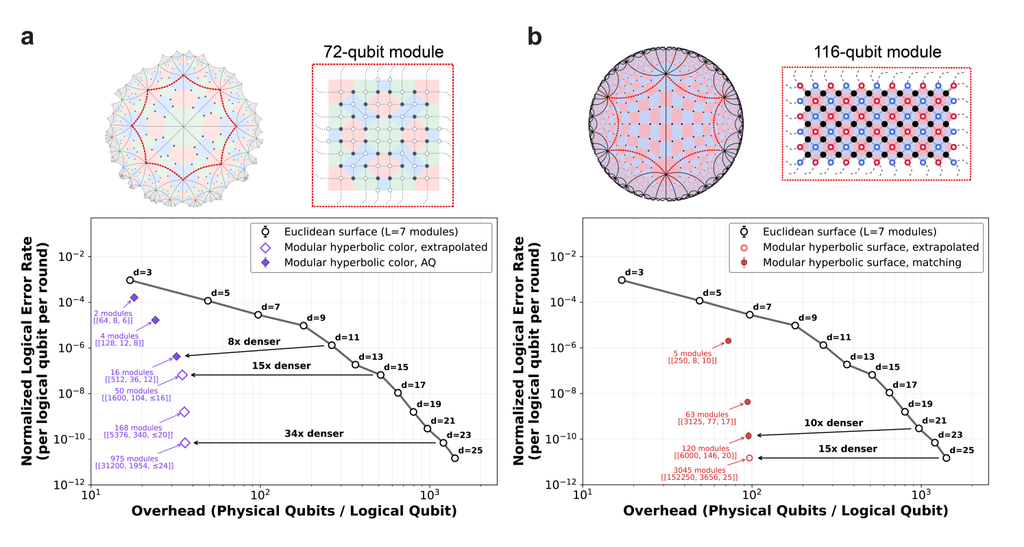
Superconducting hardware developer IQM Quantum Computers has introduced a quantum error correction (QEC) architecture termed directional tile codes. Co-authored with academic teams at Freie Universität Berlin, the University of Edinburgh, and Johannes Gutenberg-Universität Mainz, the research outlines a framework to implement high-rate Quantum Low-Density Parity-Check (qLDPC) codes on standard, two-dimensional planar processor layouts. By validating these error-correcting codes on a strictly planar grid, the approach reduces the physical physical-to-logical qubit overhead up to 1,000 times compared to traditional surface codes, bypassing the need for long-range couplers, three-dimensional vertical routing lines, or complex physical mechanical qubit shuttling mechanisms. Spacetime Routing Arrays and [...]

IQM Quantum Computers Minimizes Qubit Footprint via Planar Directional Tile Codes2026-06-23T08:33:35-07:00

Infleqtion Launches America’s Quantum Space Initiative to Develop Orbital Technology Infrastructure

2026-06-22T10:34:07-07:00

Neutral-atom developer Infleqtion (NYSE: INFQ) has launched America’s Quantum Space Initiative to accelerate the deployment of quantum technologies within the aerospace sector. The public-private coalition brings together a group of founding innovators, including Voyager Technologies, Monarch Quantum, Armada, and the University of Colorado Boulder. Operating through a collaborative network called the Quantum Space Hub, the consortium is designed to foster research and development partnerships across commercial industry, academia, and government agencies to translate early laboratory breakthroughs into ruggedized, mission-ready space assets. The initiative addresses an operational shift as space systems grow more dependent on precision timing, absolute navigation, secure communications, and [...]

Infleqtion Launches America’s Quantum Space Initiative to Develop Orbital Technology Infrastructure2026-06-22T10:34:07-07:00

Fraunhofer IPMS Unveils Q-Dice Quantum Random Number Generator for Enterprise Security

2026-06-22T07:30:51-07:00

© Fraunhofer IPMS QRNG competencies. The Fraunhofer Institute for Photonic Microsystems IPMS has announced the development of Q-Dice, a high-performance Quantum Random Number Generator (QRNG) engineered to deliver true random numbers at data rates exceeding 4.1 Gbit/s. Moving beyond traditional, deterministic software algorithms that can introduce structural predictability vulnerabilities, the system isolates true mathematical entropy by executing precise physical measurements of quantum vacuum fluctuations—the spontaneous, unpredictable variations in electromagnetic energy that occur in empty space. The architecture provides an unbiased cryptographic foundation designed to future-proof communication networks against both classical and quantum computing threats. In-House Competencies and Technical Architecture To ensure [...]

Fraunhofer IPMS Unveils Q-Dice Quantum Random Number Generator for Enterprise Security2026-06-22T07:30:51-07:00

IBM Nighthawk Processor Validated in Quantum Chromodynamics and Cybersecurity Benchmarks

2026-06-19T20:46:37-07:00

Independent researchers from the IBM Quantum Network have published two separate technical studies validating real-world applications on the IBM Nighthawk quantum processor framework. Orchestrated through the RPI-IBM Future of Computing Research Collaboration, the peer-reviewed papers demonstrate scalable, hardware-native executions across particle physics simulations and graph-based cybersecurity optimization workloads. Both milestones were achieved through decentralized academic collaboration across the network, establishing reproducible software pipelines on utility-scale superconducting quantum hardware without direct operational intervention from IBM engineering. The first study, a collaboration spanning Rensselaer Polytechnic Institute, Stony Brook University, the University of Washington, and Brookhaven National Laboratory, executed a quantum simulation tracking nucleon–antinucleon [...]

IBM Nighthawk Processor Validated in Quantum Chromodynamics and Cybersecurity Benchmarks2026-06-19T20:46:37-07:00

Duke University and IonQ Demonstrate Tripartite Entanglement of Remote Atomic Qubits

2026-06-19T20:35:00-07:00

Researchers from the Duke Quantum Center and IonQ have demonstrated the distributed generation of a Greenberger–Horne–Zeilinger (GHZ) state across a three-node quantum network using individual trapped atomic ions. The experimental configuration consisted of three spatially separated hardware modules positioned approximately 2 meters apart, linked by 3-meter single-mode optical fibers to a centralized, free-space GHZ-state generator. The networking setup achieved remote tripartite entanglement without requiring local two-qubit gates or post-selection protocols, establishing a bounded atomic state fidelity between 0.841(17) and 0.881(17) at an entanglement generation rate of 0.095(5) s−1. Ion-Photon Entanglement Mechanics and Centralized Interference Each hardware node isolates a single 138Ba+ (barium) [...]

Duke University and IonQ Demonstrate Tripartite Entanglement of Remote Atomic Qubits2026-06-19T20:35:00-07:00

Fixstars Amplify Integrates IonQ Backend to Support Trapped-Ion Algorithm Prototyping

2026-06-19T20:12:36-07:00

Cloud-based optimization developer Fixstars Amplify Corporation has added IonQ’s trapped-ion quantum computing environment as a standard execution backend within its optimization platform. The integration enables enterprise users in the United States and Japan to develop, test, and execute combinatorial optimization workloads across hardware-agnostic pipelines. Under the initial deployment framework, access to IonQ’s cloud-based quantum simulator is available to existing platform account holders at no additional charge, while access to actual trapped-ion hardware processing units is scheduled to roll out progressively through tiered, paid subscription plans. Unified SDK Architecture and Hybrid Optimization Loops The backend integration is orchestrated by combining the Fixstars [...]

Fixstars Amplify Integrates IonQ Backend to Support Trapped-Ion Algorithm Prototyping2026-06-19T20:12:36-07:00

INNOSPACE and Norma Partner to Develop Space-Based Quantum Computing Infrastructure

2026-06-19T20:06:03-07:00

South Korean launch services company INNOSPACE has signed a memorandum of understanding (MOU) with quantum software developer Norma to co-engineer space-based quantum computing technologies. The strategic agreement sets up a collaborative framework across three operational areas: the execution of in-orbit technical demonstrations, joint participation in state-funded aerospace R&D programs, and the conceptual planning of a dedicated Space Quantum Computing Center. The project addresses the growing data bottlenecks in orbital networks, where the increasing complexity of satellite mega-constellations demands decentralized, high-performance computing to handle localized telemetry and payload data processing. The initial technical milestone of the partnership centers on integrating a compact [...]

INNOSPACE and Norma Partner to Develop Space-Based Quantum Computing Infrastructure2026-06-19T20:06:03-07:00
Go to Top