
Author: Mohamed Abdel-Kareem
-
-
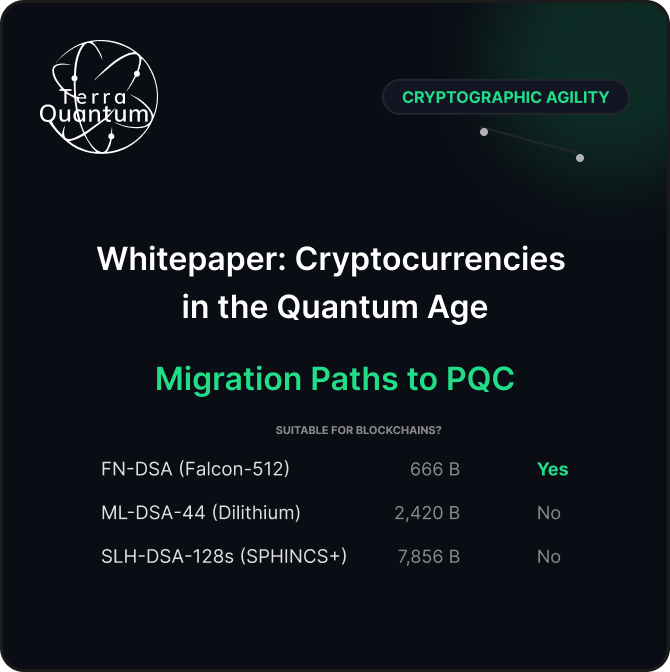
Terra Quantum Publishes White Paper Detailing Post-Quantum Cryptography Migration Paths for Blockchain Ecosystems
A white paper by Terra Quantum AG analyzes the vulnerability of major blockchain platforms like Bitcoin, Ethereum, and Solana to post-quantum cryptography (PQC) threats, highlighting the risks posed by Shor's algorithm to digital signature algorithms. The study evaluates PQC migration strategies, emphasizing signature payload size as a critical factor for high-throughput ledgers, and suggests FN-DSA (Falcon-512) as a viable solution due to its compact signature footprint. The paper also reviews mitigation frameworks, including Solana's WOTS vaults, Algorand's Falcon account roadmaps, and Ethereum's EIP-8052 proposal.
-
Terra Quantum and Schaeffler Publish Peer-Reviewed Study on Hybrid Quantum Machine Learning for Materials Modeling
Terra Quantum and Schaeffler have published a peer-reviewed study in Computational Materials Science on hybrid quantum machine learning for materials modeling. Their research demonstrates that a hybrid quantum-classical Allegro model, incorporating Quantum Depth-Infused (QDI) variational quantum circuit layers, significantly improves the accuracy of atomic energy and force predictions, particularly for copper-lithium structures relevant to battery anode research. This hybrid approach offers a substantial reduction in computational overhead while maintaining high accuracy, even when transferring hyperparameters to new datasets.
-
Terra Quantum Joins QuEra Quantum Alliance to Expand Neutral-Atom Software Layer
Terra Quantum has joined the QuEra Quantum Alliance to advance neutral-atom quantum computing. Terra Quantum, a quantum software and algorithm developer, will contribute its TQ42 platform to the alliance, offering a Python SDK, APIs, and command-line interfaces for various industry applications. This collaboration aims to strengthen the software and applications tier of the alliance and prepare enterprises for QuEra's fault-tolerant hardware roadmap, including the 256-logical-qubit "Libra" system.
-
Argonne and UIUC Demonstrate First On-Chip Coupling of Propagating Spin Waves to Superconducting Circuits
Scientists from Argonne National Laboratory and UIUC have developed the first-of-its-kind hybrid circuit, integrating propagating spin waves with a superconducting resonator on a single chip. This innovation allows for strong coupling between microwave photons and spin waves, addressing issues of signal noise in quantum devices. By using a rare-earth-free YSGG substrate, the team achieved significant power isolation, paving the way for compact, on-chip microwave isolators for quantum circuits.
-
IonQ and the University of Cambridge Open Quantum Innovation Centre at Cavendish Laboratory
IonQ and the University of Cambridge have opened the IonQ Quantum Innovation Centre at the Cavendish Laboratory, deploying a 256-qubit Superion quantum computer and a quantum network. This initiative, supported by Innovate UK and aligning with the UK National Quantum Strategy, will host nine inaugural research projects and aims to expand the regional quantum workforce.
-
D-Wave Delivers Italy’s First Annealing Quantum Computer to Lombardy Infrastructure Hub
D-Wave has installed Italy's first on-premises Advantage2 annealing quantum computer at Villa Saporiti in Como. Funded by Swiss Quantum Technology SA (SQT) with a €10 million agreement, this 4,400+ qubit system will be accessible to European researchers and businesses both on-site and remotely via D-Wave's Leap cloud service. This initiative supports the Volta Declaration's goals for quantum computing and AI development in Europe, coinciding with the bicentennial of Alessandro Volta's death.
-
Dirac Labs Joins Wisconsin Security Research Consortium to Advance Quantum PNT for Autonomous Defense Platforms
Dirac Labs has joined the Wisconsin Security Research Consortium (WSRC) to advance quantum-enabled Positioning, Navigation, and Timing (PNT) systems. They are developing a quantum universal positioning system using diamond-based quantum sensors and AI to provide GPS-independent navigation for autonomous defense platforms. This partnership aims to overcome cost and scaling barriers in quantum sensing through standard manufacturing processes and integration.
-
-
-
Riverlane and NVIDIA Demonstrate Accelerated QEC Decoder Calibration Using GPU Processing
Riverlane and NVIDIA have demonstrated significant acceleration in quantum error correction (QEC) decoder recalibration using NVIDIA's H100 GPU. By adapting Riverlane's Local Clustering Decoder for GPU processing, they achieved up to 71x raw throughput gain and reduced training epochs from minutes to seconds. This advancement allows for more frequent and efficient recalibration, improving the accuracy of QEC systems and highlighting the growing role of GPUs in quantum computing.
-
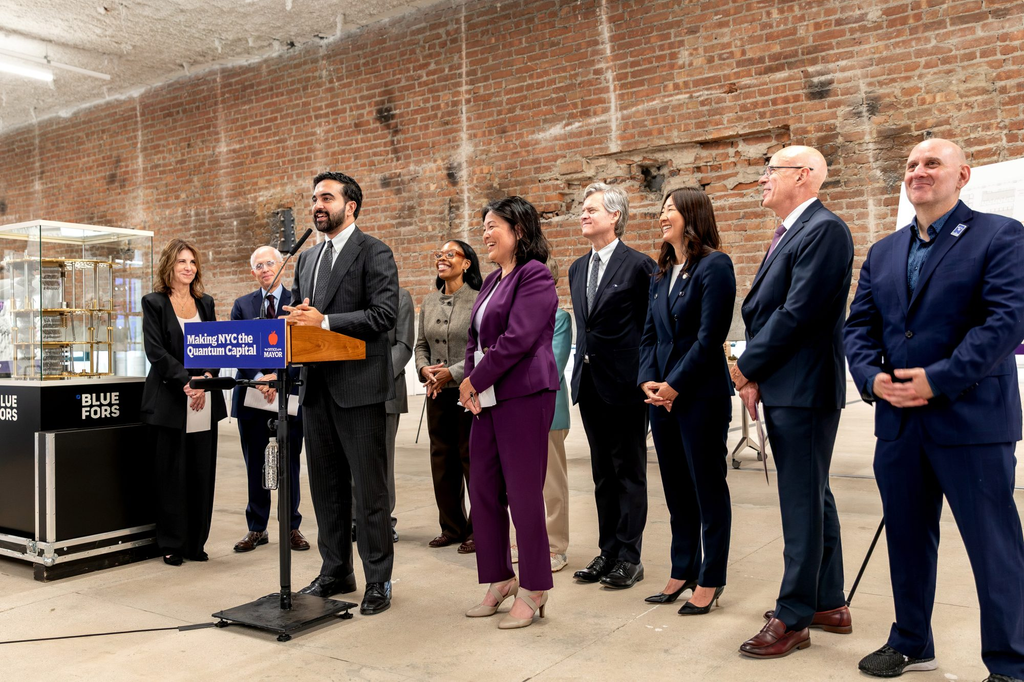
New York City and NYU Partner to Launch $284 Million Quantum Fabrication Facility
New York City and NYU are partnering to launch the $284 million Quantum Fabrication Facility (QFab) at 770 Broadway, set to open in 2030. The facility will focus on quantum chip development and aims to foster startups, provide fabrication services, and support workforce development through CUNY and NYC Public Schools. This initiative features a unique public-equity model, granting NYC a 15% share in IP generated with city-funded equipment and seats on the QFab Executive Advisory Board.
-
SAXON Q and Fraunhofer IWU Demonstrate Record 3-Qubit Grover Search on Commercial Room-Temperature Quantum Computer
SAXON Q and Fraunhofer IWU have achieved a record-breaking 3-qubit Grover search on a commercial room-temperature quantum computer, outperforming previous room-temperature quantum searches and nearing cryogenic superconducting processors' benchmarks. The experiment, detailed in a pre-print paper, utilized a nitrogen-vacancy center diamond quantum computer operating at ambient conditions, showcasing a significant advancement in quantum computing hardware.
-