Author: Mohamed Abdel-Kareem
-
-
Fujitsu Fabricates Diamond-Spin QPU Prototype Integrating Tin-Vacancy Centers and Photonic ICs
Fujitsu has fabricated a prototype diamond-spin quantum processing unit (QPU) integrating tin-vacancy (SnV) color centers into photonic integrated circuits (PICs), operating at a warmer cryogenic temperature of -271.6°C. This architecture addresses scaling challenges through heterogeneous material bonding and nanometer-scale diamond thinning, utilizing SnV centers for their reduced sensitivity to electric field noise and higher photon emission brightness compared to traditional nitrogen-vacancy centers. Fujitsu plans to develop a multi-module prototype by 2027, aiming for a 1,000 logical qubit system by FY2035, and is also working on linking this with their superconducting hardware for a heterogeneous quantum computing architecture.
-
-
-
NEC Discontinues Superconducting Quantum Computer Development to Focus on Annealing and Classical Emulation
NEC Corporation has ceased its research and development into superconducting quantum computers, shifting focus to quantum-inspired annealing and classical emulation due to long commercialization timelines and high capital investment. This move, reported by Nikkei Asia, means NEC will now concentrate on software and optimization services, leaving Fujitsu as the main domestic corporate developer of superconducting hardware in Japan.
-
-
-
Who’s News: Strategic Appointments at QuIC, Atom Computing, and Qilimanjaro Quantum Tech
Cécile Perrault is the new Executive Director of QuIC, Kevin Messerle is the new CFO of Atom Computing, and Albert Solana is the new Chief of Staff at Qilimanjaro Quantum Tech, all bringing their expertise to advance quantum technologies.
-
RIKEN Integrates QunaSys QURI SDK Enterprise into Japan’s JHPC-quantum Platform
RIKEN Center for Computational Science has adopted QunaSys QURI SDK Enterprise for Japan’s JHPC-quantum project, integrating supercomputer Fugaku and the ROQUO GPU cluster with quantum processing units. This platform, funded by NEDO, will facilitate hybrid algorithm execution across diverse hardware, offering solutions for materials science, quantum chemistry, and CAE, and is part of Japan’s Society 5.0 Roadmap.
-
Forschungszentrum Jülich Operates eleQtron’s JION Trapped-Ion QPU via JUNIQ Infrastructure
Forschungszentrum Jülich and eleQtron have launched the JION quantum computer, a trapped-ion QPU utilizing eleQtron’s MAGIC technology for microwave control and room-temperature operation. Integrated into JUNIQ, it connects directly to Jülich’s HPC supercomputing cluster for hybrid quantum-classical workloads, supported by significant funding from North Rhine-Westphalia and EU programs for quantum technology development and regional economic transformation.
-
Quantum Foundry Copenhagen and Novo Nordisk Foundation Announce 5,300 m² Fabrication Facility for Quantum Chips
Quantum Foundry Copenhagen and the Novo Nordisk Foundation are establishing a 5,300 m² quantum chip fabrication facility in Copenhagen, Denmark, to be operational by 2027. This initiative, backed by a €390 million investment from the Novo Nordisk Foundation, aims to bridge academic research with industrial manufacturing by offering commercial wafer fabrication, characterization, assembly, and packaging services for quantum technology vendors globally. It aligns with European strategies to bolster regional manufacturing capabilities for critical semiconductor and quantum components.
-
-
-
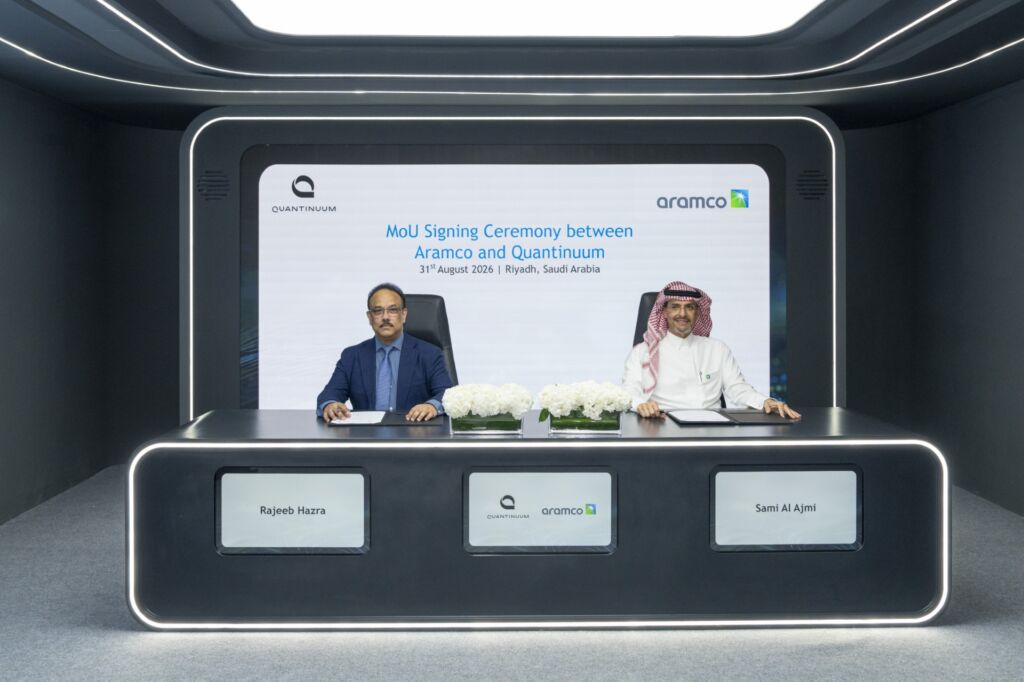
Quantinuum and Aramco Execute Non-Binding MoU for Energy Sector Quantum R&D
Quantinuum and Aramco have signed a non-binding MoU to explore quantum computing applications in the energy sector. This collaboration involves Aramco gaining access to Quantinuum’s trapped-ion hardware and software stack to research fault-tolerant quantum computing for complex simulations in energy production and to integrate quantum solutions into their digital transformation. This partnership also expands Quantinuum’s presence in the Middle East.
-
Giesecke+Devrient Joins European uPQComing Consortium to Develop Quantum-Safe eID Operating Systems
Giesecke+Devrient (G+D) has joined the European uPQComing consortium, co-funded by the EU’s Chips Joint Undertaking, to develop quantum-safe eID operating systems. The project focuses on migrating critical public digital infrastructure and resource-constrained embedded secure elements to Post-Quantum Cryptography (PQC). G+D’s role involves integrating PQC algorithms into Java Card chip operating systems, designing crypto-agile architectures, and implementing hybrid key exchange and authentication schemes, building upon their previous work with Germany’s Bundesdruckerei to establish quantum-resistant digital identity architectures across the EU.
-
SEEQC Signs MoU with Taiwan Quantum Industry Technology Promotion Office to Build Cryo-Chip Supply Chain
SEEQC has signed an MoU with Taiwan’s QITPO to create a cross-border quantum technology and supply-chain partnership. This agreement, signed at SEMICON Taiwan 2026, focuses on leveraging Taiwan’s semiconductor infrastructure for the development, testing, and commercialization of quantum computing components, including cryo-CMOS and SFQ manufacturing, and advanced packaging for superconducting QPUs. This collaboration aims to integrate SEEQC’s IP with Taiwan’s foundry capabilities to establish a robust supply chain for commercial multi-qubit systems.
-
Classiq Expands in Taiwan via Go-to-Market Partnerships with Scientek and Kensho
Classiq Technologies has expanded into Taiwan through partnerships with Scientek Corporation and Kensho, strategically timed with SEMICON Taiwan 2026. These collaborations aim to integrate Classiq’s quantum software engineering platform into Taiwan’s semiconductor manufacturing, defense, material science, and academic research sectors. The partnerships will facilitate local distribution, customer enablement, and joint R&D, bridging quantum hardware infrastructure with Classiq’s AI synthesis engine and Qmod programming language.
-