Category: Uncategorized
-
-
E.ON, Qoro Quantum, and NQCC Scale Constrained Optimization on IBM Heron QPUs via Distributed QAOA and Spatial Packing
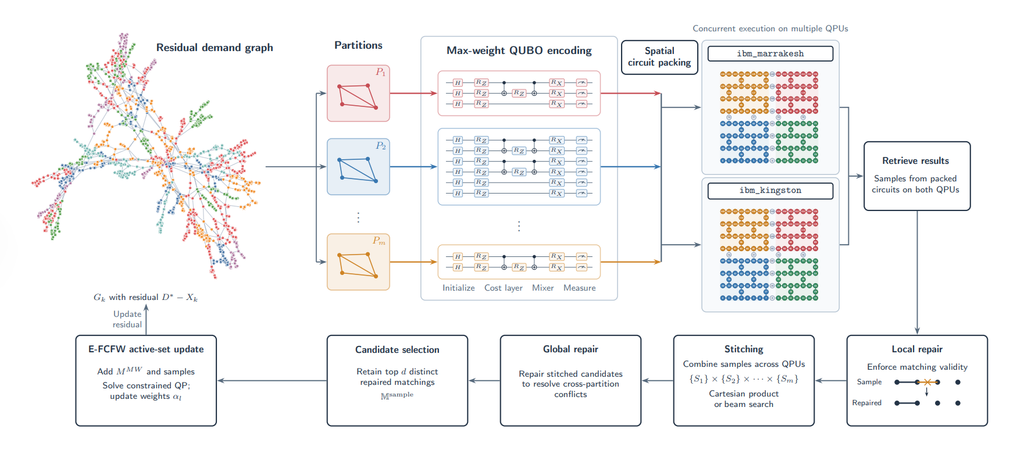
E.ON, Qoro Quantum, and NQCC have successfully demonstrated a distributed hybrid optimization pipeline that reduced quantum execution time by approximately three times on IBM Quantum hardware. They achieved this by decomposing a 1,710-variable problem into 41 subgraphs, each bounded to 50 qubits, to map the PEGASE-1354 European transmission grid benchmark onto 156-qubit IBM Heron processors. This method, detailed in a preprint on arXiv, leverages shallow QAOA sampling, spectral partitioning, and greedy feasibility repair to address the Minimum Birkhoff Decomposition problem.
-
-
-
UK Space Agency and DSIT Publish Quantum Technology Roadmap for Space Targeting 2035–2040 Sovereign Capabilities
The UK Space Agency and DSIT have published a Quantum Technology Roadmap for Space, outlining strategic priorities for 2035–2040. The roadmap identifies four investment themes: assured timing, resilient sensing, sovereign communications, and long-term computing, aiming to transition prototypes into flight-qualified space systems. It also emphasizes the need to address engineering bottlenecks and proposes immediate actions to strengthen the UK's sovereign industrial capabilities in quantum space technology.
-
Pasqal 256-Qubit Neutral-Atom Processor Observes Unpredicted Slowdown in 2D Quantum Magnet Dynamics
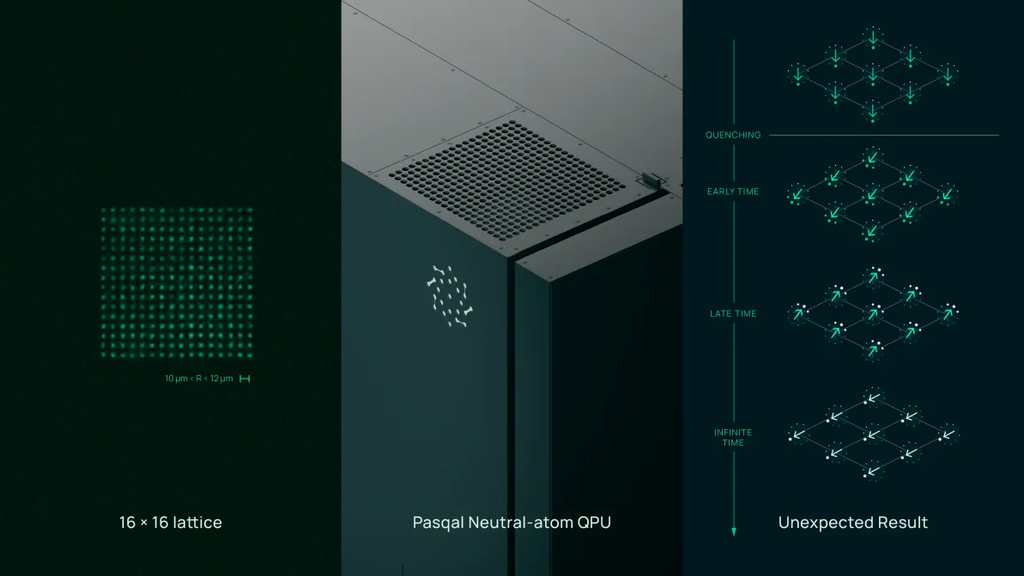
Pasqal's 256-qubit neutral-atom processor observed an unexpected slowdown in a 2D quantum magnet's dynamics, diverging from classical simulations. This research, detailed in a preprint, explores the relaxation landscape of a 2D transverse-field Ising model, uncovering three distinct physical behaviors including a previously unpredicted relaxation slowdown at intermediate field strengths. The study highlights the quantum processor's ability to explore non-equilibrium condensed-matter regimes beyond the limits of classical tensor-network simulations.
-
BlueQubit Benchmarks Quantum Computational Advantage in Random-Circuit Sampling on IBM Nighthawk r2 Hardware
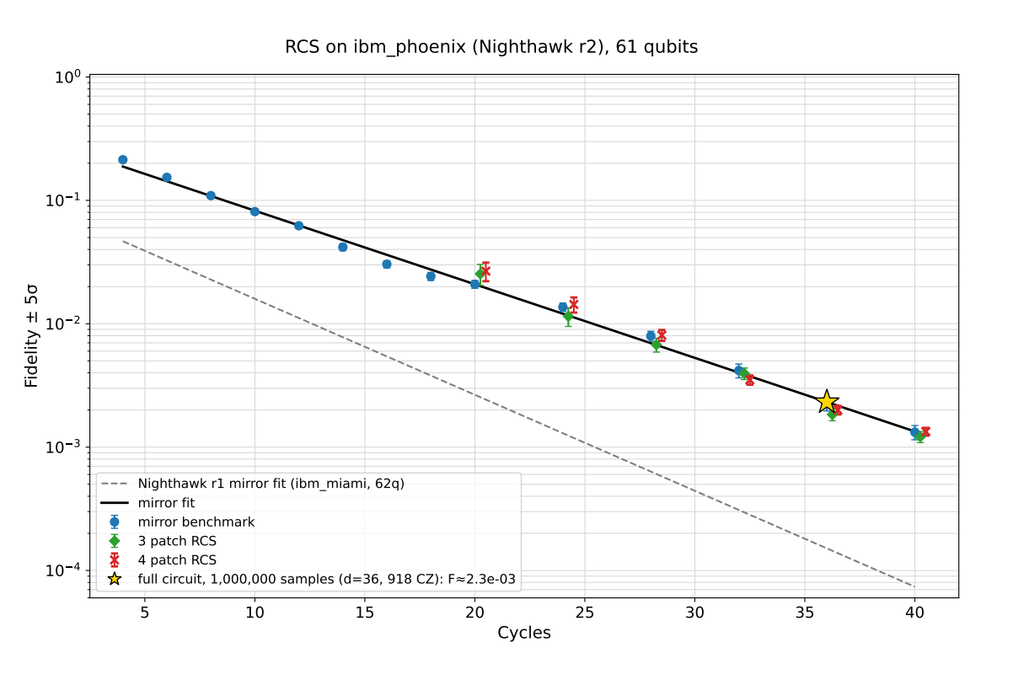
BlueQubit, in collaboration with EPFL and the XPRIZE Foundation, has demonstrated quantum computational advantage using IBM Quantum's 120-qubit ibm_phoenix processor. Their random-circuit sampling experiment, involving 61 active qubits, achieved a fidelity that would take over a century for classical supercomputers to replicate. This study highlights significant architectural improvements in IBM processors and validates the classical hardness of their quantum benchmarks.
-
Gothenburg and Chalmers Researchers Develop Modular Graph Neural Decoder for Surface Code Memory and Lattice Surgery
Researchers from the University of Gothenburg and Chalmers University of Technology have developed a modular neural decoder for surface code quantum error correction (QEC). This decoder demonstrates superior performance compared to traditional methods and is capable of adapting across different hardware architectures, noise profiles, and multi-patch logical operations. Its efficient design, inspired by the renormalization group, allows for training on a single commercial GPU and offers portability advantages for fault-tolerant computing.
-
Yonsei University Researchers Develop Mamba State-Space Neural Decoder to Enable Real-Time Quantum Error Correction
Researchers at Yonsei University have developed a Mamba-based neural decoder for quantum error correction, significantly reducing computational complexity from O(d4) to O(d2) compared to Transformer-based models. This new decoder matches the accuracy of Transformer models like AlphaQubit but eliminates the quadratic self-attention bottlenecks, making real-time feedback on quantum hardware possible. The Mamba decoder shows superior performance in real-time conditions and has implications for advancing fault-tolerant quantum computing, though practical implementation requires overcoming edge-compute limitations.
-
University of Sydney Demonstrates Multi-Qubit Logical Entanglement and 170-Round Stability on IBM Square-Lattice Nighthawk r2 Processor
University of Sydney researchers have demonstrated significant advancements in quantum error correction on IBM Quantum's ibm_phoenix processor. They achieved multi-qubit fault-tolerant logic and sustained error suppression for up to 170 rounds using a novel dynamic "walking" syndrome circuit. This breakthrough, utilizing the Nighthawk r2 architecture, includes successful logical Bell-state preparation and three-logical-qubit teleportation, marking a crucial step towards scalable fault-tolerant quantum computing.
-
Nord Quantique Secures $10 Million DARPA Quantum Benchmarking Initiative Stage B Agreement Extension
Nord Quantique secured a $10 million extension for Stage B of the DARPA Quantum Benchmarking Initiative (QBI) to advance its bosonic quantum error correction (QEC) architecture. This funding supports engineering milestones and prototyping to demonstrate the viability of their approach, which aims for a 1:1 physical-to-logical qubit footprint using superconducting bosonic codes. The company will focus on reducing error rates and developing hardware subsystems to meet DARPA's goal of achieving utility-scale quantum computing by 2033.
-
LANL and Cornell Researchers Demonstrate Extraction of Quantum Information Structures from Condensed-Matter Dynamical Simulations
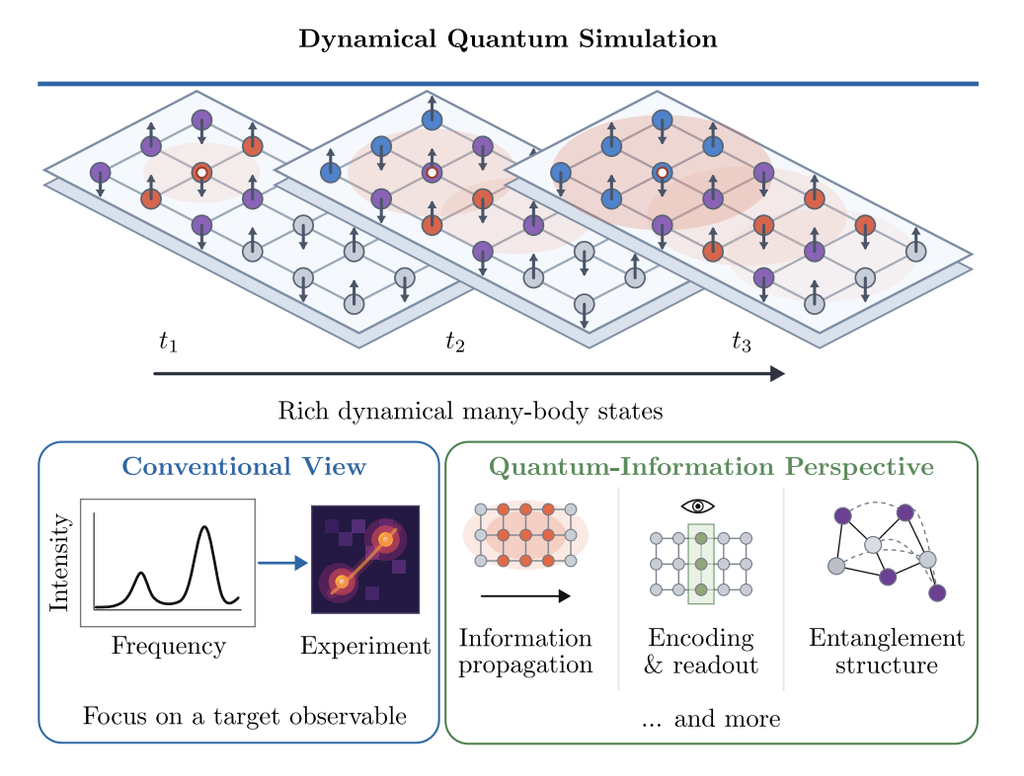
Researchers from LANL and Cornell have developed a framework to extract quantum information from dynamical quantum simulations, revealing how information propagates and reorganizes in many-body states. Their work demonstrates that traditional measurements capture only a limited view of quantum information, and that multipartite entanglement can be certified even as entanglement is redistributed. This framework can repurpose quantum simulators as multi-purpose quantum information laboratories, though full quantum information reconstruction on hardware faces significant scaling challenges.
-
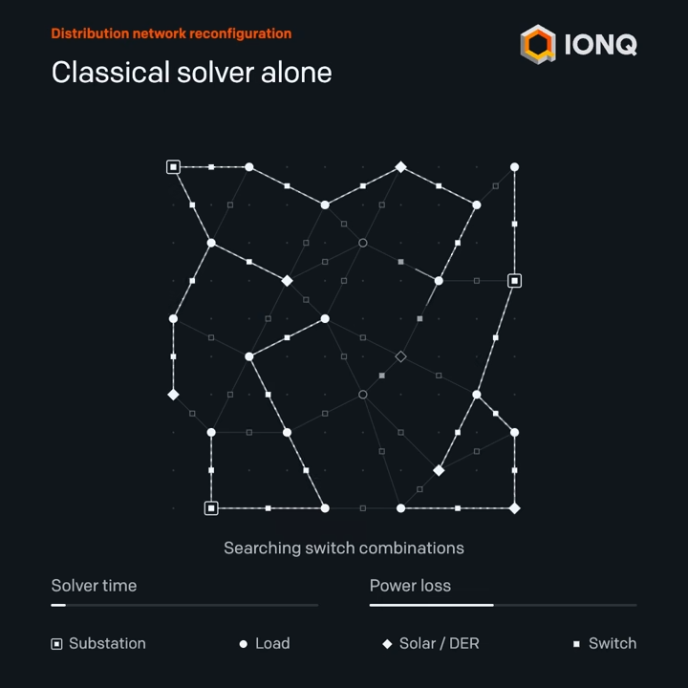
EPB and IonQ Deploy Hybrid Trapped-Ion Algorithms on Forte Enterprise to Optimize Power Grid Topology
EPB and IonQ have successfully deployed hybrid quantum-classical algorithms on IonQ Forte Enterprise to optimize power grid topology, significantly reducing power loss and improving efficiency. Their research, funded by a $4 million NIST grant, utilized trapped-ion systems to benchmark three distinct computational frameworks for distribution network reconfiguration. These methods demonstrated substantial parameter reduction, decreased classical solver runtime, and recovered global minimal-loss configurations across various bus systems, establishing a practical boundary where quantum-assisted pipelines become more efficient.
-