

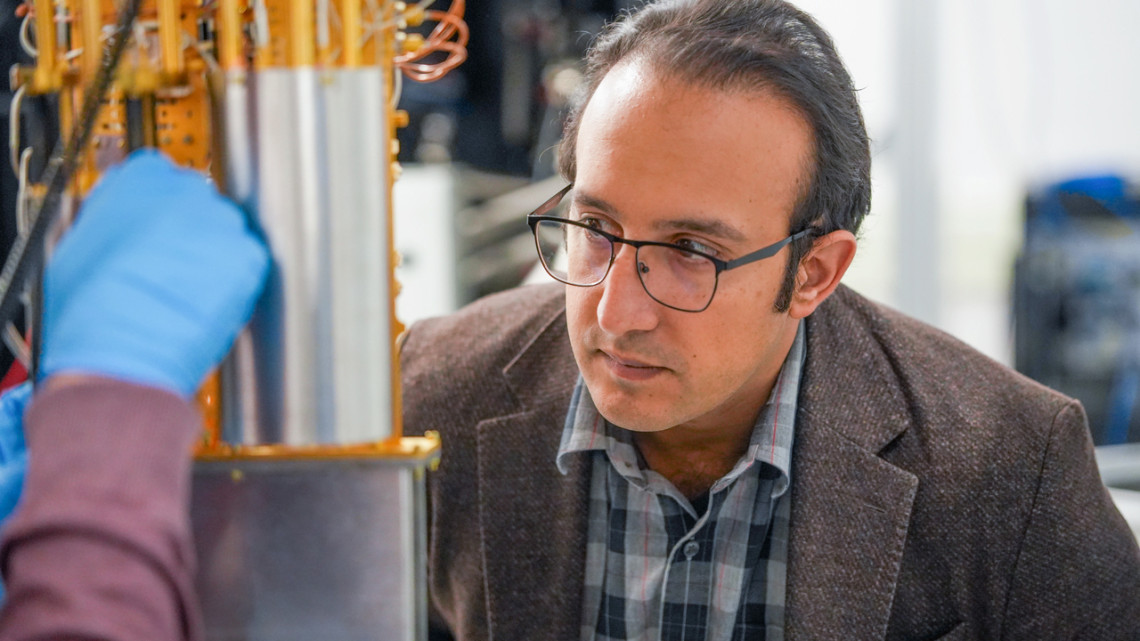
A research team led by Cornell University Assistant Professor Valla Fatemi has developed a low-temperature fabrication process for tantalum-based superconducting qubits, resolving a major manufacturing bottleneck for superconducting quantum processing units (QPUs). Detailed in Nature Materials (“Krypton-sputtered tantalum films for scalable high-performance quantum devices“), the team substituted standard argon gas with krypton gas during magnetron sputtering, lowering the required substrate deposition temperature for body-centered cubic (α-phase) tantalum on silicon from >400∘C to 200∘C.
                 [ Cornell Low-Temperature Tantalum Sputtering Architecture ]
                                              │
     ┌────────────────────────────────────────┼────────────────────────────────────────┐
     ▼                                        ▼                                        ▼
  Krypton Sputtering Physics             BEOL Semiconductor Compatibility        Transmon Performance Metrics
  • Heavy Kr Ion Momentum Transfer.       • Drops Deposition Temp to 200°C.        • Transmon Q Factors up to 16.9M.
  • Stabilizes α-Phase (bcc) Tantalum.    • Fits Commercial BEOL Thermal Limits.   • Compact 20 µm Capacitor Gaps.
  • Eliminates Ta-Si Intermixing Layer.   • Standard Silicon Substrate Integration.• Minimal Microwave Energy Loss.
Foundry Compatibility and Fabrication Breakthrough
Tantalum (α-Ta) has emerged as an attractive material for superconducting qubits due to its high conductivity and stable surface oxide, which reduces dielectric loss compared to traditional niobium films. However, conventional argon-sputtered deposition requires heating silicon substrates above 400∘C to form the desired α-phase crystal structure. This high thermal budget exceeds standard commercial semiconductor foundry Back-End-of-Line (BEOL) processing limits and causes harmful tantalum-silicon intermixing that degrades qubit coherence.
- Krypton Gas Kinetics: Ionized krypton gas transfers higher kinetic momentum to ejected tantalum atoms than lighter argon ions, stabilizing the high-conductivity α-phase crystal lattice on silicon at a significantly reduced thermal threshold (∘C).
- Quality Factor Metrics: Transmon qubits fabricated using krypton-sputtered films with compact 20 μm capacitor gaps achieved internal quality factors (Q) up to 16.9 million.
- Commercial BEOL Integration: By lowering processing temperatures to 200°C, the technique opens a wide fabrication window that allows commercial semiconductor foundries to integrate high-performance tantalum films into existing automated tool lines without damaging underlying CMOS control circuits or interconnect layers.
Supported by the U.S. Department of War’s Microelectronics Commons Program, the Air Force Office of Scientific Research (AFOSR), and the Cornell NanoScale Science and Technology Facility (CNF), the process provides a scalable manufacturing pathway for industrial superconducting quantum hardware.
Review the peer-reviewed research in Nature Materials here, read the coverage on the Cornell Chronicle here, and examine our previous coverage of Tantalum Supply Chains and Superconducting Qubit Material Scaling here.
In GQI Portal
The players behind the news
The team that writes QCR tracks every company, deal and technology in the GQI Factory, GQI's verified database of the quantum industry. Next up: every story linked to its players, coming to QCR's paid plans.
- Players Companies and institutions across the quantum industry, by segment.
- Scorecards How the players compare on hardware, software, funding and more.
Newsletter
QCR Alerts in your inbox
The latest reporting and analysis from Quantum Computing Report. Free, unsubscribe any time.