Physicists at the Center for Computational Quantum Physics (CCQ) at the Simons Foundation’s Flatiron Institute, in collaboration with Boston University, have developed a classical algorithm that significantly advances the state of the art in simulating complex three-dimensional quantum dynamics. Published in the journal Science, the study demonstrates that a novel classical framework can efficiently and accurately compute large-scale quantum annealing dynamics of Ising spin glasses across multiple lattice configurations. The research introduces a powerful benchmarking tool that challenges aspects of a high-profile “beyond-classical” computation milestone reported in March 2025 by researchers using D-Wave Systems’ 5,000-qubit Advantage2 superconducting quantum annealing processor.
Technical Architecture & Specifications / Operational Implementation
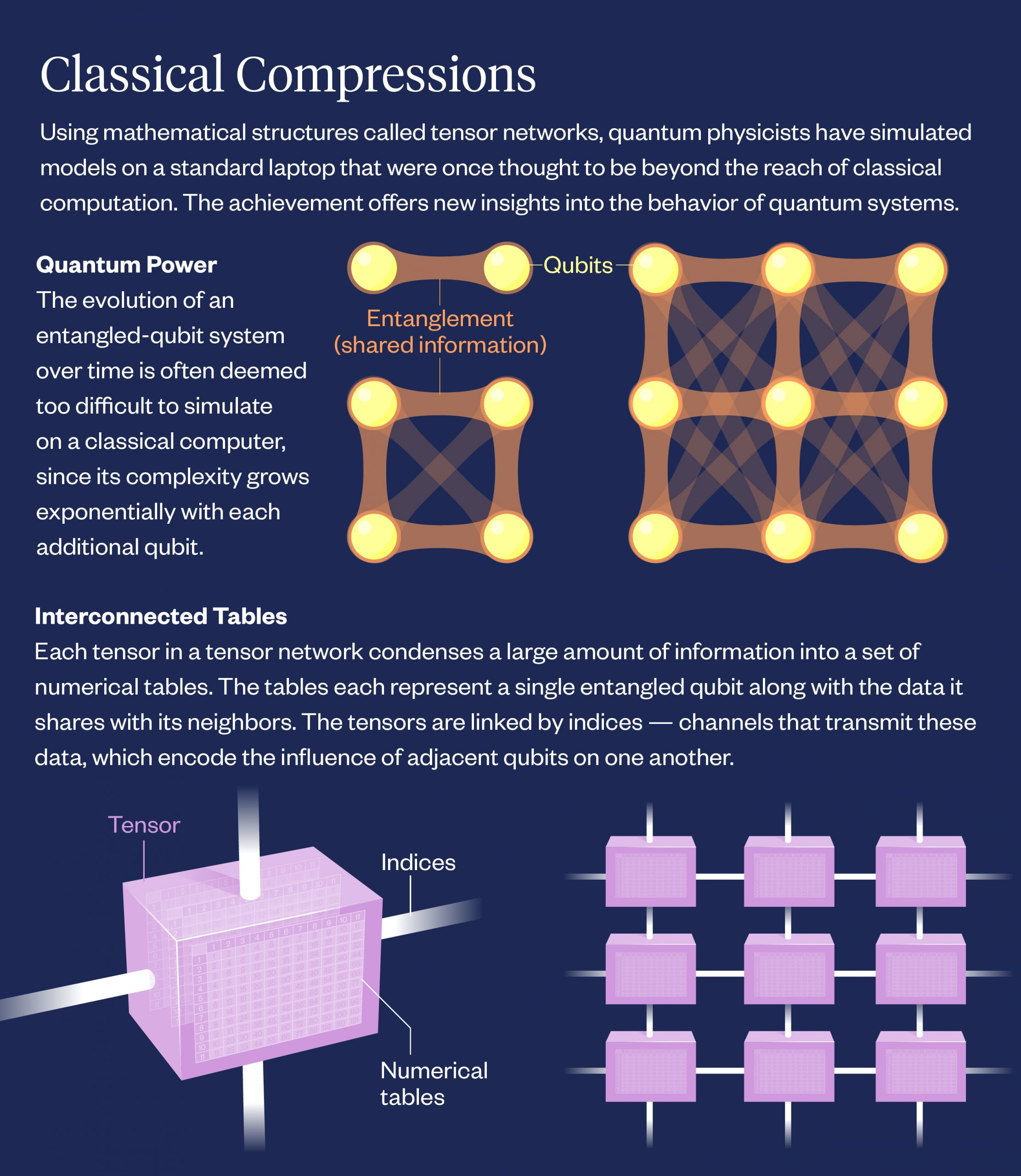
The computational framework targets the simulation of continuous-time quantum dynamics within the transverse-field Ising model (TFIM) across multi-dimensional square, cubic, and diamond disordered spin-glass topologies. Traditional classical simulation tools, such as matrix product states (MPS), face an exponential memory wall due to the rapid growth of area-law entanglement generated when hundreds of interacting qubits undergo a rapid quench through a quantum phase transition. To bypass this barrier without storing the uncompressed wave function, the CCQ team constructed a lattice-specific, three-dimensional tensor network architecture using ITensor, an in-house high-performance software library.
The mathematical implementation tracks and processes the entangled state progression via a two-stage pipeline:
- Time Evolution Tracking: The algorithm adapts belief propagation (BP)—a localized message-passing routine originally formulated in the 1980s for classical statistical inference—to approximate and update the interconnected tables of numbers representing the quantum state. This approach severely limits the numerical instabilities typically caused by unconstrained three-dimensional network contractions.
- Expectation Value Extraction: Once the time-evolution sequence is stabilized, advanced variants of the belief propagation protocol, such as loop corrections and MPS message passing, query the compressed data structure to compute specific physical observables.
The Scientific Debate and D-Wave Response
While the CCQ framework successfully demonstrated state-of-the-art accuracies using modest computational hardware, including standard workstations and laptops for targeted problem classes, its implications on the limits of quantum annealing remain a subject of active scientific discussion. Following the study’s publication, D-Wave Quantum Inc. issued an official response clarifying that the Flatiron paper does not fully reproduce the entire scope of the peer-reviewed 2025 Science demonstration. Specifically, D-Wave notes that the BP-TNS algorithm was applied to specific instances and measurements but did not replicate the original findings across:
- The most complex lattice geometries: Higher-dimensional biclique problems and heavily frustrated network topologies.
- The largest physical scales: The maximum-size three-dimensional lattice simulations evaluated on the physical hardware.
- The hardest coupling regimes: Highly disordered, low-precision ensembles where quantum correlations grow at the fastest rates.
- The full set of measurements: Higher-order physical metrics, including specific full-state and fourth-order observables produced by the physical quantum annealing processor.
Evaluating Limits via Quantum Hardware Reference
The boundary between classical and quantum simulability has been further analyzed through cross-verification studies. In an arXiv pre-print titled “Evaluating Classical Simulations with a Quantum Processor,” D-Wave researchers and collaborators flipped the traditional benchmarking paradigm, utilizing a physical superconducting quantum annealing processor to generate ground-truth data to evaluate the limits of classical tensor-network scaling. The combined findings indicated that while BP-TNS methods are highly effective in low-entanglement or nearly planar regimes, they can fail to converge or lose accuracy when confronting strongly coupled three-dimensional spin glasses on cubic and diamond lattices. Furthermore, the analysis showed that loop-corrected BP-TNS variants become computationally ineffective when simulating complex biclique graphs, delineating the clear boundaries where physical quantum processors maintain a performance edge over classical approximations.
Strategic Positioning & Ecosystem Integration
Rather than executing a definitive refutation, the validation of this classical tensor network architecture establishes a more refined and rigorous baseline in the ongoing debate surrounding practical quantum supremacy. By matching or exceeding quantum processing unit (QPU) accuracies on designated baseline instances involving hundreds of simulated qubits, the CCQ framework provides an immediate validation protocol to benchmark the noise floors, precision limits, and universal Kibble-Zurek physics scaling of near-term quantum annealers. The structural code framework is currently being expanded beyond static spin systems to address itinerant electron transport models, creating a repeatable software blueprint to help cross-disciplinary R&D teams evaluate when a physical quantum processor is genuinely required for data-intensive simulation workloads. This virtuous cycle of competition between classical algorithms and physical quantum processors ultimately sharpens the exact parameters defining true quantum advantage.
You can review the official institutional announcement from the Simons Foundation here and read D-Wave’s formal response statement here. Access the full May 2026 Science research paper detailing the 3D tensor network algorithms here, examine the original March 2025 Science manuscript detailing D-Wave’s quantum simulation milestone here, and review the D-Wave technical rebuttal preprint on arXiv here.
May 22, 2026 / Updated: May 26, 2026
