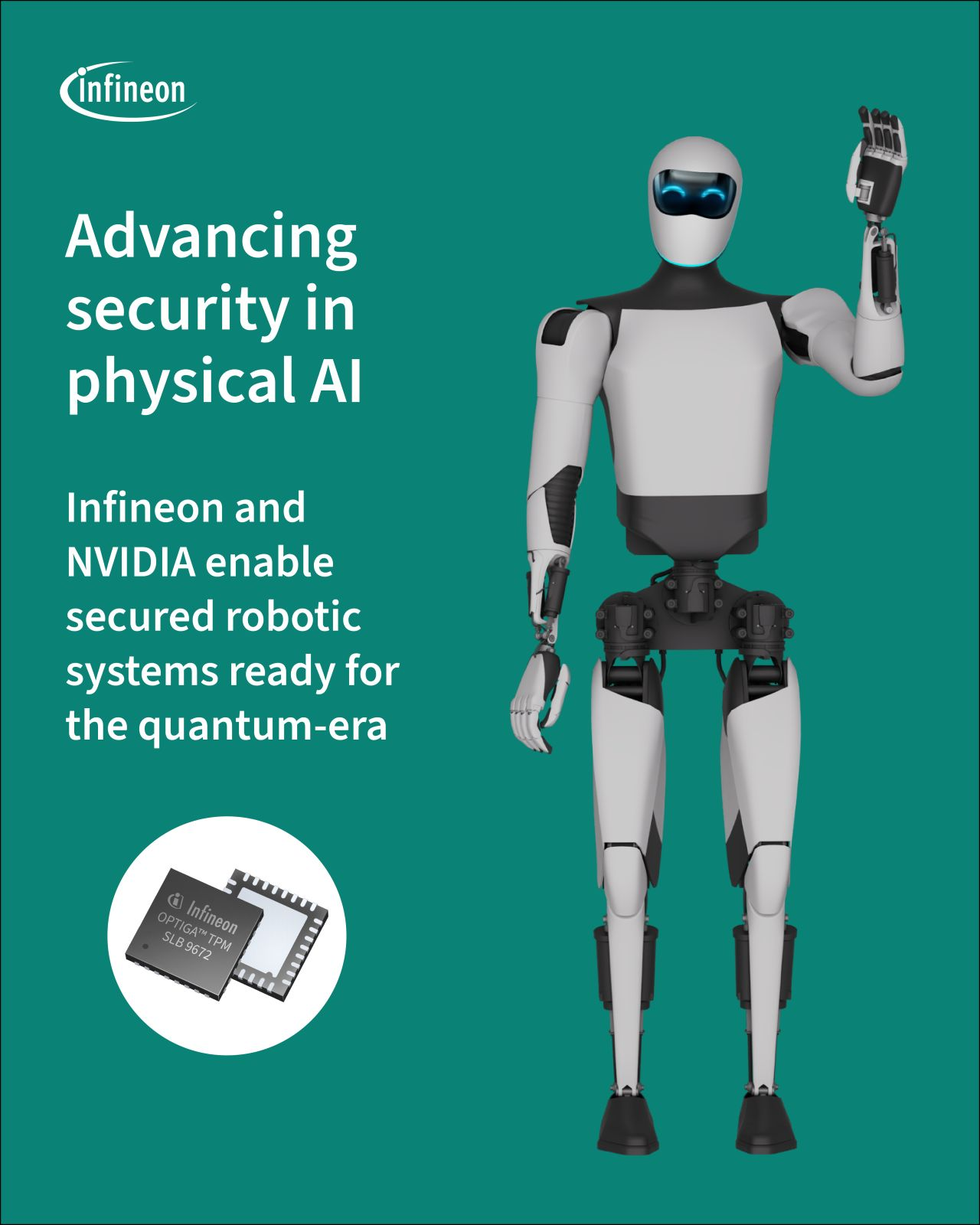
Infineon Technologies AG has integrated its OPTIGA™ Trusted Platform Module (TPM) SLB 9672 with NVIDIA’s Jetson Thor processing platform. Designed to isolate cryptographic assets and monitor system state parameters at the silicon level, the hardware module serves as a certified root of trust for robotics and Physical AI systems. The architecture provides robotic fleet operators with cryptographic verification mechanisms to prevent software manipulation as autonomous machinery moves into factories, medical facilities, and public infrastructure spaces.
Technical Architecture & Quantum-Resilient Fleet Attestation
The system integration pairs NVIDIA’s robotics and edge-AI processor with a physically isolated security controller to bypass the vulnerabilities of software-defined isolation barriers on the main application unit. The OPTIGA TPM functions as an autonomous cryptographic vault certified under FIPS and Common Criteria guidelines, governing secure code execution loops via hardware-enforced protection profiles. The platform generates cryptographic hashes of the operating system and AI model weights during startup, allowing remote monitoring consoles to verify that the runtime software stack remains unmodified. Crucially, the module utilizes a post-quantum cryptography (PQC) secured firmware update mechanism to safeguard the device’s root authority against future quantum decryption vectors. To achieve long-term quantum resistance, the hardware roadmap embeds US National Institute of Standards and Technology (NIST) standardized algorithms, specifically ML-KEM for key exchange and ML-DSA for digital signatures, securing over-the-air (OTA) updates and local neural network weights against cryptographic threats.
Compliance Frameworks & Robotics Market Economics
The deployment of chip-level security architectures is driven by evolving international regulatory mandates, including the EU Cyber Resilience Act, the EU AI Act, and industrial manufacturing standards like IEC 62443, which require hardware-verifiable proof of security across a device’s active lifespan. By embedding hardware-based roots of trust at the early design-in stage, manufacturers ensure that deployed robot fleets can meet auditable compliance requirements without facing physical hardware retrofits when mandates take effect. Led by Division President Dr. Stephan Zizala at Infineon and Vice President Deepu Talla at NVIDIA, the partnership targets the market for humanoid and industrial automation systems. With total semiconductor content estimated at approximately $500 per humanoid robot across power, sensing, and actuation blocks, dedicated security hardware represents an expanding portion of the overall component bill of materials, shifting edge-AI prototyping into verified commercial fleet operations.
The corporate product launch documentation can be found via the Infineon Technologies portal here.
June 3, 2026
