

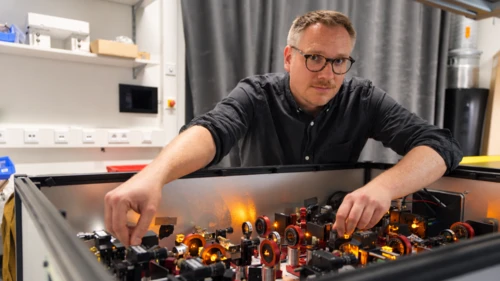
Leibniz University Hannover researcher Dr. Kai Voges has established a new research group dedicated to building hybrid quantum computing architectures that combine ultracold polar molecules with neutral Rydberg atoms. Operating within the Quantum Valley Lower Saxony (QVLS) ecosystem and the QuantumFrontiers Cluster of Excellence, the 5-year HybriQCS (Hybrid Systems for Quantum Computing and Simulation) project is supported by €5.8 million (~$6.53 million USD) in grant funding from the German Federal Ministry of Research, Technology and Space (BMFTR) under its Quantum Futur competition for early-career researchers.
The HybriQCS architecture couples the long coherence times of ultracold molecules with the rapid gate speeds and long-range interactions of Rydberg atoms. Molecules act as long-lived quantum memory storage units (maintaining coherence over seconds to minutes due to weak environmental coupling), while Rydberg atoms mediate fast multi-qubit gate operations and entangling interactions. The project’s primary technical target over its five-year timeline (running through February 28, 2031) is to execute the first two-qubit quantum logic gate operations combining ultracold molecules and Rydberg excitation states.
| [ HybriQCS Hybrid Quantum Architecture & Project Parameters ] | ||
|---|---|---|
| Project Parameter | Funding & Institutional Profile | Technical Function & Deliverables |
| • Project Name & Grant | • HybriQCS Project (€5.8 Million / ~$6.4M USD) • BMFTR Quantum Futur Early-Career Award | • 5-year development timeline (March 1, 2026 – February 28, 2031) at Leibniz University Hannover |
| • Ultracold Molecules (Memory) | • Cooled molecular dipole states • Long coherence times (seconds to minutes) | • Serves as stable quantum information storage; protects stored qubits from environmental noise |
| • Rydberg Atoms (Processing) | • Highly excited neutral atomic states • Strong dipole-dipole interactions | • Mediates high-speed entangling logic gates and optical readout across the hybrid register |
| • Ecosystem Partnerships | • Quantum Valley Lower Saxony (QVLS) • PTB & QuantumFrontiers Cluster | • Collaborates with regional trapped-ion groups; explores dual optical clocks and commercial spin-offs |
Beyond quantum computing logic gates, the HybriQCS team is exploring dual-specie optical atomic clock schemes. By cross-referencing clock transitions between molecules and neutral atoms, the system aims to cancel common-mode optical noise to produce low-noise frequency standards. The project also collaborates with local trapped-ion research groups at the Physikalisch-Technische Bundesanstalt (PTB) to assess future commercial spin-off pathways for hybrid quantum hardware.
Review regional ecosystem reporting on the here, explore research announcements on the here, inspect cluster initiatives via the here, read our previous coverage on Quantum Valley Lower Saxony’s hardware scaling initiatives here.
In GQI Portal
The players behind the news
The team that writes QCR tracks every company, deal and technology in the GQI Factory, GQI's verified database of the quantum industry. Next up: every story linked to its players, coming to QCR's paid plans.
- Players Companies and institutions across the quantum industry, by segment.
- Scorecards How the players compare on hardware, software, funding and more.
Newsletter
QCR Alerts in your inbox
The latest reporting and analysis from Quantum Computing Report. Free, unsubscribe any time.