
News
Company, funding, product and policy news from across the quantum industry, as it happens.
-
-
IonQ Partners with SDT to Deploy Superion 256 Quantum System and Establish SiV Quantum Memory Assembly Hub in South Korea
IonQ partners with SDT to deploy a Superion 256 quantum system and establish a SiV quantum memory assembly hub in South Korea, expanding their collaboration from software to hardware. This agreement strengthens IonQ's presence in the Asia-Pacific region, supporting biomedical and pharmaceutical research through hybrid quantum infrastructure.
-
QuEra Computing Joins Maryland’s Capital of Quantum Initiative and Opens Facility in Discovery District
QuEra Computing has opened an office in Maryland's Discovery District, joining the Capital of Quantum initiative. This expansion includes a partnership with UMD's QLab, providing cloud access to QuEra's 256-qubit Aquila neutral-atom quantum computer.
-
QuEra Computing and HPE Partner to Integrate Fault-Tolerant Neutral-Atom QPUs with On-Premises HPE Cray Supercomputers
QuEra Computing and HPE are partnering to integrate QuEra's neutral-atom quantum processing units (QPUs) with HPE Cray supercomputers, enabling on-premises, hybrid quantum-classical supercomputing for national laboratories and enterprises. This collaboration aims to develop integrated hardware, co-design algorithms, and establish low-latency software for secure and efficient high-performance computing.
-
Babcock and Arqit Demonstrate Quantum-Safe Tactical Communications at DVD 2026
Babcock International Group and Arqit Quantum Inc. successfully demonstrated quantum-safe tactical communications at DVD 2026, using Arqit’s NetworkSecure software to encrypt operational data across various networks. This collaboration showcases a software-defined encryption protocol for securing tactical data against post-quantum threats within existing military communication infrastructure.
-
Quantum XChange Partners with Carahsoft to Distribute FIPS-Validated Phio TX Platform Across Federal Agencies
Quantum XChange partnered with Carahsoft to distribute its FIPS-validated Phio TX platform to federal agencies, helping them meet post-quantum migration deadlines. The platform provides a crypto-agile management overlay, allowing agencies to hot-swap post-quantum algorithms and protocols without re-architecting applications.
-
Microsoft Opens 15,000-Square-Foot Quantum Research Center and Hardware Makerspace in Maryland Discovery District
Microsoft Quantum has opened a 15,000-square-foot Quantum Research Center in Maryland, partnering with the University of Maryland and supported by the Capital of Quantum initiative. The facility features a hardware makerspace, classified research zones, and testing infrastructure for quantum system integration and workforce training. Microsoft also unveiled its Quantum Development Kit (QDK) for analytics and published a paper on scalable logical qubits.
-
Zapata Quantum Unveils Quantum Pilot Platform for Automated Application Discovery and Resource Estimation
Zapata Quantum has launched Quantum Pilot, a cloud-based platform designed to automate quantum application discovery, resource estimation, and software verification. The platform aims to bridge the gap between quantum hardware advancements and the ability of organizations to identify and prioritize high-value enterprise use cases. It achieves this through its Quantum Graph for dynamic knowledge mapping, Quantum Engine for automated algorithm selection and hardware benchmarking, and Quantum Assurance for formal software verification.
-
OQC, Citi, and NQCC Evaluate Quantum-Compressed PINNs for Financial Derivative Pricing Workflows
Oxford Quantum Circuits (OQC), in collaboration with Citi and the National Quantum Computing Centre (NQCC), completed a study evaluating Quantum-compressed Physics-Informed Neural Networks (QPINNs) for financial derivative pricing. The research demonstrated that QPINNs can significantly reduce model complexity without sacrificing pricing accuracy, offering a promising avenue for more efficient financial modeling. However, the study also identified challenges related to compression efficacy in specific areas and the need for improved classical-quantum integration as quantum hardware develops.
-
IonQ Demonstrates Real-Time QEC Decoding at MegaQuOp Scale on Single Commodity CPU
IonQ has successfully demonstrated a real-time Quantum Error Correction (QEC) decoding pipeline capable of handling large-scale fault-tolerant workloads on a single commodity CPU, achieving near-zero computational backlog delays and minimal stretch time. This dual-decoder architecture efficiently processes syndrome extraction data, enabling scalable quantum computing without the need for expensive custom hardware. This breakthrough validates a core component of IonQ's Walking Cat architecture, paving the way for multi-thousand physical qubit systems.
-
Quobly Integrates Alloy Forge Emulator with qBraid Cloud to Accelerate Silicon Spin-Qubit Application Development
Quobly has partnered with qBraid to integrate its Alloy Forge emulator into the qBraid Cloud, allowing developers to test silicon spin-qubit applications under realistic semiconductor constraints. This collaboration provides a platform for validating quantum applications before Quobly's 10-qubit Alloy Pioneer QPU is commercially released, utilizing a 15-qubit emulation with a native RZZ gate set and empirical noise models. This initiative is a strategic step towards Quobly's long-term goal of developing VLSI silicon quantum processors with one million qubits by 2032.
-
-
-
QNu Labs Launches QShield 2.0 to Drive India’s National Cryptographic Assessment & Assurance Framework
QNu Labs has launched QShield 2.0, a sovereign, full-stack post-quantum cryptography (PQC) and crypto-agility platform, to drive India’s National Cryptographic Assessment & Assurance Framework (NCAAF). The platform, introduced at the company’s 10th anniversary, helps critical infrastructure sectors initiate formal PQC migration by 2027, as mandated by the National Quantum Mission (NQM) Task Force Report. QShield 2.0 consolidates five operational modules into a unified management plane to address “Harvest Now, Decrypt Later” attack vectors and AI-driven attack surfaces.
-
SEALSQ, WISeKey, and Canton of Jura Execute MoU for CHF 40–60M ($48.7M–$73M USD) Post-Quantum Semiconductor Personalization Hub
SEALSQ, WISeKey, and the Canton of Jura have partnered to create a CHF 40-60 million ($48.7M–$73M USD) Post-Quantum Semiconductor Personalization Hub in Switzerland. This center will focus on developing and implementing post-quantum cryptography using SEALSQ’s QS7001 Quantum Shield technology, serving defense, aerospace, and critical infrastructure sectors. The project aims to create over 250 jobs and will adapt operational methodologies from a similar facility in Spain.
-
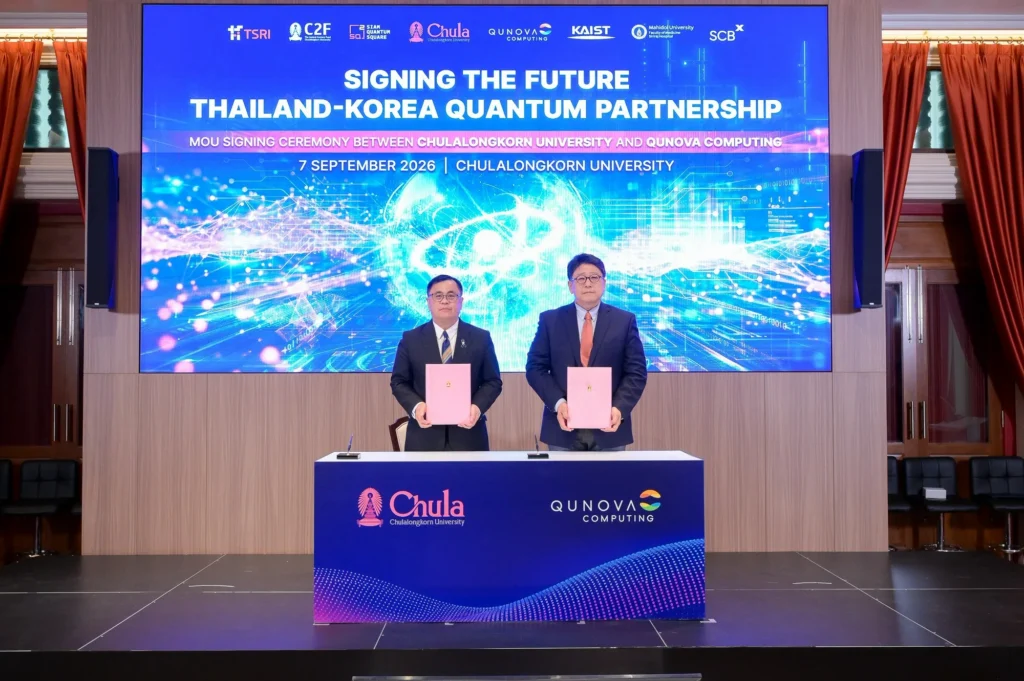
Chulalongkorn University and Qunova Computing Execute MoU to Advance Hybrid Quantum Algorithms for Industrial R&D
Chulalongkorn University and Qunova Computing have partnered to advance hybrid quantum algorithms for industrial R&D in Thailand. This collaboration, coordinated by Siam Quantum Square, focuses on applying quantum-classical algorithms to chemistry, material science, fluid dynamics, and financial modeling. The initiative aims to accelerate regional quantum adoption and establish Southeast Asia as a hub for hybrid quantum-AI application development.
-
Chulalongkorn University and AIST (G-QuAT) Sign Five-Year Memorandum of Understanding to Build Bilateral Quantum Technology Ecosystem
Chulalongkorn University (Thailand) and Japan's National Institute of Advanced Industrial Science and Technology (AIST) have signed a five-year MoU to advance quantum technology in Southeast Asia. This partnership will focus on joint research, scientific exchange, and developing quantum computing applications. The collaboration aims to address workforce shortages and establish Southeast Asia as a hub for enterprise quantum technology adoption, with an emphasis on quantum-AI integration, drug discovery, materials science, and industrial logistics.
-
Phasecraft Establishes U.S. Headquarters in Arlington, Virginia to Accelerate Government and Defense Quantum Software Partnerships
Phasecraft established its U.S. headquarters in Arlington, Virginia, supported by VEDP and VJIP, to expand its quantum software partnerships and workforce. This move aims to accelerate algorithm development across federal defense, energy, and commercial sectors, building on existing engagements with DARPA and ARPA-E.
-
-
-
Who’s News: Strategic Appointments at Quantum Motion, SQC, Lawrence Semiconductor, and Pasqal
Quantum Motion promoted Dr. Anna Stockklauser to CPO, Silicon Quantum Computing appointed John Hollister as CFO, Lawrence Semiconductor named Don Garrison GM and COO, and Pasqal added Roberto Mauro as CPO and Joëlle Lumb as CHRO. These leadership moves support silicon spin-qubit deployment, global financial strategy, expanded epitaxial foundry capacity, and neutral-atom product and talent scaling across the quantum industry.
-
IBM Research Demonstrates Hybrid Spacetime PEC to Reduce Error-Mitigation Sampling Overhead by 63×
IBM Research has introduced Spacetime Probabilistic Error Cancellation (Spacetime PEC), a hybrid error-handling framework that significantly reduces the sampling overhead in quantum computing. This new protocol combines Probabilistic Error Cancellation (PEC) with post-selected Quantum Error Detection (ED), achieving up to a 63-fold reduction in sampling overhead compared to standard PEC. The approach was experimentally validated on IBM's 27-qubit heavy-hex superconducting processor, demonstrating its effectiveness in mitigating errors and improving computational efficiency for complex quantum circuits.
-
University of Pennsylvania Demonstrates Single-Gate Parallel Entanglement on Room-Temperature Diamond Quantum Register
University of Pennsylvania researchers have achieved a breakthrough in quantum computing by demonstrating single-gate, parallelized multipartite entanglement on a room-temperature diamond quantum register. They successfully generated a four-qubit Greenberger–Horne–Zeilinger (GHZ) state in just 14.8 microseconds, a tenfold speedup over traditional methods, with significantly improved fidelity. This new approach, detailed in Nature Nanotechnology, converts inherent crosstalk into parallel conditional gates, offering a scalable template for future quantum technologies.
-
Fortaegis Technologies Raises $50 Million Series A to Deploy Hardware-Rooted Quantum-Safe Secure Compute Architecture
Fortaegis Technologies has successfully closed a $50 million Series A funding round led by Serendipity Capital, with participation from major strategic investors. This capital will accelerate the deployment of their hardware-rooted quantum-safe secure compute architecture, which provides advanced security against AI and post-quantum decryption threats by generating dynamic, quantum-resistant encryption keys from physical silicon properties. The company plans to scale FPGA deployment and develop custom ASICs for various markets, including AI data centers, defense, and telecommunications.
-
-
-
GlobalFoundries Finalizes $375 Million CHIPS Act Award for Onshore Quantum Semiconductor Fabrication
GlobalFoundries has finalized a $375 million CHIPS Act award to expand its Quantum Technology Solutions (QTS) unit in Malta, New York. This funding will scale domestic quantum hardware manufacturing, utilizing GF's 22FDX process for cryogenic CMOS and advanced packaging. The agreement establishes a secure domestic foundry ecosystem for various quantum computing architectures, reinforcing U.S. microelectronics supply chains.
-
Diraq and Dell Technologies Partner to Integrate Silicon QPUs with High-Performance Classical Computing
Diraq and Dell Technologies have partnered to integrate silicon spin-qubit quantum processors with classical HPC and AI server infrastructure, with Dell deploying an HPC server cluster directly inside Diraq's Sydney lab for ultra-low-latency quantum-classical interconnect and real-time control. The collaboration focuses on hybrid orchestration software for automated qubit calibration and error correction, aiming to scale CMOS-compatible silicon QPUs into standard data centers for applications in optimization, logistics, finance, and AI-driven drug discovery.
-
Quantum B Secures European Patent for Quantum Conference Key Agreement Protocol
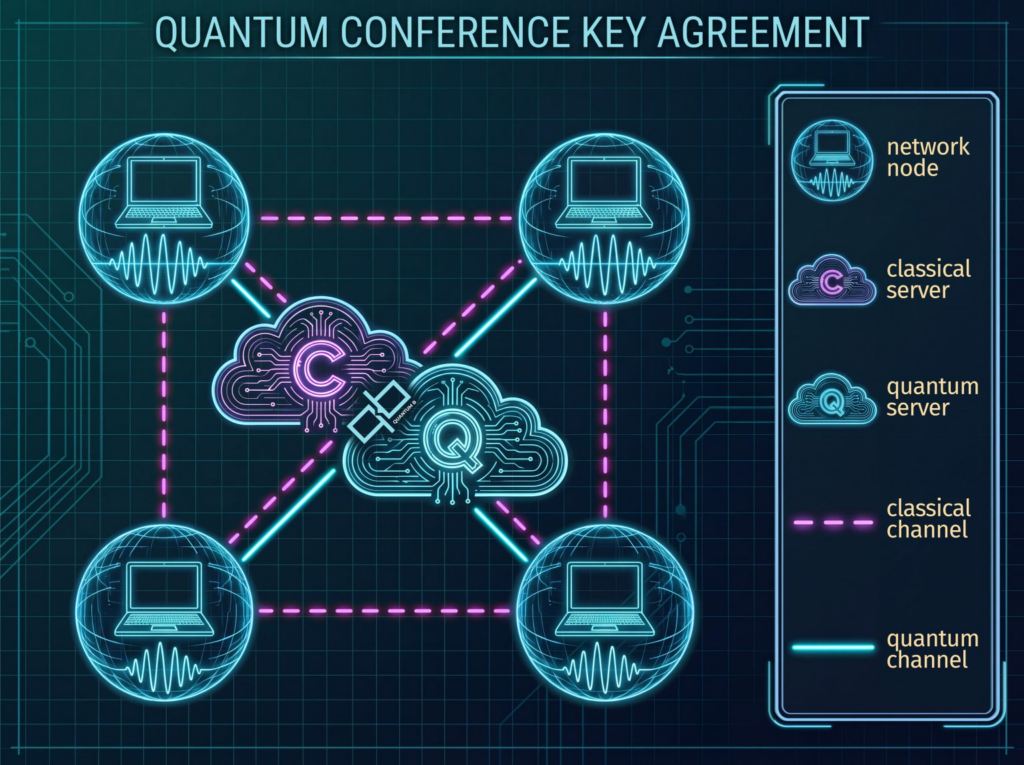
Quantum B has been granted European Patent EP 4462727 for its Quantum Conference Key Agreement (QCKA) protocol. This protocol utilizes multipartite quantum entanglement to establish distributed consensus across independent network nodes, offering an alternative to classical consensus mechanisms. The technology aims to lower communication overhead for multi-party synchronization and is part of Quantum B's broader portfolio, including its involvement in the EU-funded POSEIDON project.
-
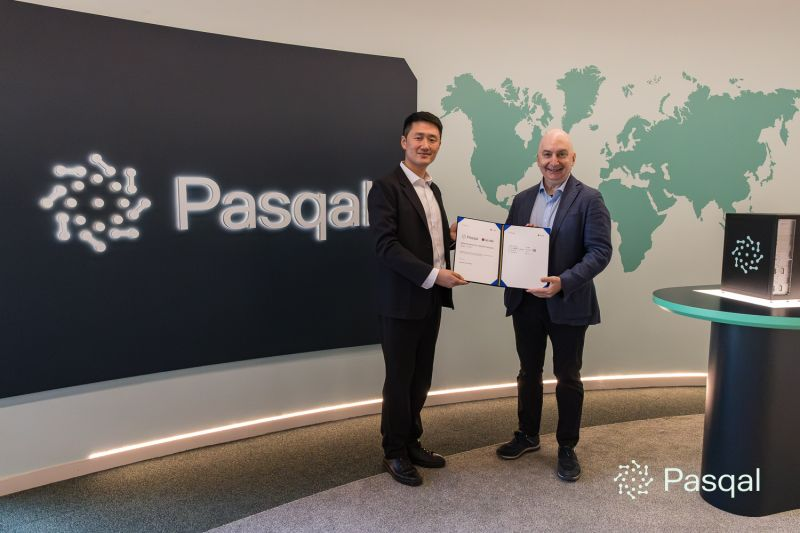
Pasqal and LG CNS Sign Three-Year MoU to Integrate Neutral-Atom QPUs into AI Data Center Infrastructure
Pasqal and LG CNS have signed a three-year agreement to integrate Pasqal's neutral-atom quantum processing units (QPUs) into LG CNS's AI Data Centers in South Korea and the Asia-Pacific region. This partnership aims to deploy hybrid quantum-classical computing platforms for high-performance AI workloads, expanding Pasqal's presence in the APAC market.
-
USA Rare Earth, Pasqal, and Riven Systems Partner to Advance Quantum ML for Critical Mineral Processing
USA Rare Earth, Pasqal, and Riven Systems are collaborating to develop quantum machine learning (QML) models for separating rare earth elements. This partnership combines Pasqal's quantum computing, Riven's autonomous chemistry lab, and USA Rare Earth's resources to optimize chemical separation, aiming to reduce supply chain dependencies and improve efficiency in processing critical minerals.
-
Sectigo Launches Quantum Ready™ Platform to Drive Enterprise Quantum Security Posture Management (QSPM)
Sectigo has launched Sectigo Quantum Ready™, a new enterprise software solution for Quantum Security Posture Management (QSPM). This platform helps organizations identify and assess quantum-vulnerable cryptography across their systems, generating a dynamic Cryptographic Bill of Materials (CBOM). It aims to facilitate the migration to post-quantum cryptography by providing continuous discovery and integration with Sectigo's Certificate Manager for automated policy enforcement.
-