
News
Company, funding, product and policy news from across the quantum industry, as it happens.
-
-
Quantum X Labs Announces Quantum-Native Cybersecurity Architecture Under QuantumQ Division
Quantum X Labs, under its QuantumQ Security division, has introduced a quantum-native cybersecurity architecture with three layers: Detect (LayerQake), Encrypt (Qatacomb), and Verify (Quantum Verification Suite). This initiative, guided by former Mossad Chief Yossi Cohen, aims to integrate quantum mechanics directly into network defense, moving beyond traditional post-quantum cryptography. While the programs are still in research and IP filing stages, they represent a significant pivot for the company, formerly Viewbix Inc.
-
NLM Photonics and LIGENTEC Build First Silicon Nitride Organic Hybrid Modulators Amid Materials Supply Chain Expansion
NLM Photonics, LIGENTEC, and Spark Photonics have successfully created the first Silicon Nitride Organic Hybrid (NOH) modulators on a commercial photonics platform. This breakthrough allows for the integration of NLM's organic electro-optic materials onto silicon nitride substrates, enabling active, low-loss modulation across visible and near-infrared wavelengths. This advancement has applications in photonic qubit routing, quantum key distribution, and laser control in trapped-atom systems, and is supported by NLM Photonics' expanded investor base, securing its materials supply chain and manufacturing pipeline.
-
Qtonic Quantum Corp Launches QShield for Immediate Software-Only Post-Quantum Network Protection
Qtonic Quantum Corp has launched QShield, a software-only post-quantum cryptography solution designed to protect network connections between Linux endpoints. It utilizes NIST-standardized algorithms like ML-KEM-1024 and ML-DSA-87 to defend against "Harvest Now, Decrypt Later" attacks. QShield operates at the host layer, providing encrypted overlay tunnels without requiring specialized hardware, and has demonstrated high reliability in a 72-hour AWS endurance test.
-
Mitsubishi Electric and OptQC Expand Strategic Partnership Amid JPY 7B ($47M USD) Series A2 and Tokyo R&D Expansion
Mitsubishi Electric and OptQC are expanding their strategic partnership through investments and R&D collaborations. OptQC secured JPY 7 billion in Series A2 funding, bringing its total funding to over JPY 20 billion, which will support the development of a 10,000-qubit optical processor and a new Tokyo R&D facility. Mitsubishi Electric, through its ME Innovation Fund, participated in OptQC's funding round and is also leading two national quantum hardware control projects.
-
Mitsubishi Electric Selected for Two NEDO R&D Projects to Scale Quantum Hardware Platforms
Mitsubishi Electric has been selected by NEDO to lead two R&D projects focused on scaling quantum hardware control systems. The first project, "Research and Development of Multi-Qubit-Control Laser Systems," aims to develop low-latency, multi-channel optical systems for neutral-atom and trapped-ion quantum processing units. The second project, "Development of Ultra-Compact, Multi-Channel, Low-Noise Amplifier Modules for Large-Scale Superconducting Quantum Computers," will engineer cryogenic low-noise amplifier modules for superconducting quantum computers. These projects aim to achieve commercial deployment of million-qubit-scale systems by the 2030s, collaborating with AIST and academic institutions.
-
EPB Commissions IonQ Forte Enterprise Quantum Computer in Chattanooga Hub
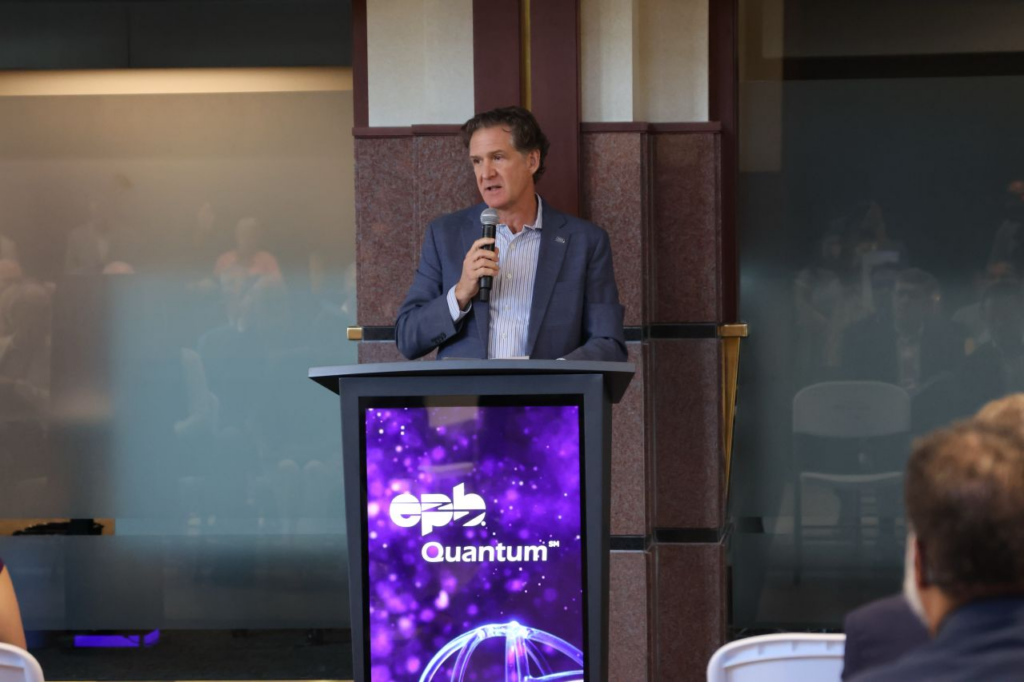
EPB has launched the IonQ Forte Enterprise quantum computer at its Chattanooga Quantum Center, making it the first commercial U.S. hub to integrate trapped-ion quantum processing units and photonics-based quantum networking. Initial access is for the EPB Quantum Computing Fellows, with commercial service opening in October 2026. This launch is supported by workforce and academic initiatives and positions Chattanooga as a leader in quantum technology.
-
EigenQ and Silicon Valley Acquisition Corp. Secure $45M Committed Convertible Financing Ahead of $3B SPAC Merger
EigenQ and Silicon Valley Acquisition Corp. have secured $45 million in convertible note financing, providing $22.5 million upfront and the remainder upon closing their $3 billion SPAC merger. This funding will accelerate EigenQ's quantum-safe security commercialization, expand delivery, and support R&D, with the company expected to list on Nasdaq as EIGQ in Q4 2026. EigenQ plans to focus on government, defense, and critical infrastructure sectors, leveraging partnerships with companies like TD SYNNEX, AMD, WNC Corporation, HPE, and Intel.
-
ICTK and Jiran Security Partner on ‘Q-BRIDGE’ to Commercialize End-to-End PQC Migration Frameworks
ICTK and Jiran Security have partnered to launch Q-BRIDGE, an initiative offering end-to-end Post-Quantum Cryptography (PQC) migration for enterprises, governments, and financial sectors. Jiran Security will handle diagnostic auditing, risk assessment, and migration planning, while ICTK will provide hardware-rooted PQC security architecture using its VIA PUF™ (Physically Unclonable Function) Hardware Root of Trust (HRoT) chips. This collaboration aims to streamline PQC transitions by integrating cryptographic inventory discovery with physical PUF-PQC hardware deployment.
-
-
-
Q-SAFE Solutions Unveils EU-27 Carrier-Grade Quantum-Safe Network Platform
Q-SAFE Solutions GmbH has launched a carrier-grade quantum-safe network platform in the EU-27, integrating Quantum Key Distribution (QKD) and Post-Quantum Cryptography (PQC) with centralized hybrid key management. This system operates over existing fiber-optic infrastructure, eliminating the need for dedicated dark fiber, and is designed for telecommunications providers, critical infrastructure, and government agencies. It aligns with EU technological sovereignty mandates and will be showcased at the European Commission’s QCI Days 2026.
-
USC and Quantum Elements Demonstrate Surface Code Scaling on IBM Heavy-Hex Processors
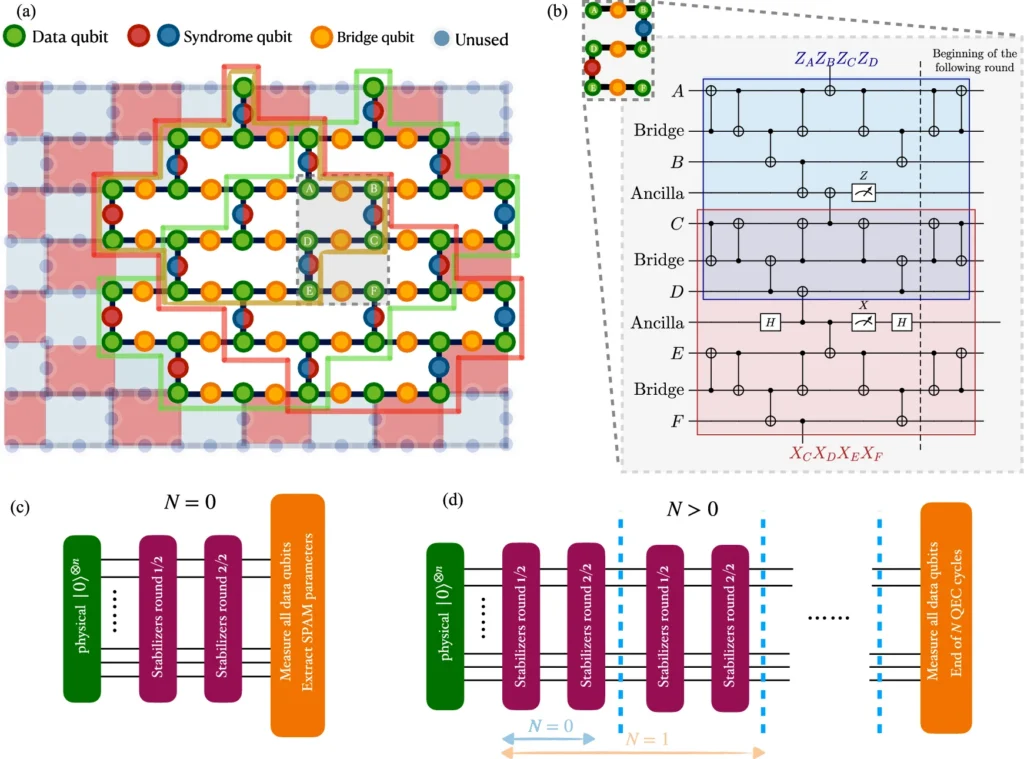
USC and Quantum Elements successfully demonstrated subthreshold surface code scaling on IBM Heavy-Hex processors, overcoming connectivity challenges with a "fold-unfold" SWAP embedding and robust dynamical decoupling. This work, published in Nature Communications, validates that physical quantum processors can achieve distance-scaling error suppression on non-native geometries and introduces a SPAM-aware Entanglement Fidelity metric for accurate logical error rate assessment. The research utilized 156-qubit IBM Heron processors and builds upon their previous collaborative work in classical digital-twin simulation.
-
Riverlane Establishes U.S. Headquarters in Maryland’s Discovery District to Scale Real-Time QEC Deployments
Riverlane has established its U.S. headquarters in Maryland's Discovery District to expand its quantum error correction (QEC) technology in North America, fostering collaborations with academic and government partners. This new facility, located near the University of Maryland, will house executive offices and laboratory space. The expansion is part of Riverlane's strategy to advance real-time QEC deployments and workforce development in the quantum technology sector.
-
Oxford Quantum Circuits Releases Erado: An Open-Source Qiskit Simulator for Erasure Noise and Post-Selection
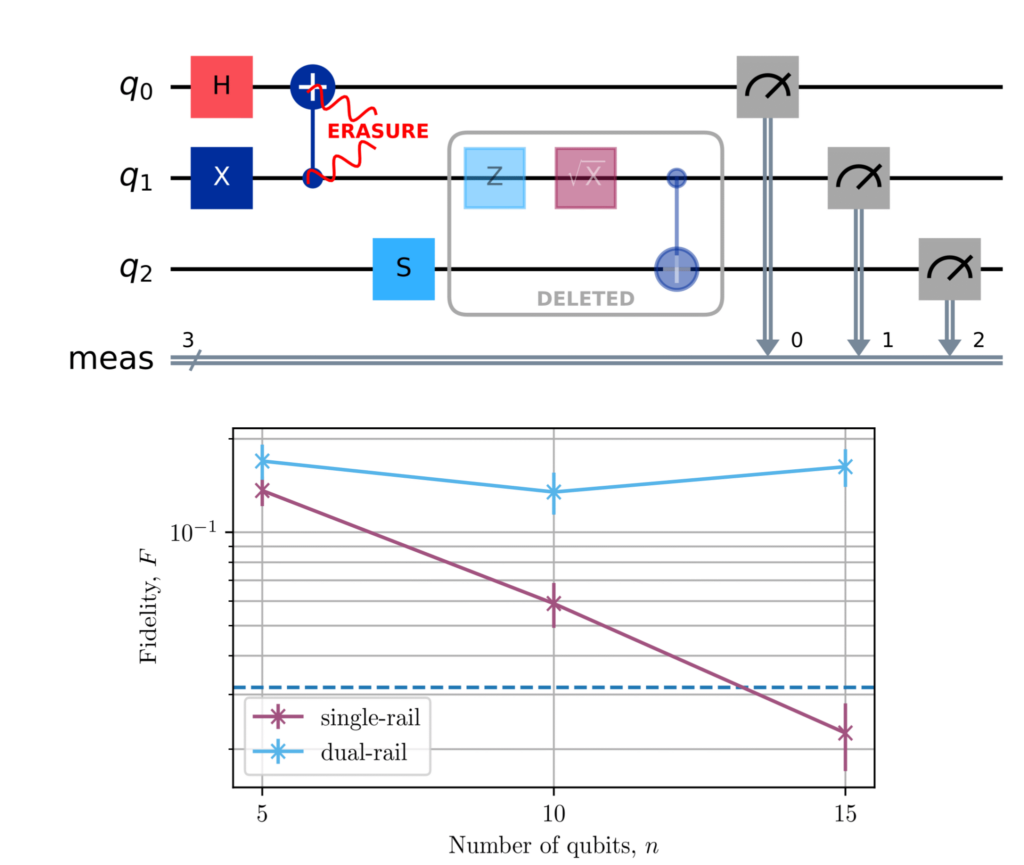
Oxford Quantum Circuits (OQC) has launched Erado, an open-source Qiskit simulator for erasure noise and post-selection, integrated into their QCaaS SDK. This tool allows researchers to simulate erasure-aware noise models and evaluate quantum error mitigation techniques, with accompanying research showing postselection can fully mitigate erasure noise below 3.0% error rates, outperforming single-rail architectures. Erado offers flexible simulation modes and precise parameter controls for analyzing the trade-offs of post-selection.
-
Alice & Bob Partners with CEA to Integrate Cat Qubit Software into HPC Infrastructure
Alice & Bob is partnering with CEA to integrate its cat qubit software into High-Performance Computing (HPC) environments, aiming to develop hybrid supercomputing workflows and algorithms for Fault-Tolerant Quantum Computing by 2030. This collaboration will see Alice & Bob's software integrated into Eviden's Bull Qaptiva™ platform, leveraging CEA's expertise for hardware-agnostic execution across supercomputers and cloud-hosted quantum processors. They will also jointly research many-body quantum physics problems to apply cat qubit technology to materials science, chemistry, and industrial physics.
-
IQM Expands to South America with On-Premises QPU Sale to Brazil’s Eldorado Research Institute
IQM Quantum Computers is expanding into South America by selling an on-premises IQM Spark system to Brazil's Eldorado Research Institute, set for deployment in Q1 2027. This marks the first quantum computer acquisition by a private research institution in Brazil. The system, combined with cloud access to IQM's European 54-qubit QPU, will enable Eldorado to collaborate with universities, startups, and industrial partners in various sectors to develop quantum algorithms and explore hybrid HPC-AI-quantum workflows. This deal contributes to IQM's significant order backlog and global commercial growth.
-
IonQ and Synopsys Accelerate CAE Computer-Aided Engineering Workloads by 14.6% via Trapped-Ion Hardware
IonQ, Synopsys, and NVIDIA have successfully demonstrated quantum-accelerated performance gains in large-scale Computer-Aided Engineering (CAE) workflows, reducing total execution time by up to 14.6%. Their joint research, awarded 1st Place Best Paper at IEEE Quantum Week 2026, utilized a quantum matrix reordering algorithm embedded in classical simulation suites like Ansys LS-DYNA. This innovation optimizes matrix equations, leading to significant time and memory savings in industrial design pipelines and offering substantial reductions in HPC energy consumption and compute costs.
-
DOE Launches $215M Quantum Genesis Q Competition and $45M V&V Lab Call
The U.S. Department of Energy (DOE) has launched the Quantum Genesis Q Competition, offering up to $215 million to develop Scientifically Relevant Quantum Computers (SRQCs) with a minimum of 100 logical qubits. Concurrently, a $45 million National Laboratory call aims to establish a Quantum HPC Validation and Verification (V&V) Testbed to benchmark these systems. This initiative seeks to accelerate fault-tolerant quantum hardware for complex problem-solving in various scientific fields, with an applicant webinar on September 25, 2026, and submissions due by October 19, 2026.
-
-
-
Oracle Launches Java 27 Featuring Hybrid Post-Quantum Cryptography for TLS 1.3
Oracle has released Java 27 (Oracle JDK 27), introducing significant security and performance updates. A key feature is the integration of hybrid post-quantum cryptography for TLS 1.3, designed to protect against future quantum decryption threats. This release also includes Oracle Jipher 20 for NIST-standardized quantum-resistant algorithms and various performance optimizations.
-
QuTech Spinout Q*Bird Rebrands to Falqon Systems to Commercialize Quantum Secure Networks
Q*Bird has rebranded to Falqon Systems, signaling its expansion from hardware manufacturing to deploying end-to-end Quantum Secure Networks (QSN). The company, a spinout from QuTech and TU Delft, will continue with its existing leadership and technological roadmaps, focusing on its integrated platform built upon Measurement-Device-Independent Quantum Key Distribution (MDI-QKD) for enhanced security and scalability in quantum communication. Falqon Systems currently operates across several European countries, aligning with the European Quantum Communication Infrastructure (EuroQCI) initiative.
-
BDC Deploys $1 Billion Under Sovereign Defence Platform to Capitalize Quantum and Deep-Tech Ecosystems
The Business Development Bank of Canada (BDC) has unveiled a $1 billion capital allocation under its $6 billion Defence Platform, aiming to boost quantum computing and deep-tech ecosystems. This initiative, announced at the Canada Investment Summit 2026, involves deploying $500 million into a BDC Defence Fund for indirect investments in venture capital and private equity funds, and an additional $200 million into StrongNorth, its direct early-stage venture capital fund, expanding its total to $500 million. This strategy addresses funding gaps for Canadian hardware and deep-tech startups, aligning with the National Quantum Strategy to secure sovereign supply chains and accelerate commercial deployments.
-
NSF and UKRI Commit $10 Million in Joint Funding for Molecular Quantum Information Science
The NSF and UKRI have jointly committed $10 million to fund eight transatlantic research teams in molecular quantum information science. This initiative, with $5 million from NSF and £3.7 million from UKRI, focuses on foundational chemistry research to manipulate quantum states in complex molecular architectures. This second phase of funding aims to synthesize custom molecular systems, engineer molecular-scale spin qubits, and model quantum information transfer, directly supporting international research partnerships.
-
Casper College Awarded $444,000 NSF Grant to Build Statewide Quantum Workforce Pipeline
Casper College received a $444,059 NSF grant (Award #2609718) to create a statewide quantum education and workforce initiative. This "Quantum Pipeline" project will deploy 130 Quantum Trunks across Wyoming, host a summer science camp, and establish an undergraduate course to build a diverse talent pipeline for the quantum economy. This initiative, led by Dr. Andrew Young, marks the college's first NSF PI award since 1995.
-
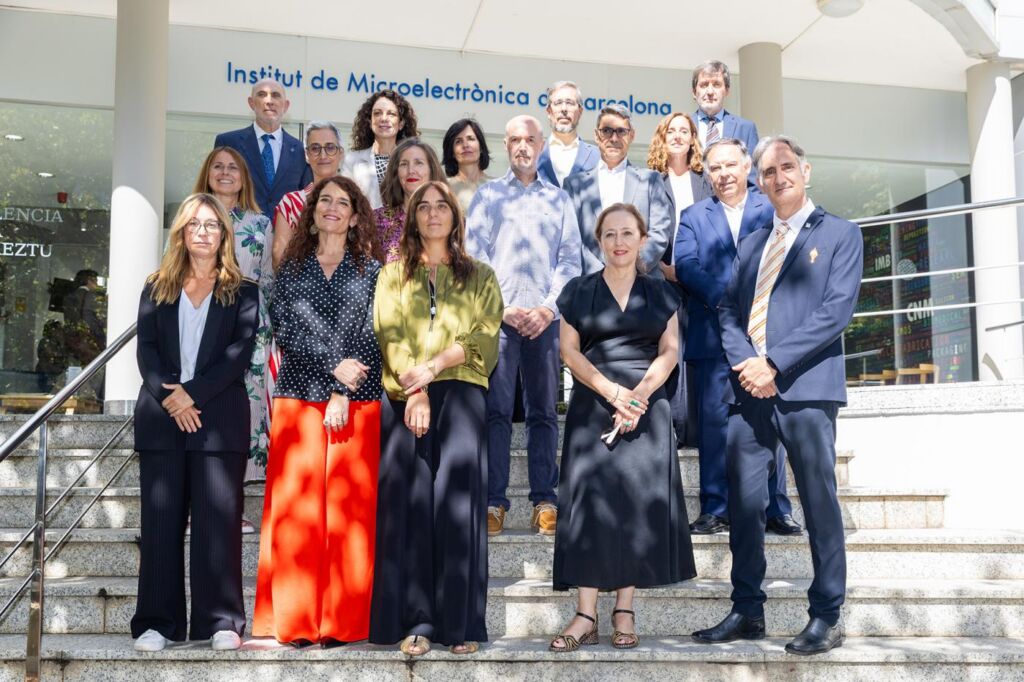
CSIC Inaugurates Spain’s Quantum Nanofabrication Area at IMB-CNM in Barcelona
Spain's CSIC has opened a Quantum Nanofabrication Area at IMB-CNM in Barcelona, a €6 million investment funded by Spain's PERTE Chip program and NextGenerationEU. This facility, equipped with advanced lithography and microscopy systems, is designed for prototyping quantum hardware like QPUs and QKD components. It's part of CSIC's QuARC-CSIC initiative, consolidating 36 research groups to advance quantum technologies across various pillars, from computing to sensing.
-
IonQ, ORNL, NVIDIA, and UT Knoxville Advance AI-Driven Generative Quantum Circuit Synthesis
A collaboration between ORNL, IonQ, NVIDIA, and UT Knoxville introduced DQAOA-GPT, a generative AI framework that synthesizes quantum optimization circuits, eliminating iterative parameter-tuning. This framework significantly reduces circuit synthesis runtime to a constant 28 seconds and doubles solution quality for higher-order unconstrained binary optimization (HUBO) problems, as presented at IEEE Quantum Week 2026. DQAOA-GPT replaces traditional trial-and-error with a transformer model trained on high-performing circuit profiles, allowing hybrid algorithms to scale subproblem sizes efficiently.
-
Oxford Quantum Circuits and Trust Base Benchmark Hybrid Quantum Workloads for Financial Risk Modeling
Oxford Quantum Circuits (OQC) and Trust Base benchmarked hybrid quantum workloads for financial risk modeling, evaluating classical, hybrid quantum-classical, and fault-tolerant quantum algorithms for tasks like derivative pricing and Value-at-Risk. The study found that while Quantum-compressed Physics-Informed Neural Networks (QPINNs) showed parameter efficiency, classical PINNs offered better runtimes and stability. Optimizations like Quantum Signal Processing (QSP) could significantly reduce resource requirements for Quantum Monte Carlo, and improved hardware error correction thresholds could drastically cut the physical qubit footprint for fault-tolerant quantum computing.
-
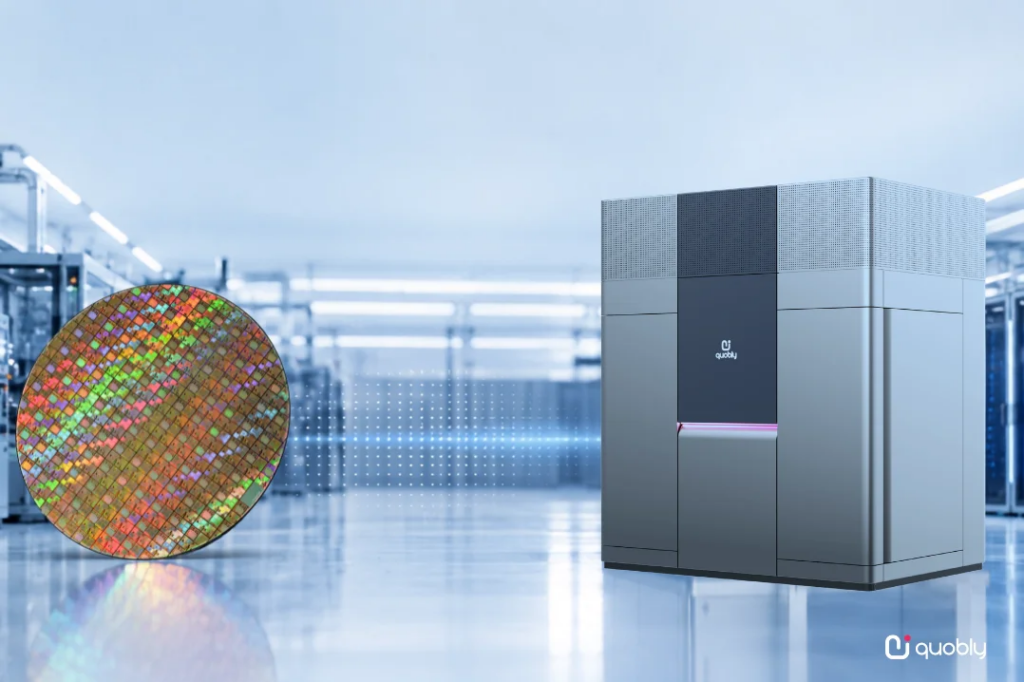
Quobly Demonstrates Single-Chip Readout and Gates on 300mm Industrial Silicon Process
Quobly has successfully demonstrated single-chip execution of qubit readout, single-qubit gates, and two-qubit gates on its QSOI® architecture, fabricated on an industrial 300mm silicon process at STMicroelectronics. This achievement validates their technology transfer strategy, allowing co-integration of quantum and classical circuitry. With plans for cloud access to their Alloy Pioneer system by late 2026 and a long-term target of one million qubits by 2032, Quobly is advancing its commercial and scaling roadmap, supported by significant Series A funding and strategic partnerships.
-