
News
Company, funding, product and policy news from across the quantum industry, as it happens.
-
-
CGI Federal, DLA, and University of Tennessee Launch “Quantum Pathfinder” Initiative for Supply Chain Resilience
CGI Federal, the DLA, and the University of Tennessee have partnered to launch the "Quantum Pathfinder" initiative. This program will explore how AI and quantum computing can optimize supply chain resilience, particularly in warehouse management, reverse logistics, and inventory positioning within military contexts. Hosted at CGI Federal's Knoxville center, the initiative aims to solve logistical bottlenecks and strengthen supply chains during disruptions.
-
DRDO Signs First High-Value TDF Pact with Startup Zero mK India for 20 mK Dilution Refrigerator
DRDO has partnered with Zero mK India to indigenously develop a 20 mK dilution refrigerator, crucial for quantum computing and defense. This marks the first high-value project under the expanded ₹500-crore TDF scheme, aiming to reduce import dependency and strengthen India's National Quantum Mission. The project will establish a domestic supply chain for sub-kelvin cryogenic hardware.
-
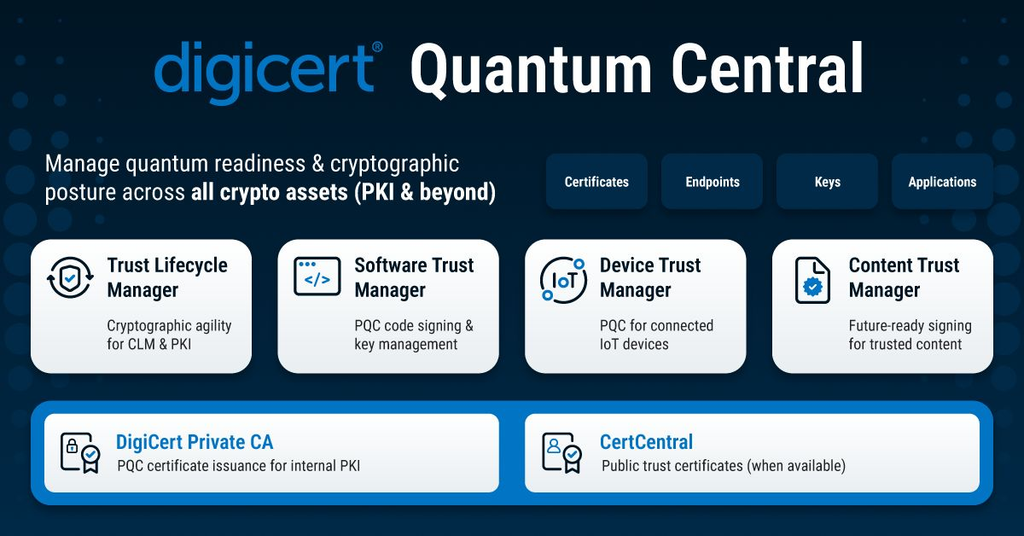
DigiCert Announces General Availability of Quantum Central Platform for PQC Migration Management
DigiCert has launched Quantum Central, an enterprise management suite within its DigiCert ONE platform, to help organizations manage their transition to quantum-safe encryption. This tool consolidates cryptographic assets, tracks policy compliance, and automates remediation workflows, addressing the gap where most enterprises are planning PQC initiatives but few have deployed quantum-safe primitives. Quantum Central facilitates incremental PQC migration, providing auditable metrics and cryptographic bill of materials (CBOM) exports for regulatory compliance.
-
Qambria Secures $2.4M Pre-Seed Funding to Commercialize Sub-Microsecond Classical Control Infrastructure for Fault-Tolerant Quantum Systems
Qambria AG, a Swiss quantum infrastructure developer, has successfully closed a $2.4 million pre-seed funding round led by Syntropy. The company aims to commercialize a classical engine for quantum computing, focusing on software and control orchestration to integrate quantum processing units with high-performance computing. Qambria's IP-licensing model will help lower costs and complexity for quantum hardware manufacturers and data centers.
-
-
-
QuiX Quantum Partners with Tohoku Electronic Industrial for Exclusive Distribution in Japan
QuiX Quantum has partnered with Tohoku Electronic Industrial Co., Ltd. (TEI-C) for exclusive distribution of its integrated photonic processing hardware in Japan. This includes the Alquor 2.0 quantum photonic processor and the PACU control unit. The partnership aims to accelerate access to commercial quantum hardware for Japanese customers, aligning with Japan's national quantum initiatives.
-
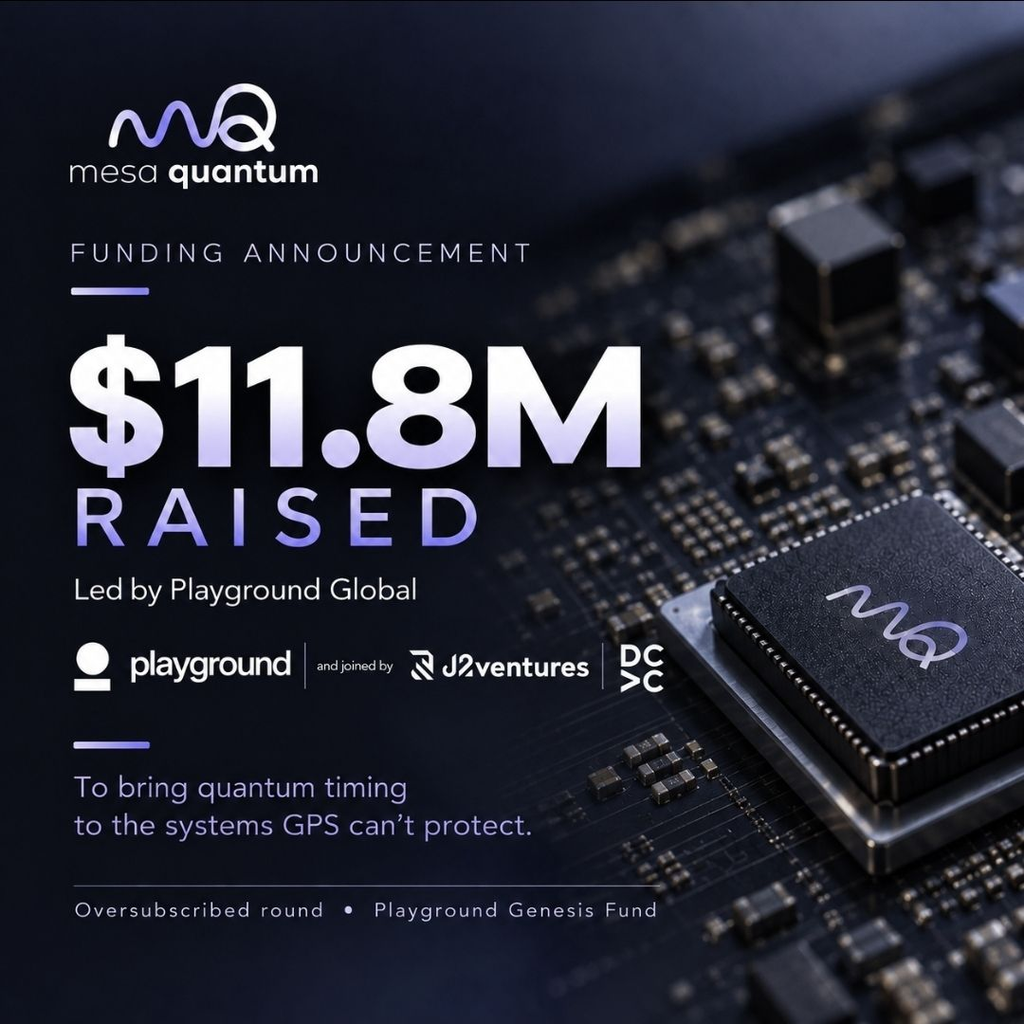
Mesa Quantum Raises $11.8M to Scale Chip-Scale Quantum Sensors and Alternative PNT Infrastructure
Mesa Quantum has raised $11.8 million in funding, led by Playground Global, bringing their total venture funding to nearly $16 million. This capital will accelerate the development and manufacturing of their chip-scale quantum sensors and alternative PNT infrastructure. Their technology, which includes chip-scale atomic clocks and quantum inertial sensors, provides precise timing and navigation independent of GPS, addressing vulnerabilities in satellite-based systems.
-
Infleqtion Achieves 30 Entangled Logical Qubits on Sqale Neutral-Atom Quantum Processor
Infleqtion has achieved 30 entangled logical qubits on its commercial Sqale quantum computing platform, utilizing 80 physical neutral-atom qubits. This breakthrough, announced at Quantum World Congress 2026, was enabled by an AI-assisted logical circuit discovery and software-based loss correction. This positions Infleqtion to scale to 100 logical qubits by 2028 and 1,000 by 2030, with current applications in biomarker discovery.
-
Mphasis and Copa Airlines Partner on Global Quantum Computing Challenge for Airline Disruption Management
Mphasis and Copa Airlines partnered on a global Quantum Computing Challenge, bringing together academic teams to develop quantum optimization solutions for airline passenger re-accommodation during disruptions. The hackathon leveraged quantum algorithms and real operational data to improve efficiency in reassigning passengers while maintaining operational constraints. This initiative is part of Mphasis's broader enterprise quantum software portfolio.
-
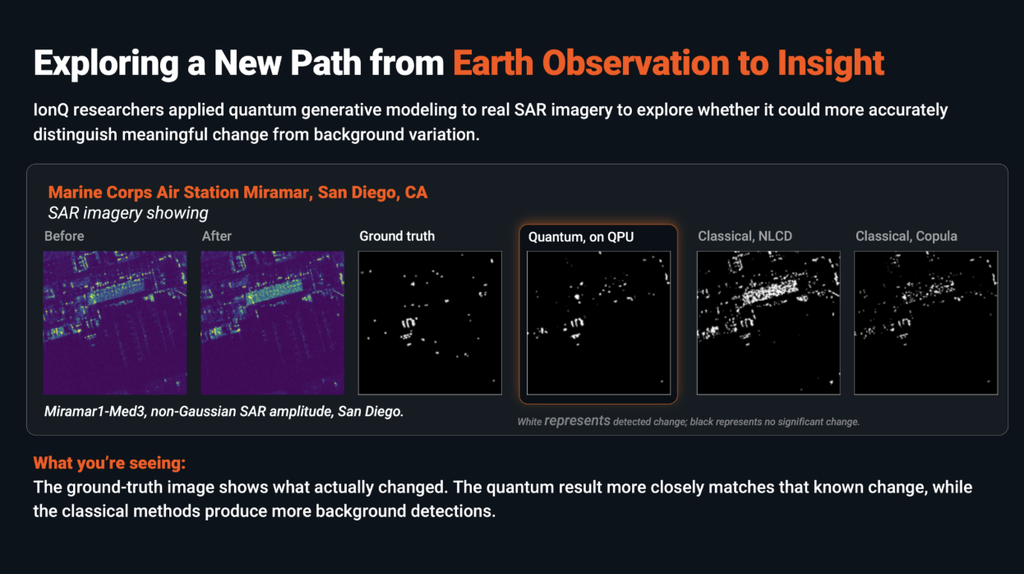
IonQ Demonstrates Quantum Generative Modeling Advantage for High-Resolution Satellite Radar Change Detection
IonQ's research shows that quantum generative machine learning models on their trapped-ion quantum processing units can more accurately detect ground-level changes from satellite radar imagery, especially with high-resolution data causing sparse pixel statistics. Their Quantum Circuit Born Machines (QCBMs) outperformed classical methods in detecting changes at MCAS Miramar Airfield and showed strong generalization capabilities. This advancement has implications for defense, intelligence, infrastructure monitoring, and disaster response.
-
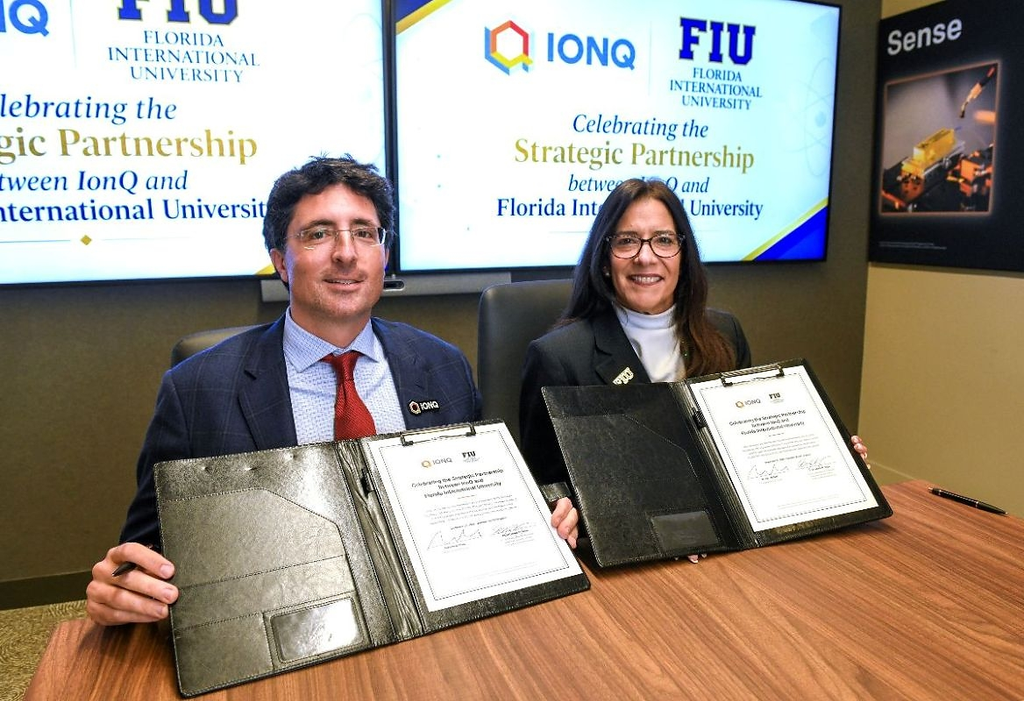
Florida International University Contracts IonQ for On-Premises Superion 256 Trapped-Ion Quantum Computer
IonQ has signed an agreement with Florida International University (FIU) to provide and install an on-premises IonQ Superion 256 trapped-ion quantum computer by late 2027. This makes FIU IonQ's main academic partner in Florida and the first to have a 256-qubit system in the state. The quantum computer will be used for research in various fields, including material science, AI, and cybersecurity, and will be accessible to FIU's faculty, students, and regional partners.
-
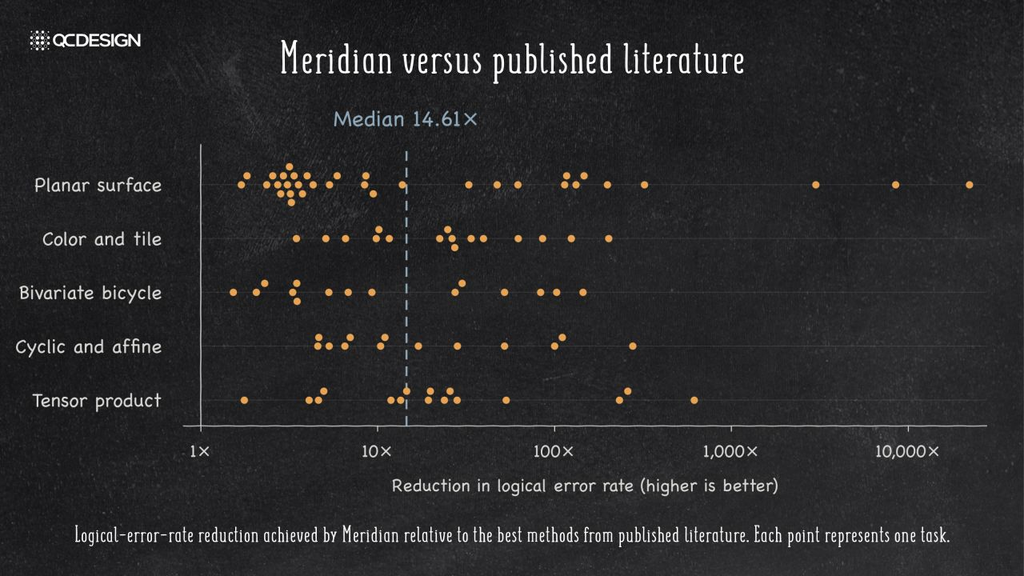
QC Design Unveils Meridian: Purpose-Built AI Architecture System Demonstrates Over 10× Reduction in Logical Error Rates
QC Design has introduced Meridian, an AI-powered platform for optimizing fault-tolerant quantum computing (FTQC) hardware. Meridian has demonstrated a 14.6x median reduction in logical error rates compared to existing methods and a 43% reduction against other frontier AI agents like GPT-6 Astra. This platform aims to accelerate the development of scalable quantum processors by automating multi-layer architectural design.
-
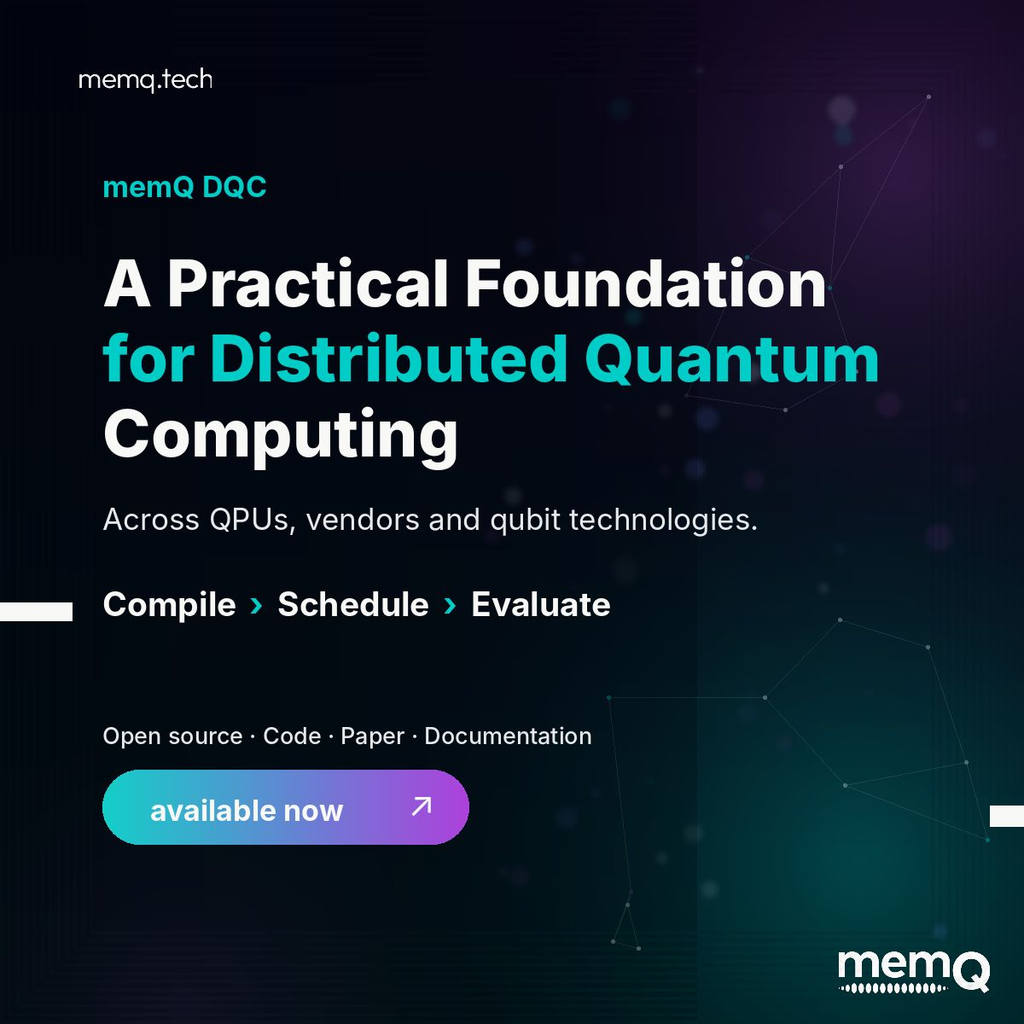
memQ Open-Sources Industry-First Modality-Agnostic Distributed Quantum Compiler (memQ DQC)
memQ Inc. has open-sourced its Distributed Quantum Compiler (memQ DQC), a modality-agnostic software framework for scaling quantum computing across multi-vendor QPU networks. This release aligns with U.S. federal directives and allows developers to model multi-QPU execution and analyze resource trade-offs without manual low-level programming. The toolchain features an interactive Quantum Network Constructor and dynamic partitioning, with accompanying research highlighting the importance of compiler selection based on hardware topology.
-
-
-
Classiq, INGL, and IonQ Advance Quantum Optimization for Natural Gas Transmission Networks
Classiq Technologies and Israel Natural Gas Lines (INGL) have published research on using hybrid quantum-classical optimization for natural gas pipeline networks. Their study, detailed on arXiv (arXiv:2609.00825), demonstrates a Quantum Approximate Optimization Algorithm (QAOA) workflow to maximize gas throughput, validated on the IonQ Forte-1 quantum computer. This approach, which complements existing engineering tools, shows how quantum processors can address complex energy infrastructure challenges.
-
CGI and D-Wave Partner to Commercialize Enterprise Quantum Optimization Across Transportation, Logistics, and Retail
CGI and D-Wave have partnered to bring quantum optimization solutions to enterprises, integrating D-Wave's quantum hardware into CGI's IT services. This collaboration aims to develop quantum-powered applications for complex challenges in transportation, logistics, and retail, leveraging CGI's global reach and D-Wave's annealing quantum technology. The initiative focuses on moving clients from proof-of-concept to full production deployment of hybrid quantum-classical solutions.
-
Global Survey Finds 90% of Quantum Companies Rely on Cross-Border Supply Chains
A global study conducted by various international quantum industry consortia found that 90% of quantum companies rely on cross-border supply chains for hardware and software, with 74% serving international customers. The report, based on data from 160 quantum enterprises across 15 countries, highlights the interconnectedness of the global quantum economy and the challenges this poses for national protectionist trade policies. It emphasizes the need for multilateral frameworks to maintain trusted trade channels while safeguarding sensitive technologies.
-
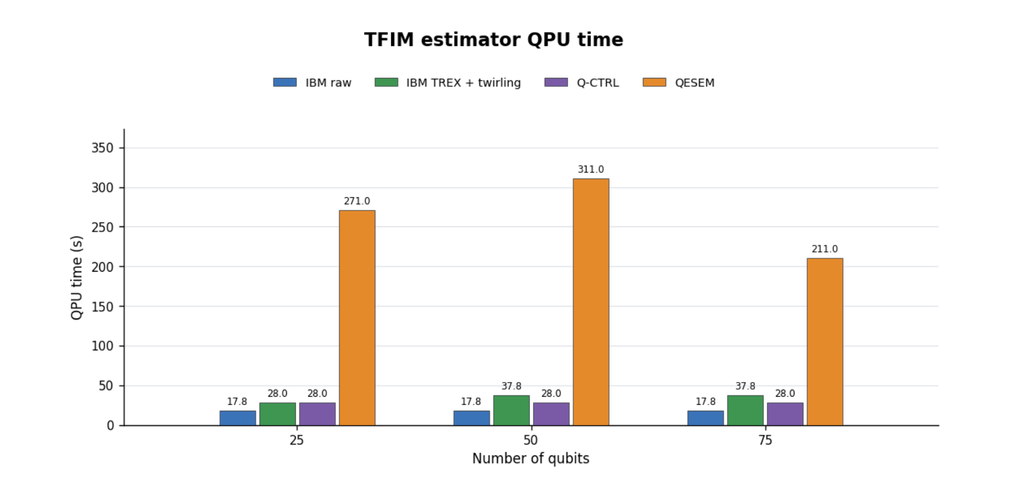
Independent Cross-Stack Benchmark Evaluates Commercial Quantum Error Management on 156-Qubit IBM Heron Hardware
An independent benchmark on IBM Heron hardware evaluated commercial quantum error management tools. Q-CTRL and Qedma QESEM significantly reduced errors compared to IBM's native Qiskit Runtime, with Qedma achieving the highest precision at a higher QPU time cost, while Q-CTRL offered a balance of error reduction and runtime. The study highlights varying resource-accuracy profiles among the tested solutions.
-
Q-CTRL Executes 100-Qubit Quantum Fourier Transform Using Convolutional Compilation Strategy
Q-CTRL has successfully executed the Quantum Fourier Transform (QFT) on up to 100 qubits using a novel Convolutional Compilation Strategy, demonstrating the largest functional QFT on quantum hardware to date. This method eliminates routing overhead on linear nearest-neighbor topologies by leveraging identity cancellations and incorporating an ancilla qubit, resulting in a compact, translation-invariant kernel. The experimental execution on the IBM Heron R3 processor achieved significant process fidelity and consistent signal output, even at 100 qubits.
-
German Government Selects QUDORA-Led Consortium for €122 Million ($138.8 USD) NFQC-1k Trapped-Ion Quantum Computer Project
The German government has selected a QUDORA-led consortium for the €122 million NFQC-1k project to build a fault-tolerant trapped-ion quantum computer with at least 1,000 physical qubits. This five-year initiative aims to establish a semiconductor pilot line for high-performance quantum processing units and is a key milestone under Germany's High-Tech Agenda Deutschland, targeting the deployment of advanced quantum computers by 2030. QUDORA's Near Field Quantum Control (NFQC®) technology will be central to overcoming scaling barriers in quantum computing.
-
IonQ Selected as First On-Premise QPU Deployment at NVIDIA’s Accelerated Quantum Research Center
IonQ's Superion 256 quantum computer will be the first on-premise QPU at NVIDIA's Accelerated Quantum Research Center, integrating with NVIDIA's GB200 NVL72 accelerated computing rack via NVQLink. This collaboration aims to advance quantum-GPU architectures and hybrid software frameworks for applications in finance, materials science, and drug discovery, utilizing IonQ's EQC technology for scalable quantum computing.
-
Photonic Inc. and Microsoft Partner to Advance Quantum Resource Estimation for Distributed Architectures
Photonic Inc. and Microsoft are collaborating to integrate Photonic's distributed quantum computing models and QLDPC error correction algorithms into Microsoft's Quantum Resource Estimator. This partnership aims to provide researchers and developers with a more accurate way to model quantum algorithms for modular, multi-chip quantum computing systems, addressing limitations of current monolithic frameworks. The integration of Photonic's SHYPS QLDPC codes, which utilize optically linked silicon spin qubits, is expected to significantly reduce the physical-to-logical qubit overhead and account for inter-module optical latencies, offering a more realistic assessment of hardware requirements for future quantum applications.
-
Yenepoya University and Edutecnicia Partner to Establish Quantum AI Catalyst Lab in Mangaluru India
Yenepoya University and Edutecnicia (through REYRA AI) have partnered to establish a Quantum AI Catalyst Lab at Yenepoya School of Engineering & Technology (YSET) in Mangaluru. This collaboration aims to advance research, certification, and hardware development in Quantum Computing, Quantum AI, and Quantum-inspired AI, with a focus on creating FPGA-based hardware accelerators and medical AI models. YSET will also offer certification courses in QML and Quantum AI.
-
Cornell Demonstrates First Standing-Wave EIT Cooling for Trapped Ions Supported by Nullspace ES Simulation Software
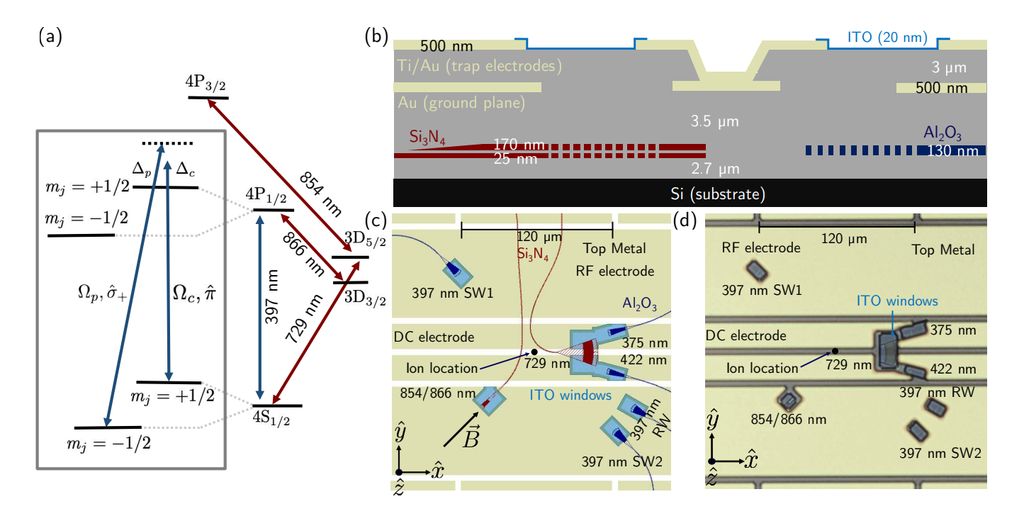
Cornell University researchers have achieved a breakthrough in trapped-ion cooling, using a standing-wave Electromagnetically Induced Transparency (EIT) scheme to cool ions 3.3 times faster than conventional methods. This technique, validated with Nullspace ES electrostatic simulation software, cooled all single-ion motional modes to near the quantum ground state within 150 microseconds. The development significantly reduces a major bottleneck in Quantum Charge-Coupled Device (QCCD) architectures and is supported by an open-source Python package for rapid experimental iteration.
-
Nanjing University Demonstrates Asynchronous MDI Quantum Cryptographic Conferencing with O(η) Loss Scaling
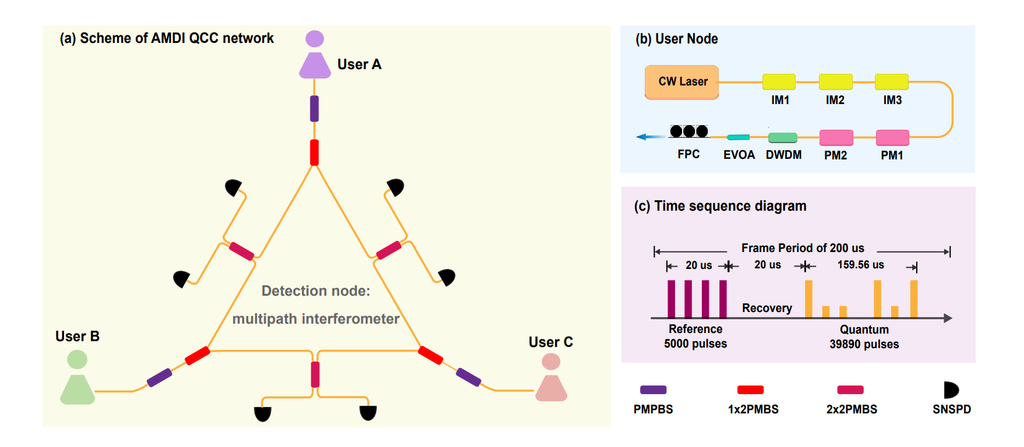
Nanjing University researchers have demonstrated an Asynchronous Measurement-Device-Independent Quantum Cryptographic Conferencing (AMDI QCC) network, achieving a key generation rate with O(η) loss scaling, independent of user number. This innovation significantly enhances loss tolerance and eliminates the need for complex global phase locking, paving the way for scalable multi-party quantum communication.
-
Quantum Computing Inc. Unveils Integrated Quantum Security Platform Combining QKD and Quantum Authentication at ECOC 2026
Quantum Computing Inc. (QCi) unveiled an integrated quantum security platform at ECOC 2026, combining high-dimensional Quantum Key Distribution (QKD) with hardware-based Quantum Identity Authentication (QIA). This platform leverages QCi’s Quantum Zero-Knowledge Proof (QZKP) technology for secure authentication and is compatible with existing telecommunications networks.
-
SK Telecom and KISTI Unveil Standards-Based Digital Twin for Quantum Cryptography Networks at ECOC 2026
SK Telecom and KISTI have developed a digital twin for Quantum Key Distribution (QKD) networks, allowing simulation and verification of network performance before physical deployment. This platform, unveiled at ECOC 2026, uses ETSI standards to connect a Key Management System with a virtual QKD network simulator, enabling cost-effective optimization and multi-vendor interoperability.
-