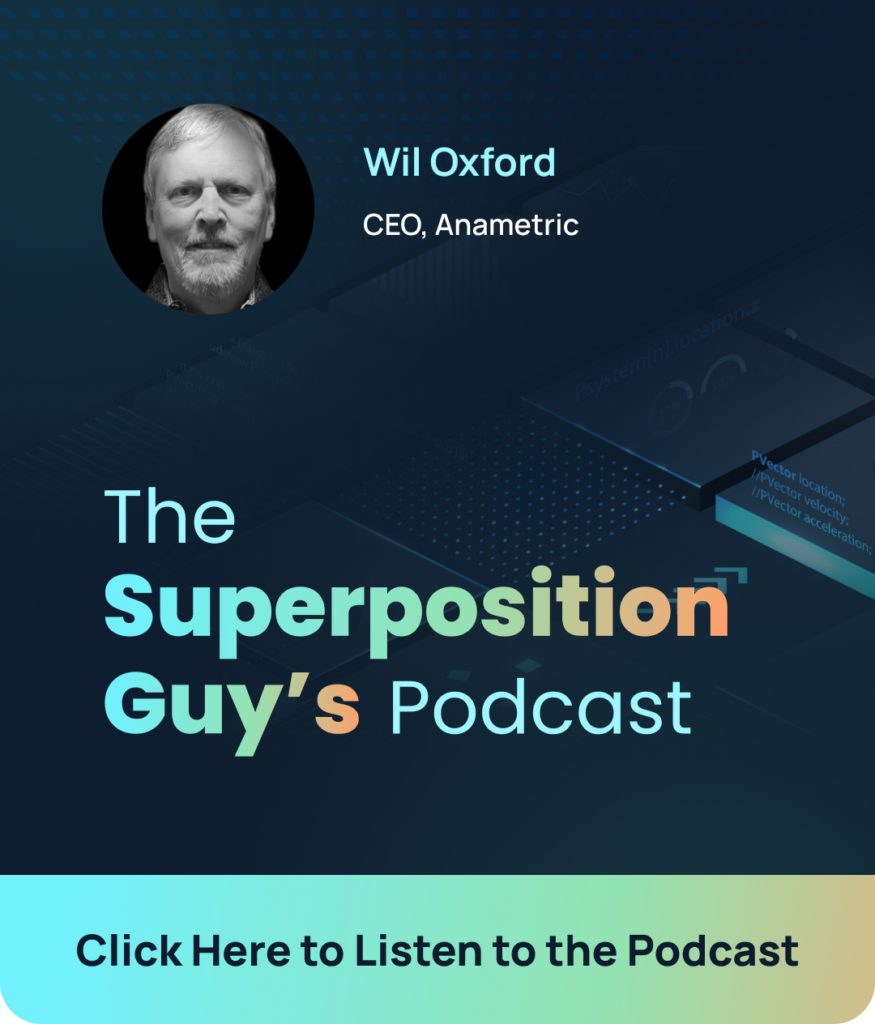
Wil Oxford, founder and CEO of Anametric, a company developing new technologies for chip-scale quantum photonics, is interviewed by Yuval Boger. Wil and Yuval spoke about Anametric’s initial cybersecurity focus, why QKD is not a popular word in Washington DC, why the US Air Force is interested in Anametric’s products, and much more.
Yuval Boger: Hello Wil, and thank you for joining me today.
Wil Oxford: Thanks for having me.
Yuval: So, who are you and what do you do?
Wil: I’m a former architect at Apple computer turned serial entrepreneur. I’m a bit of an anomaly. I love the research side of things, and I’m very academically inclined, but I’m a devout believer in the whole practice of product engineering. So that puts me, in some ways, with a foot on both sides of what is usually a pretty wide divide.
Currently, I’m leading a very talented team that’s pushing the envelope in building truly scalable quantum devices and affordable quantum devices.
Yuval: And these are quantum communication devices, quantum security devices, quantum computers? Which kind of quantum devices are these?
Wil: Well, our initial market is aimed squarely at the security space. I’ve been in the cybersecurity business for probably the better part of 15 years now, and a lot of my cohorts at Anametric are also very experienced in the cybersecurity field. Having said that, what we are building is a foundation. And we’re building a foundation of small, scalable and affordable quantum devices. And in this particular case, that really means that they’re quantum photonics devices. So we’re building things in the quantum photonics realm, and the first application area that we believe very clearly is needed is in the security space.
Yuval: Okay. So what does the device do, to the extent you can tell me?
Wil: All right. So our initial product is based around a quantum core, a quantum random number generator, and it’s photonic, as I’d said. And I can go into a long description of why quantum RNGs are, in fact, necessary, but I’ll just say that that core allows us to then build on top of that layers that allow us to do post-quantum security in a more performant, and frankly, more secure way than a lot of other implementations.
Yuval: Where do photonics come into play? Because quantum random number generators, you could do this as a service, you could have chips that have maybe non-photonic elements that generate random numbers, so where does the photonics come into play?
Wil: Sure. So interesting thing about photonics is that photons are not affected by nearly so many external influences as other quantum effects. So if you look at a quantum diode, basically you’re talking about electrons tunneling across a junction, and if you put a strong magnetic field, for example, around that, then you’re going to bias that action quite heavily. You put a strong enough electrostatic field, the same thing will happen. If you put a really strong magnet next to a photonic emitter, it just ignores it. And so, in a lot of ways, it’s a more secure, more robust, and in fact, lower power way of generating quantum randomness or quantum entropy. So that’s the reason for photonics. One of the reasons for photonics.
I think the other part of it, though, is that if you look at quantum random number generators, one of the things you really want to do is you want to be able to prove that it is, A, operating as you intended. So it’s not generating a bunch of strings that repeat itself, but also you want to have some way, at least, towards a computational quantum element. And that’s another thing that photonics really allows us to do in a more sophisticated way than if you had just a quantum diode that’s useful for generating entropy, but it’s not like a structure that you could use for computation in the future.
Yuval: So you’re describing a device where the output is also optical, so it’s not just optics in light on the inside, but it also emits light. Is that correct?
Wil: That’s right. So we do generate single photons in our chips, and we also detect those single photons in our chips. Ultimately, the input and output are, in fact, electrical. But the mechanism, the quantum effect, is all completely photonic in nature. So when we generate those single photons, we then put them into superposition using a Hadamard gate. Our Hadamard is an order of magnitude, if not more, smaller than every other photonic Hadamard on the planet. And then, we do some other processing on the photons themselves to make sure that we get the right kind of distribution, for example.
So these are all photonic mechanisms, and yes, they are controlled by electronic signals. And ultimately, when we read out the output of the quantum RNG, it is, in fact, an electrical signal, but at that point, it’s a digital signal, and much less susceptible to kinds of interference.
Yuval: At what stage is the product, and who would be the customers, or who are the customers?
Wil: So we’re still relatively early on, we’ve had four generations of chips already in the lab for testing, and we’ve just taped out two more chips that will be back in the lab early next year. We expect to have a fully functional prototype device in the middle of next year. So middle of 2023. Currently, our largest customer is the US Air Force, and we have multi-year contracts with them already underway. We’ve completed one two-year contract already with them. And I think that they are ultimately interested in the longer term, but probably not our shorter term high return customers. So we are still in the process of working to come up with a small number of commercial enterprises that we can sample our devices to, and like I said, we’re expecting to do that in the middle of next year.
Yuval: And would this be phone manufacturers? Would these be creators of security products for networking? Can you give me any sense on that?
Wil: Yeah, so our initial group of customers is in the secure networking space. So basically, if you look at any kind of encryptor device, or a VPN, you’re basically looking to encrypt a transmission so that someone can’t tap into it. And as I mentioned earlier, there’s a post-quantum crypto transition that’s happening in this space, and we’re just at the very beginning of that. Of course, this still hasn’t been finalized, although they’ve come up with the final set of standards, they haven’t issued a standard yet. And so there’s still some room for innovation, if you will, in that space. But having said that, our quantum RNG is designed specifically to feed a post-quantum crypto implementation, an endpoint for that. And so we believe that our implementation of a PQC accelerator, it’s all in one chip, with at its core a quantum photonic device for RNG and for other features, will, in fact, be an industry leader on the day that it’s announced.
Yuval: I think I read someplace that the technology is based on research that was done at SMU.
Wil: That’s right. Yeah. SMU has been a great partner for us from the beginning, actually pre-Anametric days. I mentioned I’ve been in the crypto business for a while. I had previously started a company called Rubicon Labs back in 2007. And as a part of doing that company, I had gone to SMU to basically figure out how I could use their supercomputer, which was sitting around running calibration cycles, frankly. That’s a long story, but the point of it is I met the chairman of the computer science department there. We got along famously, and they completed a great two-year project with us at Rubicon.
At the end of that project, I looked at Mitch, (Mitch Thornton was the professor we were working with), and said, “Mitch, I really like talking to you. So let’s just get together once a month, and let’s just talk and see what happens.” And so we did that, and at the end of one of those monthly conversations, we’d filled a whiteboard, and Mitch looked at me and looked at the other guy in the room and said, “Well, I think it’s time for you to go form another company.” And that was the genesis, actually, of Anametric. So I spun Anametric out of Rubicon Labs in 2017. And Mitch and his team have, from day one, been a great partnership for us. Really wonderful relationship.
Yuval: I’m trying to connect the dots. You mentioned that there’s going to be a post-quantum crypto accelerator chip that’s based on photonics. And then you mentioned that the Air Force is actually interested in something that is going on not right now, but will happen in the future. Is that the same thing, or is this just the first layer of the foundation that you were mentioning earlier?
Wil: Well, it’s a little of both, but I will say that the Air Force is very active in the three major quantum technology areas. Photonics certainly, but also in the Transmon or superconducting qubit area, as well as in Ion traps. And so they have their toes in all those pools. We are working with their Photonics group, not so surprisingly. But in general, what they look for is they’re looking for the same post-quantum transition that everybody else is looking for in the short term. And the simple matter is, if you put a satellite up in GeoSync orbit, it’s $100 million just to get the satellite up to that orbit. Forget about what the cost of the actual satellite is. So if you’re going to spend that kind of money, you want it to have a relatively long lifespan. And by that, I mean 30 years plus.
And if you look at the various people whom you’ve had on your show who talk about what the post-quantum threshold is for when is it going to be absolutely a requirement, then that estimate keeps coming down, and now latest estimates are, “Oh wow, it could be ten years.” And so if you put $100 million satellite up in the air and in 10 years later it’s completely hacked, then it’s probably not a good idea. So if nothing else, good use of taxpayer dollars insists that you must look at post-quantum crypto as a foundational element of future satellites.
So that’s the near term for the Air Force. As suspected, there are other longer-term things, and one of them is quantum networking. That’s another area that we will be active in more so than we are now. Right now, we’re focused solely on getting a product out the door, generating revenue, and that’s really our near-term focus. But longer term, quantum networking is a really big part of where we expect to play. And so it’s really just a very small step from a quantum RNG to taking those photons and sending them off-chip, or bringing external photons on-chip to do the same kinds of processing that we’re already talking about.
So quantum networking, whether you want to talk QKD, which is sort of a no-no word in DC these days, or entanglement distribution, which is a lot more popular, either way, you still need the kinds of structures that we’ve got on our chip. And so that’s our next area of concentration. And then ultimately, of course, everybody’s interested in the quantum computing aspects. We are as well, but we think of that as a much, much longer-term perspective for our little company. Of course, there are others who are looking at it right now.
Yuval: You’ve made me curious, why is QKD a no-no word in dc?
Wil: Well, it’s a long story, and I won’t get into all the exact names and ranks of people involved, but it’s basically, the idea was that, oh gosh, probably four years ago … And I could have the date wrong. The NSA sent out a memo saying, “Hey guys, we find QKD to be non-interesting, and here’s why.” And it gave five reasons, basically. And some of those reasons were absolutely still true today. Some of those reasons are maybe not so true. But the effect was it put a chill on QKD research in this country and on QKD commercialization efforts in this country. And that certainly has had an impact on people coming up through academia and saying, “Oh, if I’m going to get out of school, I’m going to get out of grad school, and I’ve got all these student loans to pay off, I need to find a real job, and it’s not going to be in a company that’s doing QKD.” Now that was years ago, and things have changed a little bit. But having said that, I think it’s good to note that the NSA came back out and said, “Look, we’re not saying that quantum communication is bad. We’re just saying we’ve got these problems we’ve noted with QKD.” So entanglement distribution is definitely a good word, if you will, in DC.
So I’ll finish up with saying two more things, which is in the EU of course, it’s almost the other way around. The EU has definitely been all over QKD, and then they are actively involved. And China, of course, and the interesting thing about China is that they propped up a satellite, the Micius a few years ago, and that immediately was called a Sputnik moment for the US quantum industry. And so whether they intended to do so or not, China basically boosted the US quantum awareness.
Yuval: So, tying revenue that you spoke about earlier, DC, Europe, and China, do you expect to be able to sell your chip outside the US, or do you think they’ll be some strict export restrictions on it?
Wil: We’ve had discussions with people in the export control area, and I think we’re all in agreement that there are certain things that it’s just better if we have open exports.
Now, having said that, there are certain applications where clearly that’s not the case. So what we’ve done with our particular chip, for example, is we have separated the execution environment, if you will, into two areas. So there’s a very deep sandbox, a deep-rooted sandbox in our products. So the low-level quantum part runs code that we write, that we basically are responsible for, and then on top of that will be a system application layer. And so, the application layer is really up to the customer to decide exactly what it is that they want to run. Now we’ll provide our own example product applications if our customers want them. And one of those applications is PQC key exchange. But that doesn’t mean that that’s the only thing you can do with this part.
And so some of our classified customers, for example, want to run their own code on our chip that we have no visibility into, and it’s classified. And that’s just fine with us. We will take suggestions from them as to what it is that they would like functionality-wise, but we don’t have to have any visibility into the actual business of what they’re doing. And that makes a very clean export control division. So we can sell our chip with completely open-sourced even applications, that anybody can use or customize to however they want, but then the things that are classified typically are on the application side, and we don’t have any visibility into that.
Yuval: You mentioned it’s a small chip, but my question is, do you need a large company to build a small chip? How large do you need to become to complete that first product?
Wil: Right. So we’re very small. We’re less than a dozen people overall. But I’d say a good third of us are highly experienced in building silicon. So I started at Apple, gosh, 40 years ago, 35 years ago. And I spent almost 15 years at Apple building chips. And so, at one point, there were about a dozen or so years when every Macintosh that went out the door had one of my chips in it. At least one, if not two. And so even though we are small, we understand what it takes to build chips. And as I mentioned earlier, we are already on our fourth generation part today, and we’re working to close that gap even close between tape-outs, even smaller.
So yes, we’re small, but we are taking advantage of some excellent partners in the silicon space. We’re using the AIM Photonics Foundry up in Albany, New York. This is a foundry that was basically set up by several groups together, but it is a state-of-the-art fab, 300-millimeter fab. And in this same fab, people build, for example, five-nanometer designs. We’re not pushing the envelope nearly so much, but the process technology is the same, and the equipment’s the same. And so we’ve been really lucky to partner with AIM, and it’s been a great partnership for us for at least three years, maybe longer now. And we couldn’t be happier with that.
Eventually, we will move over our design to a more commercial fab, like Global. Several options there. And the great thing about that is we’re designing our chip to be able to be built anywhere. So we’re using 65-nanometer design rules, which are ancient. So what that means, though, is that you can build them pretty much anywhere in the world. And we’re trying our best to make sure that our technology is scalable, not just in the size of the design but also in the process technology. So we can scale down to 45 nanometers, which is one of the more well-known foundry technologies around, and maybe 22, without much effort. Scaling down to five just doesn’t make sense for us. It’s too expensive to build masks for chips these days. You need three billion transistors on a chip.
Yuval: So as we get close to the end of our conversation, I wanted to ask you about dinner. And my question about dinner is if you could have dinner with someone in quantum, dead or alive, who would that person be?
Wil: Oh, no question, Anton Zeilinger. This decision of mine was long before he just got the Nobel Prize, but I find him a fascinating character. I’ve watched a lot of his interviews. I’ve seen some of the specials that have been done on him. I just find him a most incredibly fascinating person, so no question.
Yuval: Fantastic. Well, Wil, how can people get in touch with you to learn more about Anametric and your other work?
Wil: Well, we are still relatively in stealth mode. And by that, I mean we’re open about what we’re working on, but as far as specific details, those are harder to come by. We will open the kimono a little wider in the middle of next year. If you want, you can go to anametric.com, and you’ll see some very generic stuff up there about what it is we’re working on. And if you are interested in learning more, you can send me an email. Just send to info@anametric.com, and it’ll get to me, and we’ll be glad to continue the conversation as appropriate.
Yuval: Excellent. Well, thank you so much for joining me today.
Wil: Thanks for having me.
Yuval Boger is an executive working at the intersection of quantum technology and business. Known as the “Superposition Guy” as well as the original “Qubit Guy,” he can be reached on LinkedIn or at this email.
December 12, 2022
