

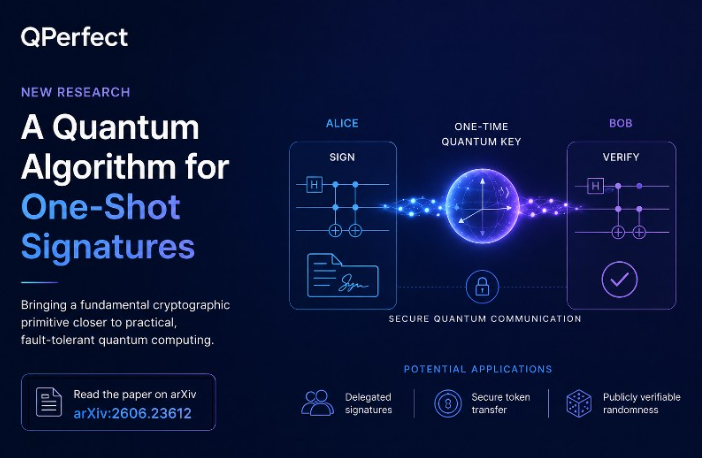
Researchers from quantum software startup QPerfect and cryptographic infrastructure firm BTQ Technologies have published a joint preprint on arXiv detailing the first concrete, circuit-level implementation of a One-Shot Signature (OSS) scheme. The breakthrough bridges the gap between abstract cryptographic theory and executable quantum circuits, providing explicit logical resource estimates and structural parameter matrices. The architecture operates within a “local quantum cryptography” framework, a hybrid model that requires no quantum internet. All network communication between external nodes remains entirely classical, while the cryptographic keys are physically bound to a fragile, uncloneable local quantum state that self-destructs upon measurement, enforcing strict single-use execution.
The quantum key generation layer bypasses the resource-intensive, deep binary structures described in legacy protocols. Instead, the authors apply a global Hadamard matrix transform directly to a uniform superposition, routing the outputs into a Puncturable Pseudorandom Function (PPRF). To map this primitive into an executable circuit without leaking the secret master key, the compiler relies on a Goldreich-Goldwasser-Micali (GGM) tree traversal mechanism. This traversal is modeled as a space-efficient, reversible pebble game that caches intermediate tree nodes to reduce logical qubit overhead. Once a leaf key is resolved using a lightweight block cipher like Simon or Present, the system initializes a uniform affine coset. To translate raw pseudorandom bitstreams directly into hardware-executable linear-algebraic operators, the team introduced a novel quantum subroutine based on the mathematical principles of Bruhat decomposition, which systematically factors matrices into specialized products using a minimal sequence of controlled-SWAP and Toffoli gates.
The signing phase leverages the physical constraints of the no-cloning theorem and measurement-induced state collapse to ensure single-use execution. When signing a multi-bit message string, the traditional iterative method requires deep, sequential bit-flipping circuits that accumulate significant error margins. The QPerfect and BTQ team resolved this by engineering a global signing approach. The algorithm executes a simultaneous computational basis measurement across the message qubits of the state. If the measured bitstring does not align with the target message, a global translation operator is applied across the entire register. This operator applies the Fourier shift theorem via a dual-space phase oracle to account for displacements across all message dimensions simultaneously, injecting a precise phase-kickback. When the subsequent global Hadamard layer projects the registers back, this phase adjustment automatically shifts the first register to the target message state while maintaining the uniform superposition of the remaining qubits. The signer then measures the remaining lines to extract the finalized classical signature, instantly destroying the fragile quantum key state.
To shield the underlying algorithms from reverse-engineering and quantum polynomial-time forgery attacks, the architecture introduces a dual-layered program obfuscation paradigm. For the classical component, the authors demonstrate that the master key can be completely masked using a fully succinct Indistinguishability Obfuscation (iO) framework. This split-description syntax proves that the size of the obfuscated program scales solely with the secret key data, remaining independent of public inputs and bounding code security to Learning With Errors (LWE) hardness assumptions. For the quantum component—where the Hadamard layers and phase-kickback oracles operate—the paper identifies a critical requirement for forward-looking quantum state obfuscation and unitary circuit cloaking. By establishing these explicit boundaries, the research provides a strategic blueprint for deploying trustless random beacons, secured token transfers, quantum money networks, and delegated signatures onto future fault-tolerant quantum coprocessors.
The full algorithmic proofs, decomposition circuits, and resource compilation charts can be analyzed in the complete technical paper, A quantum algorithm for one-shot signatures, available on the arXiv repository here. Corporate alignment notes, ecosystem integration targets, and peer milestones can be tracked via the QPerfect LinkedIn Engineering Feed here and reviewed through the BTQ Technologies Acquisition Announcement here.
In GQI Portal
The players behind the news
The team that writes QCR tracks every company, deal and technology in the GQI Factory, GQI's verified database of the quantum industry. Next up: every story linked to its players, coming to QCR's paid plans.
- Players Companies and institutions across the quantum industry, by segment.
- Scorecards How the players compare on hardware, software, funding and more.
Newsletter
QCR Alerts in your inbox
The latest reporting and analysis from Quantum Computing Report. Free, unsubscribe any time.