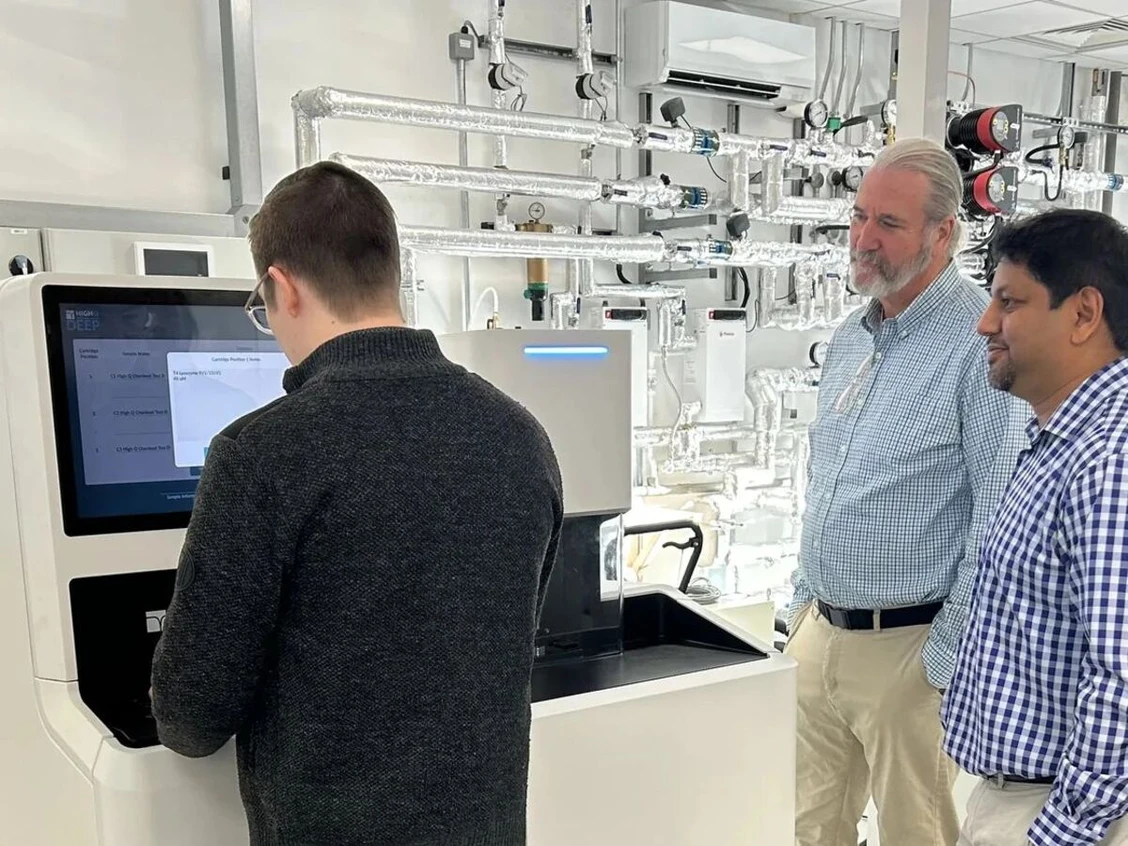
Waterloo, Ontario-based startup High Q Technologies has announced a global commercial partnership with Creative Biostructure, a Shirley, New York-based contract research organization (CRO) managing over 3,000 customers across 60 countries. Supported by Canada’s National Quantum Strategy, the collaboration integrates High Q’s quantum-enabled electron paramagnetic resonance (EPR) spectroscopy platform, FATHOM, directly into the global CRO workflow to map moving, flexible, and disordered protein building blocks with nanoscale precision.
                         [ High Q & Creative Biostructure Framework ]
  Hardware Lead       ──► High Q Technologies (University of Waterloo spinoff).
  Quantum Core        ──► FATHOM (Pulsed EPR spectrometer running superconducting sensors).
  Distribution Lead   ──► Creative Biostructure (Outsourced structural biology CRO).
  Analytical Target   ──► Characterizing protein conformational motion & dynamic equilibria.
  Public-Private Backing─► FedDev Ontario, Strategic Innovation Fund, & Quantum Valley Investments.
Resolving Dynamic Conformational Ensembles via Superconducting Sensors
Traditional biophysical structural determination methods—such as Cryo-EM, Nuclear Magnetic Resonance (NMR), and X-ray crystallography—typically capture static “snapshots” or the most statistically dominant, common configuration of a protein. However, biological functionality lives in dynamic motion; as proteins interact with foreign molecules, they flex, twist, and reconfigure.
For intrinsically disordered proteins (IDPs) like amyloid-β and tau, which are heavily implicated in Alzheimer’s disease pathology, their fluctuating behavior makes them virtually invisible to static imaging panels.
High Q Technologies addresses this analytical gap through its FATHOM platform, the world’s first commercially available quantum-enabled pulsed EPR spectrometer.
- Superconducting Quantum Resonators: By replacing classical electromagnetic assemblies with high-sensitivity superconducting quantum-sensing resonators, the instrument can capture all co-existing configurations at once.
- Nano-Scale Measurement: The system functions as a precise atomic ruler, utilizing paramagnetic spin labels to calculate point-to-point distance probability distributions across fluid conformational ensembles.
- Streamlined Workflow Automation: Traditional EPR instruments required dedicated quantum physicists to tune, calibrate, and guess parameters over weeks-long testing cycles. FATHOM achieves automated “walkaway” operation through multi-sample cartridges, reducing experimental acquisition timelines from weeks to hours without demanding in-house EPR expertise.
Optimizing the Pharmaceutical Simulation Pipeline
By embedding this hardware within an established, high-profile CRO framework, the partnership targets the ultimate bottleneck in therapeutic validation. Beyond acting as a standalone diagnostic system, the FATHOM platform is increasingly utilized as an automated pre-screening tool.
Pharma developers can use the compact quantum spectrometer to rapidly verify and validate sample quality, computational AlphaFold structural predictions, or point-to-point distance constraints before spending expensive, highly competitive time on high-end, room-sized Cryo-EM microscopes. This targeted data tier significantly drops development overhead while ensuring that only perfectly optimized samples enter the final verification phase.
High Q Technologies’ operational scale has been heavily subsidized by Canadian public-private innovation infrastructure, including early ecosystem support from the University of Waterloo’s Transformative Quantum Technologies accelerator and private backing from Quantum Valley Investments.
Federally, the company received $6.5 million in non-dilutive capital through the Strategic Innovation Fund in 2018, followed by a recent $3.75 million commercialization award in 2024 through the Federal Economic Development Agency for Southern Ontario (FedDev Ontario) via the Regional Quantum Initiative. With initial installations already operating at academic structural biology partner labs across Canada, the U.S., and the UK, High Q plans to ship its first commercial systems directly into mainland Europe in the coming months.
Track the regional deep-tech market profile and view full system hardware testing photographs via the Financial Post Feature here. For a deeper dive into the specific enterprise workflow guidelines, contract research consulting mechanics, and the underlying biophysical validation steps of this rollout, review our original comprehensive analysis here.
July 15, 2026
