
Author: Mohamed Abdel-Kareem
-
-
IonQ Announces Pricing of $2.0 Billion Equity Offering Purchased by Heights Capital Management
IonQ announced a $2.0 billion equity offering purchased by Heights Capital Management, consisting of common stock and pre-funded warrants priced at a 15% premium. The deal also includes seven-year warrants for additional shares at a 100% premium. IonQ plans to use the capital to accelerate the commercialization and deployment of its quantum platform.
-
EigenOrbit Releases Open-Source eigenkit 1.0 for Multi-Backend Quantum Execution
EigenOrbit has released eigenkit 1.0, an open-source Python library. It allows quantum algorithms to be written once and executed across multiple simulators and hardware backends without code modification. The library integrates with various classical simulators and QPU hardware access points, including machine learning and cost tools.
-
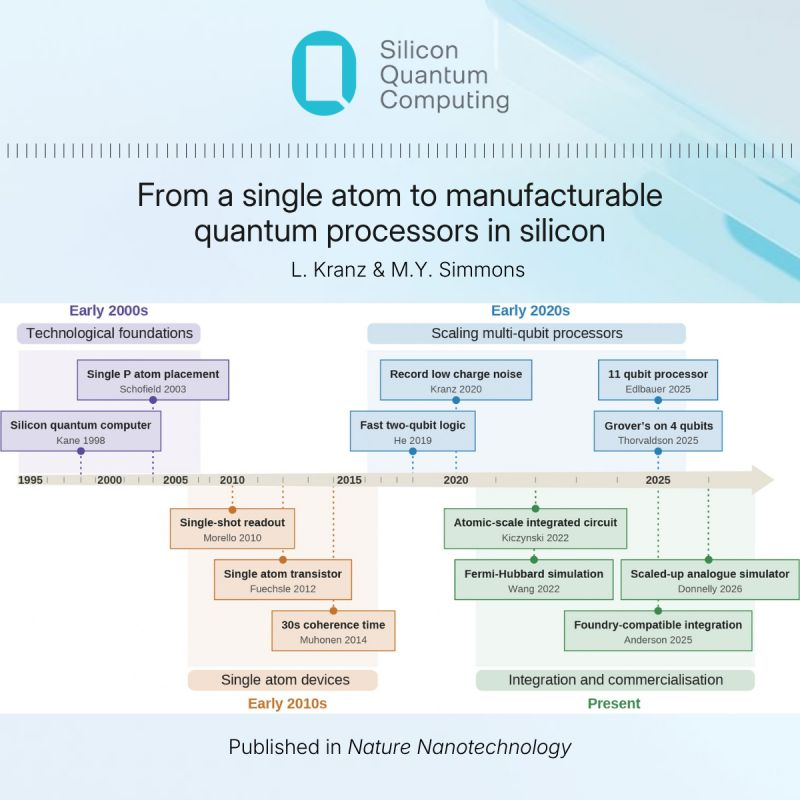
Silicon Quantum Computing Traces 25-Year Roadmap to Atomic-Precision Manufacturing in Nature Nanotechnology
Silicon Quantum Computing (SQC) has detailed a 25-year roadmap in Nature Nanotechnology for developing atomic-scale processors. The article traces the evolution of phosphorus-in-silicon quantum processors from single-atom transistor demonstrations to commercial atomic-scale products. Key milestones include the development of automated atomic-precision fabrication, achievement of high single-qubit gate fidelities and coherence times, and the deployment of commercial analog simulators.
-
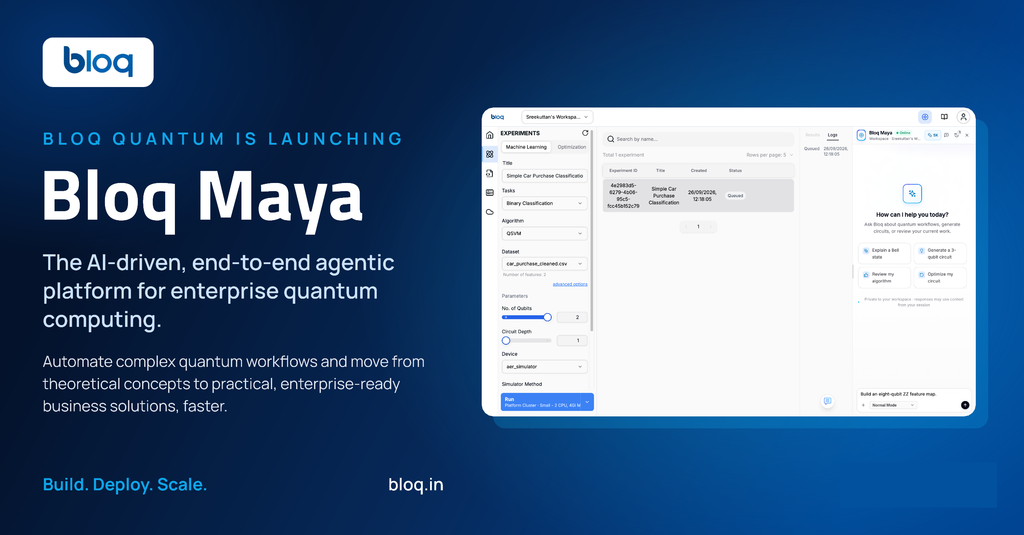
Bloq Quantum Launches Bloq Maya AI Agent to Streamline Enterprise Quantum Algorithm Development
Bloq Quantum has launched Bloq Maya, an agentic AI assistant that streamlines enterprise quantum algorithm development. It automates circuit design, algorithm formulation, and code generation, converting high-level requirements into executable quantum code and models. Bloq Maya aims to reduce development timelines for corporate R&D across various industries.
-
SkyWater and D-Wave Extend Quantum Manufacturing Partnership Through Multi-Year Agreement
D-Wave Quantum Inc. and SkyWater Technology have extended their quantum manufacturing partnership through a multi-year agreement. This collaboration ensures SkyWater's continued support for D-Wave's quantum hardware development, including the production of its Advantage2 processors and future quantum annealing and gate-model quantum computers. Additionally, D-Wave's quantum annealing algorithms have been applied to optimize SkyWater's operational workflows, reducing fab maintenance lot delays by up to 30%.
-
Alice & Bob Demonstrates GPU Decoding for LDPC-Cat Codes via NVIDIA NVQLink
Alice & Bob has demonstrated the GPU decoding of their LDPC-cat quantum error correction architecture using NVIDIA GPUs and the NVQLink system. This allows for microsecond-scale communication between quantum control systems and classical GPU supercomputers, enabling real-time error correction. The LDPC-cat architecture utilizes cat qubits and 2D LDPC codes to achieve low logical error rates for quantum computing.
-
Infleqtion Secures £9 Million ($12 Million USD) Innovate UK Award to Transition Rydberg Quantum RF Sensing to Operational Deployment
Infleqtion has secured a £9 million Innovate UK award to advance its Quantum Radio Frequency (QRF) direction-finding system, Quantum Spectrum-DF. This funding, part of the Quantum Missions Primer program, supports the transition of the Rydberg-atom-based system from prototype to operational deployment. Developed with Leonardo, the technology uses optical techniques for broadband, passive direction finding, offering a compact alternative to traditional antenna arrays for defense and infrastructure security.
-
Qilimanjaro Secures €19.6 Million ($21.9 Million USD) Series A First Close to Industrialize Multimodal Fluxonium Systems
Qilimanjaro Quantum Tech secured €19.6 million in Series A funding from Indra Group and SETT to industrialize multimodal fluxonium quantum systems. This investment will accelerate manufacturing, chip fabrication, and commercial deployment of their quantum platforms, which utilize fluxonium superconducting qubits for improved performance. The funding also highlights growing European defense interest in quantum-accelerated AI and secure communications.
-
-
-
Swinburne University and IQM Partner to Advance Quantum Ecosystem in Australia and Europe
Swinburne University of Technology and IQM Quantum Computers have partnered to advance quantum science and technology across Australia, Europe, and the Indo-Pacific. This collaboration will focus on workforce development through joint training and internships, technology translation via co-development of quantum applications, and international exchange programs for researchers and students. The partnership aims to bridge Swinburne's research with IQM's commercial expertise in superconducting quantum systems.
-
Google Quantum AI Introduces Virtual Error Cancellation for Universal Logical Circuits
Google Quantum AI has developed Virtual Error Cancellation (VEC), a classical post-processing technique that significantly reduces logical errors in fault-tolerant quantum circuits. VEC uses a dual-decoder approach, combining a fast real-time decoder with a high-accuracy offline decoder, to reweight experimental outcomes and suppress logical error rates by over 1,600-fold. This method offers a more efficient alternative to previous error mitigation techniques, with a significantly lower sampling overhead.
-