Author: Mohamed Abdel-Kareem
-
-
Rice University Researchers Engineer Tunable Finite-Temperature Reservoirs in Trapped-Ion Quantum Simulators
Rice University physicists have engineered a new method for creating tunable finite-temperature reservoirs in trapped-ion quantum simulators. This breakthrough allows for precise control over both temperature and dissipation rates, enabling realistic simulations of complex open-system quantum phenomena like chemical reactions and exciton dynamics. The technique balances laser cooling with controlled electric-field heating, overcoming previous limitations to provide continuous temperature control and opening new avenues for understanding thermally activated quantum processes.
-
Tamil Nadu Secures MoUs with Four Quantum Computing Ventures at Vetri Conclave
At the Vetri Tamil Nadu Investment Conclave 2026, the Government of Tamil Nadu signed MoUs with four quantum technology firms, establishing operational bases, R&D centers, and manufacturing facilities across the state. These agreements aim to boost India’s regional quantum hardware and software ecosystem, with key projects including superconducting quantum hardware development, control electronics manufacturing, and hybrid quantum system integration. This initiative is part of a larger investment drive, securing over ₹67,000 crore ($8.0B USD) across various advanced technology sectors.
-
Mountain West Regional Quantum Alliances Form Unified Innovation & Test Facilities Network
Innosphere, representing the NSF ASCEND Engine, along with the Montana Photonics and Quantum Alliance (MPQA) and the Headwaters Tech Hub (HTH), have formed a unified Mountain West technology and testing network. This collaboration aims to accelerate the commercialization of advanced sensing, quantum optics, and photonics technologies by coordinating testbed access, venture accelerator programs, and commercialization pipelines across Colorado, Wyoming, and Montana. The initiative solidifies the Rocky Mountain corridor as a national hub for quantum optics and sensing.
-
Florida State University Launches Florida’s First Graduate Certificate in Quantum Information Science & Technology
Florida State University has launched Florida’s first Graduate Certificate in Quantum Information Science & Technology (QIST), an interdisciplinary 14-credit-hour program accepting applications until October 1, 2026, for its Spring 2027 cohort. The program, administered by the FSU Quantum Initiative, will train graduate students and industry professionals in quantum materials, low-temperature device packaging, and quantum algorithm design, leveraging FSU’s research facilities and industry partnerships to build a skilled workforce for Florida’s tech sector.
-
Mitsui & Co. and Mitsubishi Electric Benchmark Approximate and Logical QFT on Quantinuum Helios
Mitsui & Co. and Mitsubishi Electric benchmarked Quantum Fourier Transform (QFT) on Quantinuum’s 98-qubit Helios quantum computer, executing both approximate QFT on up to 98 physical qubits and logical QFT with Steane code on up to 12 logical qubits. The study evaluated hardware scaling, algorithmic utility, and error correction trade-offs, finding that error detection achieved higher logical target-state probabilities despite reduced shot acceptance rates. They also compared direct analog rotations with fault-tolerant code-switching for logical T-gate implementation, highlighting the current overheads of full fault-tolerant gate construction.
-
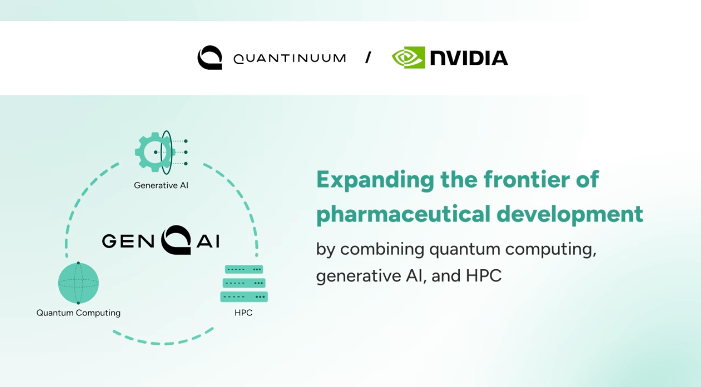
Quantinuum, NVIDIA, and Pfizer Validate Generative Quantum AI (GenQAI) Framework for Pharmaceutical R&D
Researchers from Quantinuum, NVIDIA, and Pfizer have developed a Generative Quantum AI (GenQAI) framework that significantly accelerates quantum circuit synthesis for pharmaceutical R&D. This framework, utilizing the ADAPT-GQE model, combines classical computing, generative transformer models, and quantum processing units to efficiently compute ground-state preparation circuits for complex molecules like imipramine. This approach bypasses iterative calculations and achieves a 3 to 4 orders of magnitude speedup in circuit generation, demonstrating the feasibility of AI-driven quantum algorithm generation on commercial QPUs.
-
EPFL Integrates Quantinuum Trapped-Ion Cloud Access into SCITAS HPC Platform
EPFL has partnered with Quantinuum to integrate cloud-based access to Quantinuum’s trapped-ion quantum computers directly into its SCITAS high-performance computing platform, making it the first Swiss academic institution to do so. This collaboration enables EPFL researchers and students to execute quantum algorithms and simulations without external workflows, fostering advancements in quantum computing research and education.
-
Quanta Computer and Quantinuum Partner to Industrialize Fault-Tolerant Trapped-Ion Hardware Manufacturing
Quantinuum and Quanta Computer have partnered to industrialize the manufacturing of Quantinuum’s trapped-ion quantum computers. This collaboration will leverage Quantinuum’s QCCD architecture and Quanta’s manufacturing expertise to create standardized, mass-producible quantum hardware, moving from custom-built systems to enterprise IT hardware. The focus is on scaling physical hardware assembly, stabilizing the supply chain, and developing scalable production systems to achieve fault-tolerant, megaquop-class quantum systems.
-
-
-
DARPA Awards Contract to Qunnect to Advance Real-Time Polarization Compensation for Quantum Networks
DARPA has awarded Qunnect a contract to advance their real-time polarization compensation module, a key component of their Carina™ entanglement distribution system. This initiative, part of DARPA’s QuANET program, aims to improve the stability and resilience of quantum networks by counteracting polarization drift in optical fibers caused by environmental factors. Qunnect’s technology, already deployed in several cities, is crucial for connecting distributed quantum processors, sensors, and secure communication systems.
-
T-SQUARED Begins Construction on Infleqtion’s Quantum Innovation Centre in Oxford
T-SQUARED has begun construction on Infleqtion’s new Quantum Innovation Centre at Oxford Technology Park, which will triple the capacity of Infleqtion’s UK operations. This expansion will enhance research, manufacturing, and systems integration for neutral-atom quantum computing, sensing, and precision timing. The facility builds on Infleqtion’s decade of UK operations, including deploying the country’s first 100-qubit quantum computer and sea trials of its Tiqker™ optical atomic clock.
-