
News
Company, funding, product and policy news from across the quantum industry, as it happens.
-
-
IonQ, ORNL, NVIDIA, and UT Knoxville Advance AI-Driven Generative Quantum Circuit Synthesis
A collaboration between ORNL, IonQ, NVIDIA, and UT Knoxville introduced DQAOA-GPT, a generative AI framework that synthesizes quantum optimization circuits, eliminating iterative parameter-tuning. This framework significantly reduces circuit synthesis runtime to a constant 28 seconds and doubles solution quality for higher-order unconstrained binary optimization (HUBO) problems, as presented at IEEE Quantum Week 2026. DQAOA-GPT replaces traditional trial-and-error with a transformer model trained on high-performing circuit profiles, allowing hybrid algorithms to scale subproblem sizes efficiently.
-
Oxford Quantum Circuits and Trust Base Benchmark Hybrid Quantum Workloads for Financial Risk Modeling
Oxford Quantum Circuits (OQC) and Trust Base benchmarked hybrid quantum workloads for financial risk modeling, evaluating classical, hybrid quantum-classical, and fault-tolerant quantum algorithms for tasks like derivative pricing and Value-at-Risk. The study found that while Quantum-compressed Physics-Informed Neural Networks (QPINNs) showed parameter efficiency, classical PINNs offered better runtimes and stability. Optimizations like Quantum Signal Processing (QSP) could significantly reduce resource requirements for Quantum Monte Carlo, and improved hardware error correction thresholds could drastically cut the physical qubit footprint for fault-tolerant quantum computing.
-
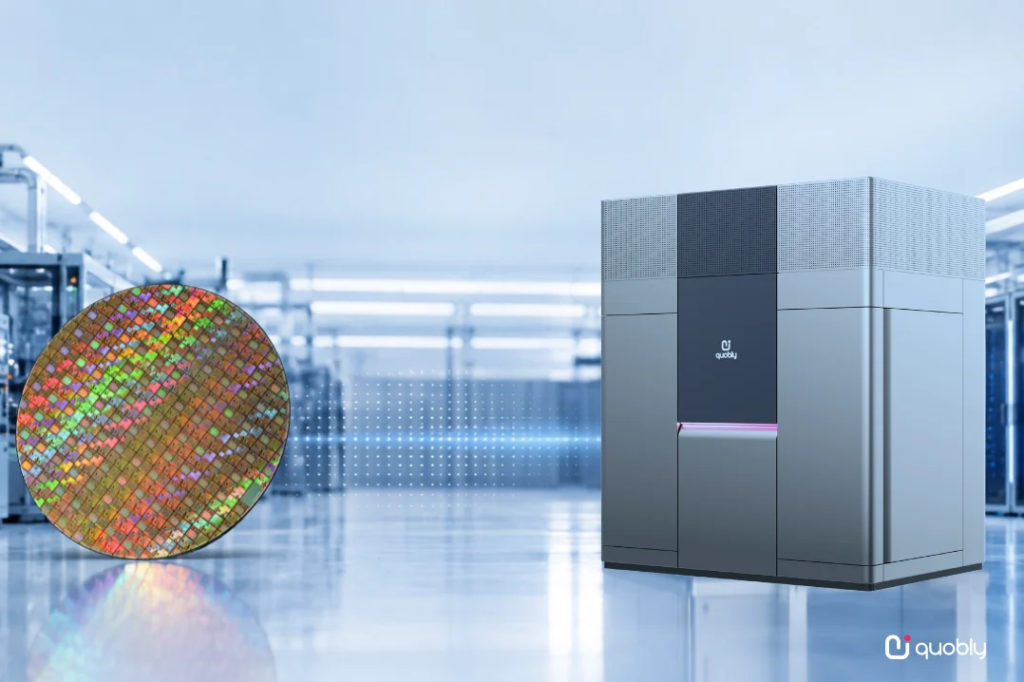
Quobly Demonstrates Single-Chip Readout and Gates on 300mm Industrial Silicon Process
Quobly has successfully demonstrated single-chip execution of qubit readout, single-qubit gates, and two-qubit gates on its QSOI® architecture, fabricated on an industrial 300mm silicon process at STMicroelectronics. This achievement validates their technology transfer strategy, allowing co-integration of quantum and classical circuitry. With plans for cloud access to their Alloy Pioneer system by late 2026 and a long-term target of one million qubits by 2032, Quobly is advancing its commercial and scaling roadmap, supported by significant Series A funding and strategic partnerships.
-
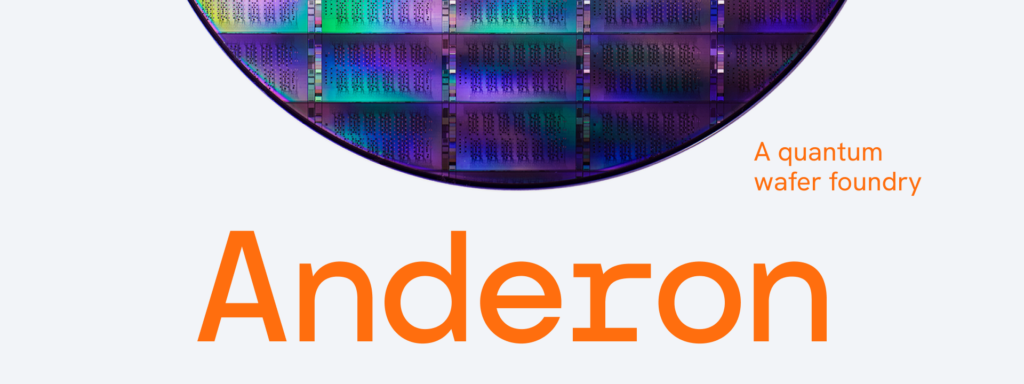
Anderon Finalizes $1 Billion CHIPS Act Award to Scale 300mm Pure-Play Quantum Wafer Foundry
Anderon LLC, an IBM subsidiary, secured $1 billion in CHIPS Act funding, supplemented by another $1 billion from IBM, to expand its 300mm pure-play quantum wafer fabrication facility at Albany NanoTech. This investment aims to scale production of superconducting qubit arrays and other quantum components, addressing QPU scaling bottlenecks and strengthening domestic microelectronics supply chains. The facility will serve as an open commercial foundry for the global quantum hardware ecosystem.
-
-
-
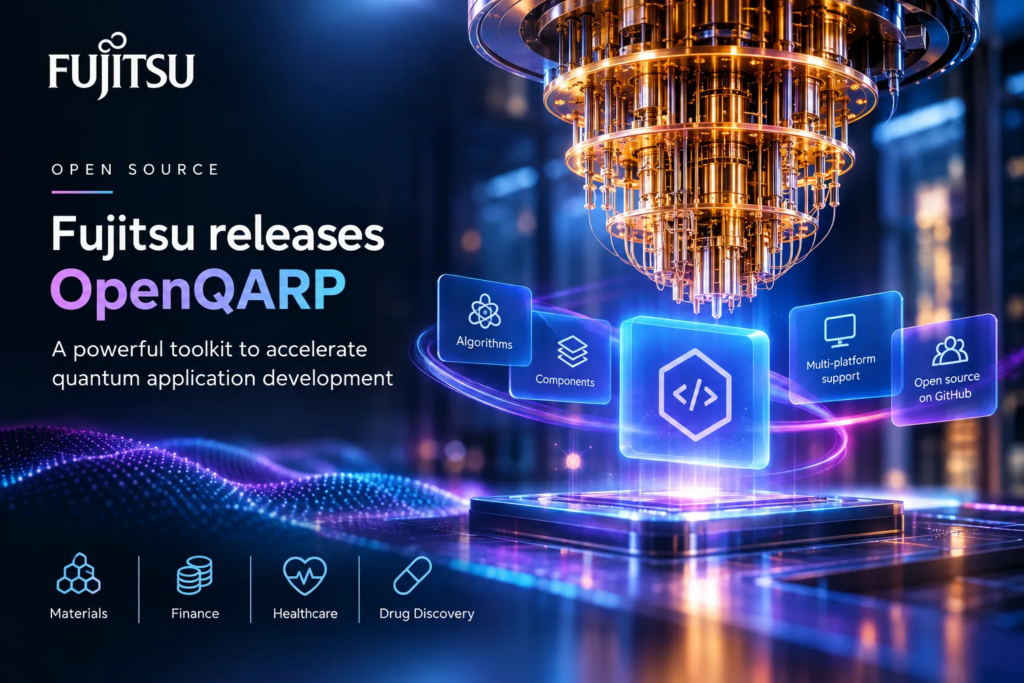
Fujitsu Open-Sources OpenQARP Framework to Streamline Quantum Application Development
Fujitsu has open-sourced OpenQARP, a quantum application development framework, under the Apache License 2.0. Available on GitHub, it offers over 100 modular software components to simplify NISQ and FTQC application workflows, potentially reducing code volume by up to 70%. The library includes Fujitsu-developed algorithms for various quantum computing tasks and supports execution across Python, NVIDIA CUDA-Q, and Fujitsu's 40-qubit simulator.
-
ParityQC Launches Parity Twine Optimizer via IBM Qiskit Functions Catalog
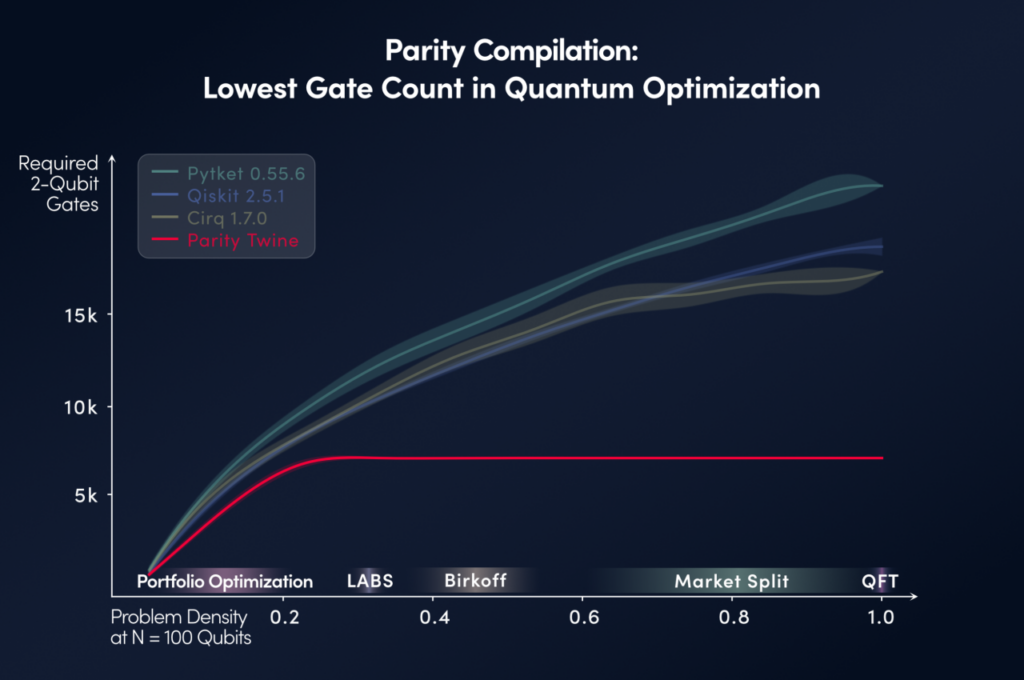
ParityQC has launched the Parity Twine Optimizer, a new compiler available through the IBM Qiskit Functions Catalog. This technology aims to improve quantum computing by natively mapping optimization problems to quantum hardware, thereby eliminating classical SWAP gate overhead and reducing circuit depth. It supports various hardware topologies and offers a 30-day free trial for IBM Quantum Network members.
-
Emergence Quantum and AirTrunk Partner to Develop Hyperscale Cryogenic Data Center Infrastructure
Emergence Quantum and AirTrunk have partnered to develop hyperscale cryogenic data center infrastructure, aiming to overcome physical scaling bottlenecks in high-density AI and HPC workloads. This collaboration will focus on engineering integrated, campus-scale cryogenic cooling infrastructure to support sub-100 Kelvin classical CMOS logic, superconducting interconnects, and fault-tolerant quantum computing. The initiative will also explore liquid air cooling and energy storage, with the goal of creating a commercial blueprint for "quantum-ready" hyperscale facilities.
-
Quantum Computing Inc. Signs Three-Year Framework Agreement with Hamad Bin Khalifa University for Middle East QPU Deployment
Quantum Computing Inc. has signed a three-year agreement with Hamad Bin Khalifa University in Qatar, focusing on quantum computing, sensing, and communications. This partnership will establish a Dirac-3 Entropy Quantum Computer in Qatar, offering cloud access and on-premises hardware for advanced optimization problems. The collaboration aims to foster joint research, workforce training, and regional technology deployment across the Gulf Cooperation Council.
-
TOYO Corporation Acquires Second On-Premises IQM System to Open Dual-QPU Testbed for Japan’s Ecosystem
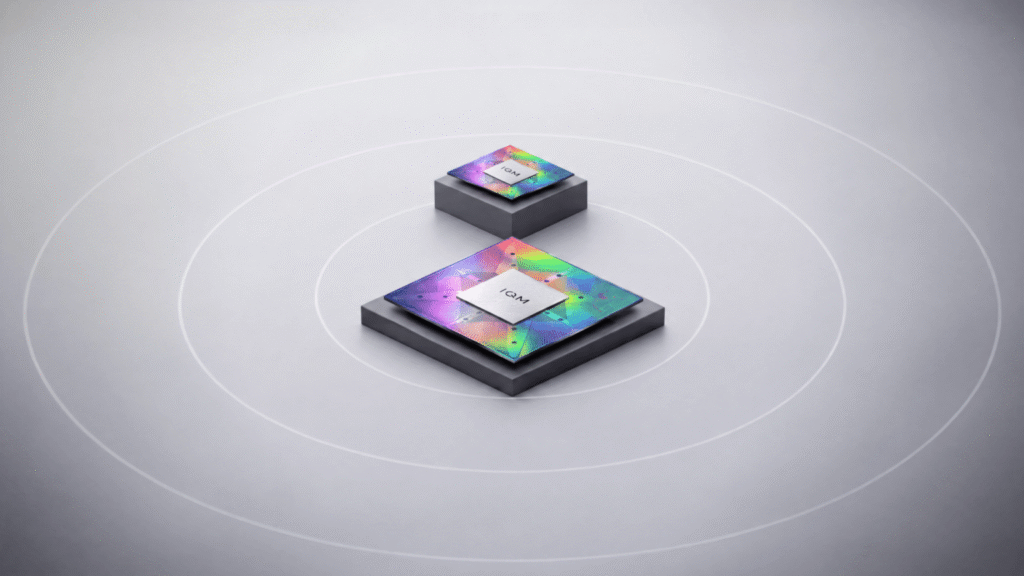
TOYO Corporation has expanded its quantum hardware by acquiring an IQM Spark (5-qubit) in addition to its previous order of a 20-qubit IQM Radiance processor from IQM Quantum Computers. These systems, expected to be operational by early 2027, will establish a dual-QPU testbed in Japan, offering open access to universities, startups, and industrial researchers to advance quantum technology and achieve national strategic targets.
-
NVIDIA Unveils CUDA-Q Logical to Accelerate Fault-Tolerant System Orchestration Across Hardware Modalities
NVIDIA has launched CUDA-Q Logical, an extension to its open-source accelerated quantum computing platform, aimed at accelerating fault-tolerant quantum computing by unifying the design of high-level algorithms, quantum error correction codes, and QPU micro-architectures. This framework, detailed in a new research publication, allows for direct derivation of full-stack resource estimates and has shown significant speedups in fault-tolerant system resource modeling at national laboratories like Fermilab. The release coincides with wide adoption of NVIDIA’s NVQLink interconnect and GPU-accelerated quantum simulation libraries, fostering an auditable foundation for utility-scale quantum-GPU supercomputers.
-
MITRE, Quantum Brilliance, NVIDIA, and SandboxAQ Introduce GPU-Accelerated Digital Twin Framework for Quantum Sensor Error Attribution
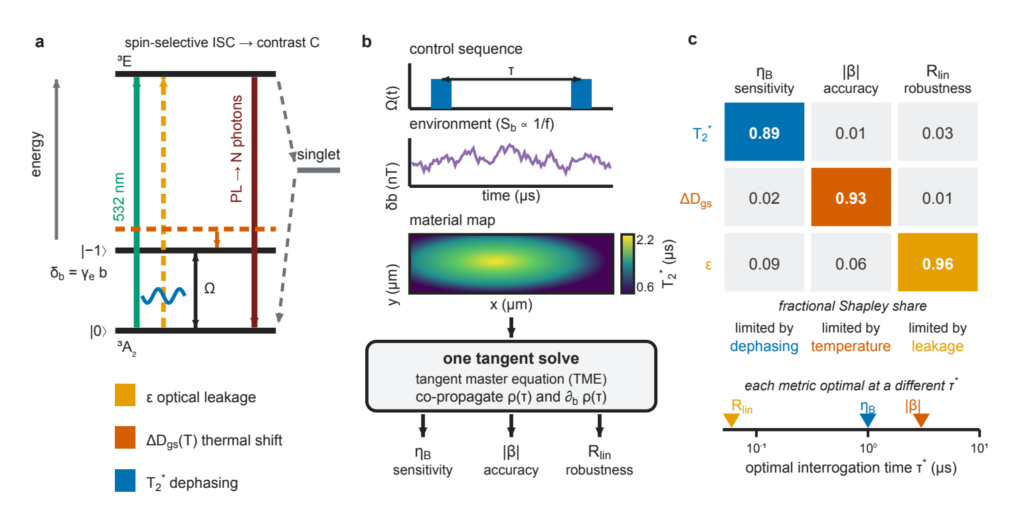
A collaboration including MITRE, Quantum Brilliance, NVIDIA, and SandboxAQ has developed a GPU-accelerated digital twin framework for quantum sensor error attribution, detailed in an arXiv preprint. This framework automates error budgeting by evaluating sensitivity, accuracy bias, and parameter-drift robustness, identifying key performance limiters for NV diamond ensembles and validating on a cesium OPM array for biomagnetic imaging. The research highlights that optimizing for sensitivity alone doesn't guarantee accuracy and that software-based noise rejection is crucial for clinical targets.
-
IonQ Demonstrates Hybrid HPC and Quantum-AI Workflows Across Nine Peer-Reviewed Papers at IEEE Quantum Week 2026
At IEEE Quantum Week 2026, IonQ presented nine peer-reviewed papers, with four receiving Best Paper Awards, showcasing advancements in hybrid HPC and quantum-AI workflows. Their work, utilizing IonQ's quantum hardware alongside NVIDIA software, demonstrated significant progress in enterprise engineering optimization (e.g., accelerating 35-million-element mesh simulations by up to 14.6% with Synopsys), quantum-accelerated AI architectures (e.g., 24% error reduction in AI classification with QuantumBasel), and dynamic error mitigation. This research highlights the practical application and performance benefits of quantum computing across various fields.
-
-
-
QC Design Integrates Plaquette Platform with NVIDIA CUDA-Q Logical for Hardware-Realistic FTQC Simulation
QC Design has integrated its Plaquette platform with NVIDIA CUDA-Q Logical, announced on September 14, 2026. This integration allows for hardware-realistic fault-tolerant quantum computing (FTQC) simulations by connecting high-level quantum error correction (QEC) circuit compilation with device-specific physical noise models. This enables evaluation of QEC code structures under continuous non-Pauli noise models, addressing discrepancies in traditional FTQC resource estimation. An initial study showed a 0.2% leakage rate on two-qubit entangling gates degraded the fault-tolerant circuit noise threshold by approximately 60%.
-
IQM Adopts NVIDIA CUDA-Q Logical Framework to Drive Open-Architecture Fault-Tolerant System Benchmarking
At IEEE Quantum Week 2026, IQM Quantum Computers announced the adoption of NVIDIA CUDA-Q Logical within their Halocene quantum error correction product line. This integration allows for the standardization of high-level logical circuit descriptions, enabling QEC algorithm workloads to be compiled, benchmarked, and executed across various physical backends. The framework provides auditable multi-layer resource estimates and supports up to 5 logical qubits, aiming to standardize the evaluation and validation of QEC designs on physical testbed hardware.
-
UCLA, Caltech, and NVIDIA Develop Fourier Neural Operator for Quantum Control Sequence Synthesis
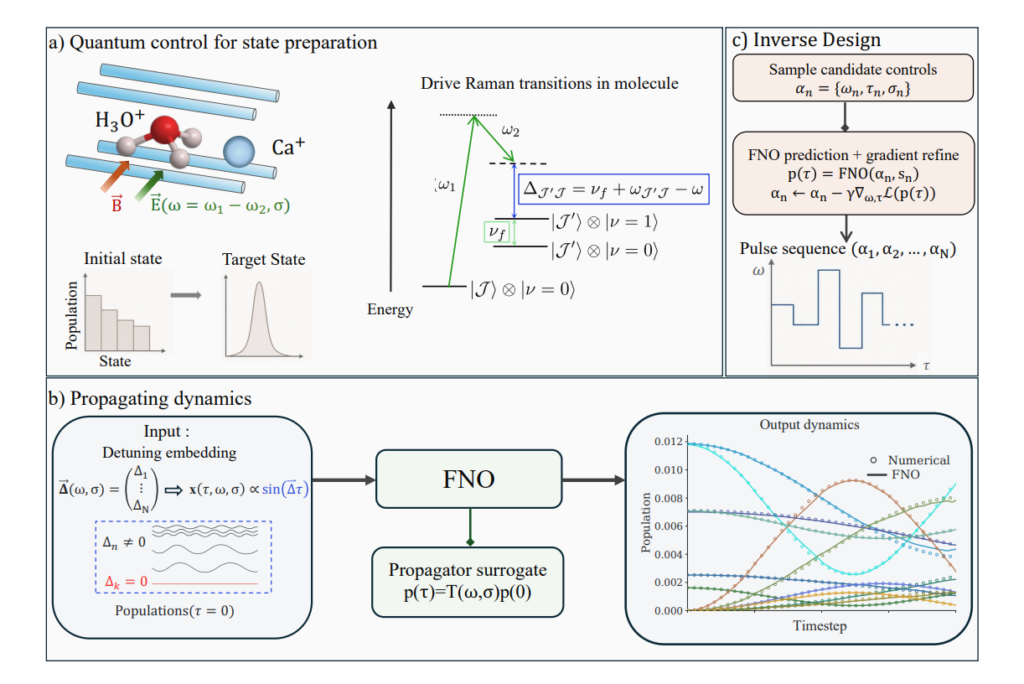
A research collaboration involving UCLA, Caltech, and NVIDIA has developed a machine-learning framework utilizing a Fourier Neural Operator (FNO) for the inverse design of quantum control pulse sequences. This FNO-based method significantly accelerates the synthesis of quantum control sequences, achieving a 10⁷x speedup and reducing computation time from 10 hours to 10-20 minutes, with an 86.2% success rate in preparing target quantum states. The framework, built on NVIDIA's CUDA-Q platform, offers a differentiable approach for optimizing laser pulse parameters in molecular quantum dynamics.
-
QCentroid Integrates QuantumOps Platform with NVIDIA CUDA-Q for Enterprise Hybrid Application Workflows
QCentroid has integrated NVIDIA CUDA-Q into its QuantumOps platform, creating an enterprise hybrid application design framework. This new system automates the placement of quantum components within classical HPC software, allowing for the optimization of classical-quantum boundaries in AI, simulation, and generative modeling. Demonstrated on a cGAN for catalyst materials discovery, the platform evaluates various hybrid Generator designs against classical baselines, leveraging GPU-accelerated simulation and quantum processing units for performance assessment.
-
BlueQubit Launches $150,000 “Quantum Flywheel” Compute Grant Program Supported by AWS, IBM, and NVIDIA
BlueQubit has launched the "Quantum Flywheel" grant program, offering $150,000 in compute credits over three months for quantum algorithm discovery, adversarial classical simulation, and quantum error correction research. Supported by IBM, AWS, and NVIDIA, the program provides access to QPU, GPU, and CPU hardware, along with BlueQubit's development environment, for selected research teams. The initiative aims to advance quantum computing through open-source contributions, peer-reviewed research, and AI-driven QEC code discovery.
-
Quandela and NVIDIA Outline Photonic QPU Integration Architecture via NVQLink
Quandela and NVIDIA have collaborated on a technical white paper outlining an architecture to integrate photonic Quantum Processing Units (QPUs) with classical AI and HPC environments using NVIDIA NVQLink. This framework connects Quandela's Quantum System Controller (QSC) to NVIDIA GPU nodes via a low-latency interconnect, enabling GPU-accelerated simulations, quantum error correction, and QPU pulse calibration within a unified host process running NVIDIA CUDA-Q and the MerLin Quantum Machine Learning framework. This initiative aims to facilitate the commercial adoption of hybrid quantum-classical computing across various phases, from cloud-hosted experimentation to scalable, fault-tolerant deployments.
-
Anyon Computing Unveils Open-Source Real-Time Control Plane Powered by NVIDIA NVQLink
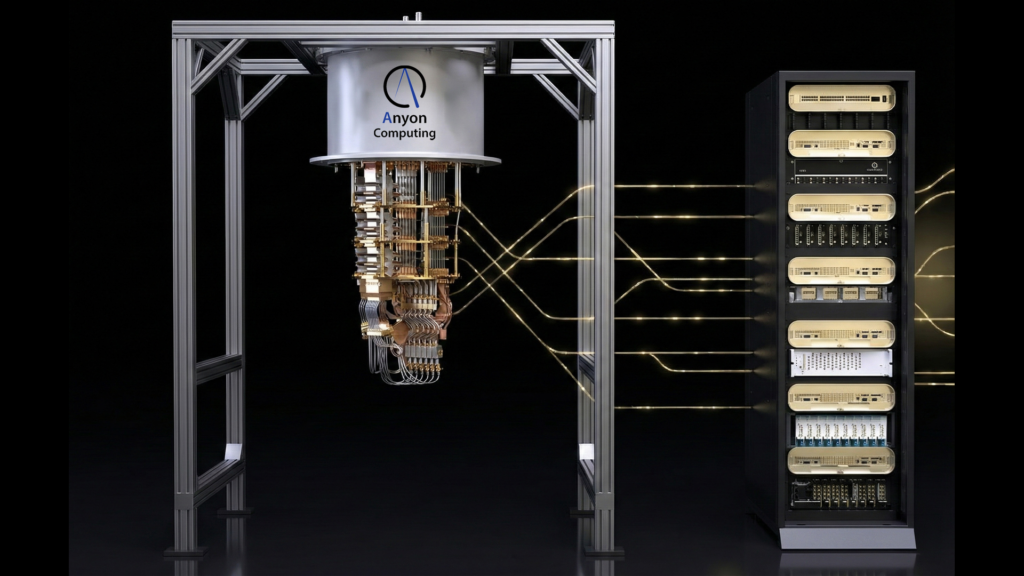
Anyon Computing has introduced an open-source, real-time quantum control system featuring NVIDIA NVQLink integration. This system unifies microwave control hardware and superconducting QPUs with CPUs and GPUs over a shared RDMA-over-Ethernet fabric, enabling microsecond execution loops vital for quantum error correction and hybrid quantum-classical machine learning. The initiative aims to standardize control layers across multi-QPU and multi-GPU supercomputing clusters.
-
Iceberg Quantum and Diraq Validate Pinnacle qLDPC Architecture on Silicon Spin Hardware via NVIDIA CUDA-Q Logical
Iceberg Quantum and Diraq have successfully compiled and validated Iceberg's Pinnacle qLDPC architecture on Diraq's silicon spin-qubit hardware using NVIDIA CUDA-Q Logical. This integration demonstrates that high-rate qLDPC error correction can be achieved on silicon spin hardware without extensive global wiring, utilizing electron shuttling for localized qubit routing. This breakthrough allows for supporting 1,000 logical qubits with 150,000 physical qubits, significantly reducing hardware requirements compared to traditional methods.
-
Quantum Motion Integrates Silicon Spin Architecture with NVIDIA CUDA-Q Logical Compiler Stack
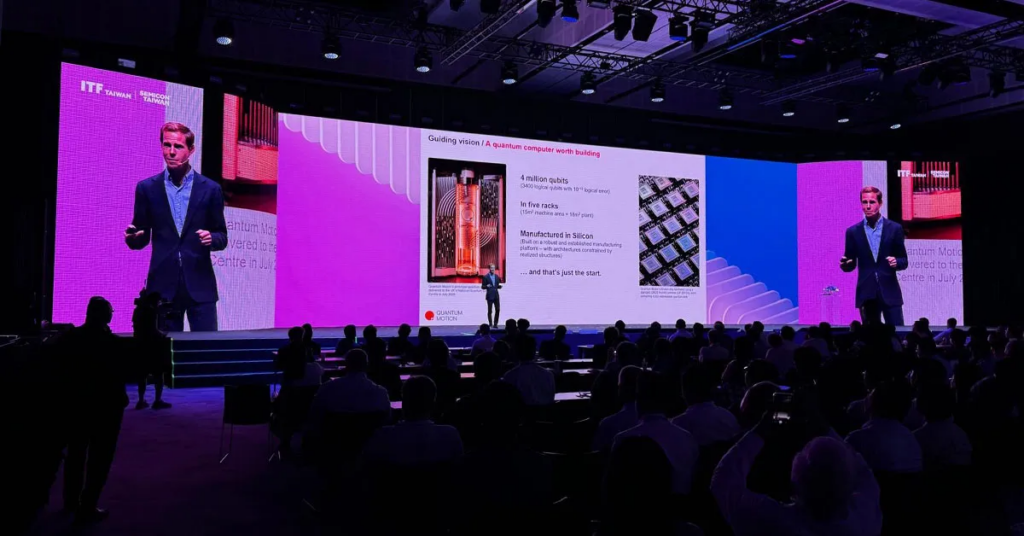
Quantum Motion has integrated its silicon spin architecture with NVIDIA CUDA-Q Logical, enabling automated quantum error correction-aware compilation. This integration translates high-level algorithms into hardware instructions for Quantum Motion's looped pipeline architecture, which uses electron shuttling to create a 3D virtual-z topology for surface codes. This advancement aims to facilitate large-scale electronic structure calculations for complex molecular systems.
-
Quantum Motion Finalizes Second Close of Series C Funding Round for Silicon QPU Scaling
Quantum Motion has finalized the second close of its Series C funding round, co-led by DCVC and Kembara, with new and returning investors including imec.ventures, Sony Innovation Fund, and Lansdowne Partners. This capital will accelerate the industrial scale-up of their fault-tolerant silicon quantum processors, supporting custom silicon co-development using 300mm CMOS semiconductor foundries, international expansion with a new U.S. research lab, and ongoing technical execution under DARPA’s Quantum Benchmarking Initiative. Their strategy focuses on dense silicon spin-qubit architectures fabricated in commercial foundries, aiming for significant cost, size, and energy reductions compared to alternative quantum computing methods.
-
Infleqtion Integrates Open-Source qLDPC Library with NVIDIA CUDA-Q Logical Architecture
Infleqtion has integrated its open-source qLDPC software library with NVIDIA CUDA-Q Logical, creating an end-to-end software pipeline for quantum error correction (QEC) codes. This integration, announced at IEEE Quantum Week 2026, allowed Infleqtion to construct and validate a Hypergraph-Product Simplex (HGPS) quantum low-density parity-check (qLDPC) code block with significantly reduced data-qubit overhead compared to standard surface codes, marking a step towards practical quantum computing.
-
Sandia, Quantinuum, and NVIDIA Introduce QUOPS Framework to Benchmark Physical and Logical Quantum Performance
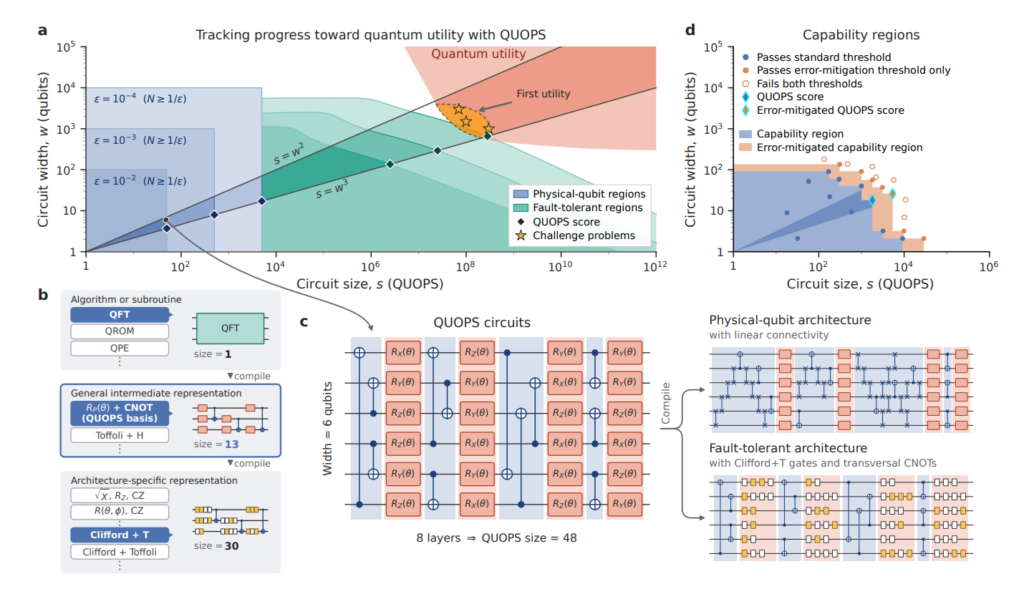
A new Quantum Universal Operations Performance System (QUOPS) framework has been introduced by Sandia National Laboratories, Quantinuum, and NVIDIA to benchmark quantum computer performance. This framework measures integrated performance across both physical and logical-qubit platforms, using metrics like QUOPS score (Q) for circuit size and QUOPS rate (Ω) for operational throughput. Initial benchmarks show Quantinuum’s Helios-1 achieving a physical score of Q = 1,504, while Google’s Willow and IBM’s ibm_boston reached Q = 216 and Q = 204 respectively.
-
Qedma Integrates QESEM Quantum Error Mitigation Software into NVIDIA CUDA-Q Platform
Qedma Quantum Computing has integrated its QESEM quantum error mitigation software into NVIDIA CUDA-Q, an open platform for hybrid quantum-GPU supercomputing. This integration allows CUDA-Q developers to run error-mitigated quantum circuits directly within their existing workflows, initially targeting Quantinuum's trapped-ion hardware, with plans for broader QPU compatibility. This expands Qedma's software ecosystem and builds on its recent hardware benchmarks and significant error-mitigation performance advantages.
-