
News
Company, funding, product and policy news from across the quantum industry, as it happens.
-
-
Quantcore Secures £2.5M ($3.4M USD) to Establish Sovereign Niobium-Based Quantum Hardware Manufacturing
Quantcore, a spin-out from the University of Glasgow, has secured £2.5 million ($3.4M USD) in seed funding to become the UK’s first sovereign manufacturer of niobium-based superconducting quantum hardware. By moving away from standard aluminum components, Quantcore is building a more resilient and energy-efficient foundation for the UK’s quantum infrastructure, directly supporting national security and high-performance computing goals.
-
-
-
IonQ Selected for Missile Defense Agency SHIELD IDIQ Contract
IonQ (NYSE: IONQ) has been qualified for the Missile Defense Agency (MDA) SHIELD contract, an massive $151 billion procurement vehicle. This selection marks a transformation for IonQ—it is no longer just a “quantum computer maker,” but a diversified defense prime. By leveraging its newly integrated subsidiaries—Capella Space, Skyloom, and Vector Atomic—IonQ is offering the MDA a “quantum-ready” stack that covers everything from satellite imagery and laser communications to un-jammable navigation.
-
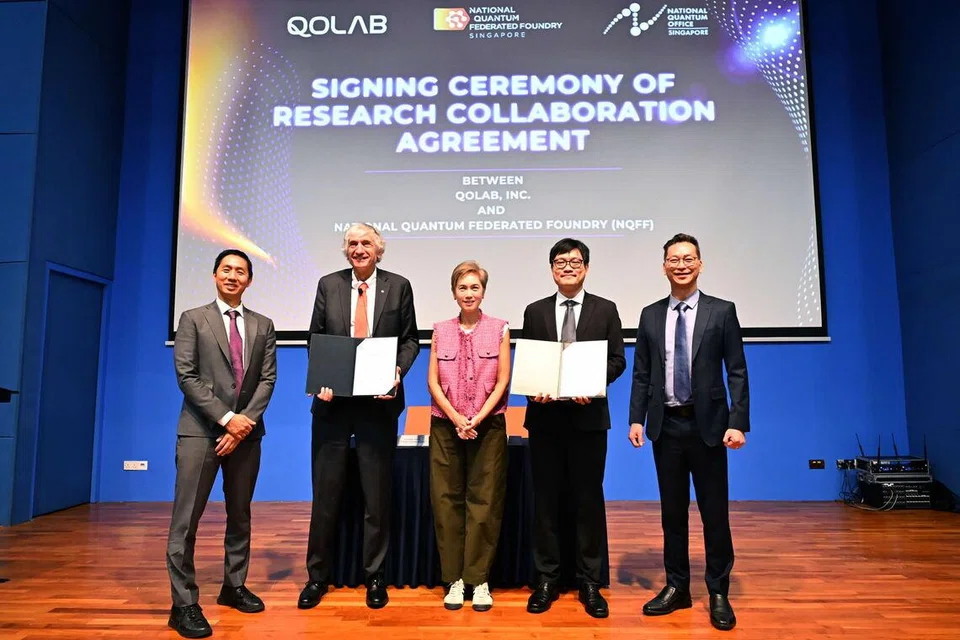
NQFF and Qolab Collaborate on Wafer-Scale Cryogenic Filters for Quantum Scaling
The National Quantum Federated Foundry (NQFF) in Singapore and Qolab have joined forces to tackle one of the most stubborn physical barriers in quantum computing: the “bulk” of cryogenic wiring. By developing wafer-scale cryogenic low-pass filters, the partnership aims to replace the hand-assembled, chunky components currently found in dilution refrigerators with sleek, mass-produced silicon filters. This is a critical step for moving from today’s experimental chips to the millions of qubits required for fault-tolerant computing.
-
IQM to List on U.S. Exchange via Merger with Real Asset Acquisition Corp.
IQM Finland Oy has announced a landmark merger with Real Asset Acquisition Corp. (Nasdaq: RAAQ), set to make it the first European quantum computing company to list on a U.S. exchange. Valued at $1.8 billion, the deal provides IQM with a war chest of over $450 million in cash to scale its “full-stack” superconducting technology. With 21 systems already sold to some of the world’s most elite supercomputing centers, IQM is moving from an experimental European leader to a global industrial heavyweight.
-
-
-
Australian Government Allocates $12.7M AUD ($9M USD) to Industrialize Quantum Prototypes
The Australian Government has committed $12.7 million to propel eight quantum projects from the laboratory to the real world. Under Stage 2 of the Critical Technologies Challenge Program (CTCP), these grants fund working prototypes designed to tackle major hurdles in mining, healthcare, and energy. By focusing on “field-ready” hardware, Australia is moving to cement its position as a global leader in the industrialization of quantum technology.
-
-
-
Quantum Elements Secures Additional Funding for AI-Driven Development Platform
Quantum Elements, a Los Angeles-based startup focused on streamlining quantum application development has received new funding. The investment, structured as a SAFE, also includes participation from QDNL Participations, Quantacet, R-Squared Ventures, and Firgun Ventures. Quantum Elements is developing Constellation, a platform designed to bridge the gap between abstract circuit design and physical hardware.
-
UCalgary Joins National Quantum Co-laboratory to Expand Distributed Research Infrastructure
The University of Calgary (UCalgary) has officially joined the National Quantum Co-laboratory, a move that synchronizes Canada’s four most powerful quantum research hubs. By linking UCalgary’s Institute for Quantum Science and Technology (IQST) with established centers at Waterloo, UBC, and Sherbrooke, the partnership creates a unified, “coast-to-coast” network of infrastructure. This expansion aims to turn Canada into a global leader by providing researchers and industry partners with shared access to high-end labs and a “quantum-ready” talent pool.
-
Tectonic Labs Releases PQ Wallet and Post-Quantum Audit Services for EVM Chains
Tectonic Labs has launched PQ Wallet, a first-of-its-kind browser extension that brings Falcon-512 quantum-resistant signatures to the Ethereum Virtual Machine (EVM) ecosystem. By operating at the application layer, the wallet allows users to secure their digital assets against future quantum threats without waiting for a massive overhaul of the Ethereum network. Alongside the wallet, the firm has introduced PQ Audits to help blockchain protocols map their “cryptographic bill of materials” and prepare for a staged migration to post-quantum standards.
-
MerLin: Framework for Differentiable Photonic Quantum Machine Learning
Quandela has released MerLin 0.3, an open-source framework designed to turn photonic quantum machine learning (QML) from a research experiment into a disciplined engineering field. By integrating directly with PyTorch, MerLin allows developers to train photonic circuits—like phase shifters and beam-splitters—using the same gradient-based optimization tools used for classical AI. With a library of 18 reproduced state-of-the-art papers, MerLin provides the standardized benchmarks needed to prove exactly where and when photonic quantum systems outperform classical ones.
-
-
-
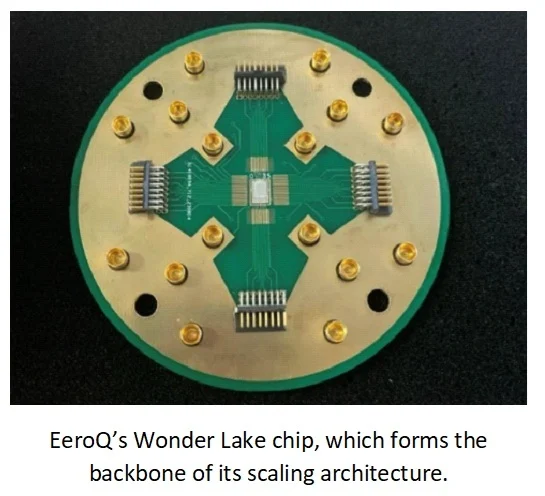
SEALSQ Increases Strategic Investment in EeroQ to Advance “Quantum Made in USA” Strategy
SEALSQ Corp (NASDAQ: LAES) has doubled down on its partnership with EeroQ, finalizing a second strategic investment to accelerate a “Quantum Made in USA” roadmap. By combining SEALSQ’s post-quantum semiconductor expertise with EeroQ’s unique “electrons on superfluid helium” hardware, the companies aim to build a fully vertical, sovereign security stack. This partnership centers on a radical new hardware design that could eventually fit a million-qubit processor onto a chip the size of a thumbnail.
-
Tower Semiconductor and Xanadu Industrialize Silicon Photonic Quantum Stack
Tower Semiconductor and Xanadu have entered a new phase of their partnership, focusing on the high-volume industrialization of silicon photonic quantum chips. By utilizing Tower’s established 200mm foundry infrastructure, the duo is moving Xanadu’s photonic designs from the laboratory to the production line. This collaboration is a critical step toward fault-tolerant quantum computing, ensuring that the “guts” of a quantum computer can be manufactured with the same precision and scale as modern smartphone chips.
-
Quantum eMotion to Transition Trading Operations to NYSE American Exchange
Quantum eMotion Corp. (TSXV: QNC) is set to elevate its market presence by transitioning its trading operations to the NYSE American exchange. Scheduled to begin trading under the ticker “QNC” around February 24, 2026, the move highlights the company’s shift from R&D to the commercialization of its “Entropy-as-a-Service” model. By listing on a major U.S. exchange, the firm aims to attract greater institutional interest in its unique quantum-safe hardware.
-
AQT Integrates IBEX Q1 Trapped-Ion QPU into Scaleway Sovereign Cloud
Alpine Quantum Technologies (AQT) and Scaleway have achieved a milestone for European technological sovereignty by integrating the IBEX Q1 trapped-ion quantum computer into Scaleway’s cloud platform. This partnership allows European researchers and companies to run quantum workloads on a “sovereign cloud,” ensuring that sensitive data never leaves European jurisdiction. By combining AQT’s high-fidelity hardware with Scaleway’s classical cloud power, the duo is creating a powerful hybrid environment for the next generation of industrial applications.
-
D-Wave Integrates into Southeastern Quantum Collaborative to Drive Regional Quantum Hardware Deployment
D-Wave Quantum Inc. has joined the Southeastern Quantum Collaborative (SQC) as an inaugural member, marking a significant step in establishing the Southeastern U.S. as a powerhouse for “field-ready” quantum applications. By integrating its Advantage2™ annealing system directly into Davidson Technologies’ Huntsville facility, D-Wave is providing the region’s defense and aerospace giants with the hardware needed to solve massive logistical and mission-planning challenges in real-time.
-
-
-
MicroAlign Secures €2.5M ($3M USD) EIC Funding for Industrialization of Quantum Fiber Arrays
MicroAlign has secured a €2.5 million ($3M USD) Accelerator Grant and equity investment from the European Innovation Council (EIC) to solve one of the most persistent bottlenecks in photonic quantum computing: the precise alignment of optical fibers. As photonic chips become more complex, they require thousands of connections that must be aligned with nanometer precision. MicroAlign’s “active alignment” technology is moving from pilot stages to high-volume production to meet this demand.
-
IBM Ventures Invests in SQK and QodeX Quantum for Specialized Software Development
IBM Ventures has announced strategic investments in SQK and QodeX Quantum, two emerging startups from the Alchemist Chicago and Duality accelerators. This move is part of IBM’s broader “regional anchor” strategy in Illinois, centered on the Illinois Quantum and Microelectronics Park (IQMP). By backing these specialized software developers, IBM aims to pull quantum technology out of the lab and into high-stakes industries like oncology and enterprise AI.
-
Palm Beach County Receives $1M Federal Funding to Expand Quantum Ecosystem
Palm Beach County is rapidly transforming into a primary high-tech corridor, securing over $3 million in new federal funding to anchor its quantum ecosystem. Combined with state grants and major corporate relocations like D-Wave, the region is building a “Quantum Coast” that bridges academic research with industrial deployment.
-
Aliro Raises $15 Million to Advance Physics-Based Network Security
Aliro has secured $15 million in an oversubscribed funding round led by Gutbrain Ventures, with backing from Cisco Investments and others. The company is pivoting network security away from traditional “mathematical hurdles” toward physics-based enforcement. By using entanglement protocols, Aliro provides a way for networks to verify trust through the laws of physics, making unauthorized access or spoofing physically impossible.
-
Qunnect and Cisco Demonstrate Quantum Entanglement over a Quantum Network in New York City
Qunnect and Cisco have achieved a major milestone in quantum infrastructure, successfully demonstrating high-fidelity entanglement swapping over the GothamQ network in New York City. Spanning 17.6 km of standard telecom fiber under the streets of Manhattan and Brooklyn, the system reached record-breaking swapping rates of over 5,400 pairs per hour with 99% fidelity. This demonstration proves that quantum networking can survive the “noise” of a major city, clearing the path for connected quantum data centers.
-
SEALSQ and Lattice Deliver Unified TPM-FPGA Architecture for Post-Quantum Security
The partnership between SEALSQ and Lattice Semiconductor marks a significant leap in “hardening” the edge of our digital world. By merging a dedicated Post-Quantum Cryptography (PQC) chip with a programmable FPGA, they have created a “crypto-agile” anchor that can evolve alongside changing security laws.
-
Quantonation Closes €220 Million ($260 Million USD) Second Fund to Scale Physics-Based Technologies
Quantonation Ventures has closed its second flagship fund, Quantonation II, at €220 million, surpassing its initial target and becoming the world’s largest dedicated quantum investment vehicle by assets under management. This new fund marks a shift from early-stage research to the “industrialization” of quantum tech, focusing on scaling hardware, software, and supply chains. Backed by major institutions like Toshiba and the European Investment Fund, Quantonation is positioning itself as the primary engine for the next phase of the global quantum economy.
-
UK Dstl Completes Trials for Next-Generation Atomic Clock Technology
The UK’s Defence Science and Technology Laboratory (Dstl) has successfully concluded trials for next-generation atomic clock technology, a critical move to ensure UK forces can navigate even when GPS is jammed or denied. By using light waves to energize atoms, these clocks provide a timing reference far more stable than current military standards. The trials, which included participants like the Royal Navy and Far Field Exploits, successfully tested these devices in “unattended” long-term operations, proving they are ready for the harsh realities of the field rather than just the lab.
-
-
-
An Italian Court Annuls a Previous €47 Million ($55.6M USD) Award to IBM for Providing a Quantum Computer at the University of Salerno
The government of Campagna, Italy had issued a tender in February 2025 to receive proposals to provide a quantum computer at the University of Salerno. The proposals were submitted in February and in September an award was issued to IBM for their bid totaling €47 Million. Subsequently, that bid was challenged in court and has recently been annulled. Additional details about this including the rationale for the annulment and potential next steps can be seen in our report here.
-
Infleqtion Goes Public on NYSE via SPAC Merger, Raising $550 Million
Infleqtion has officially become the first neutral-atom quantum company to go public, beginning trade on the New York Stock Exchange under the ticker “INFQ.” Following a successful merger with Churchill Capital Corp X, the company is now armed with over $550 million in new funding. This move signals a major shift for the industry, as Infleqtion moves to scale its unique dual-threat portfolio of quantum computing and high-precision quantum sensing for aerospace, defense, and energy. Read more in our full article here.her
-
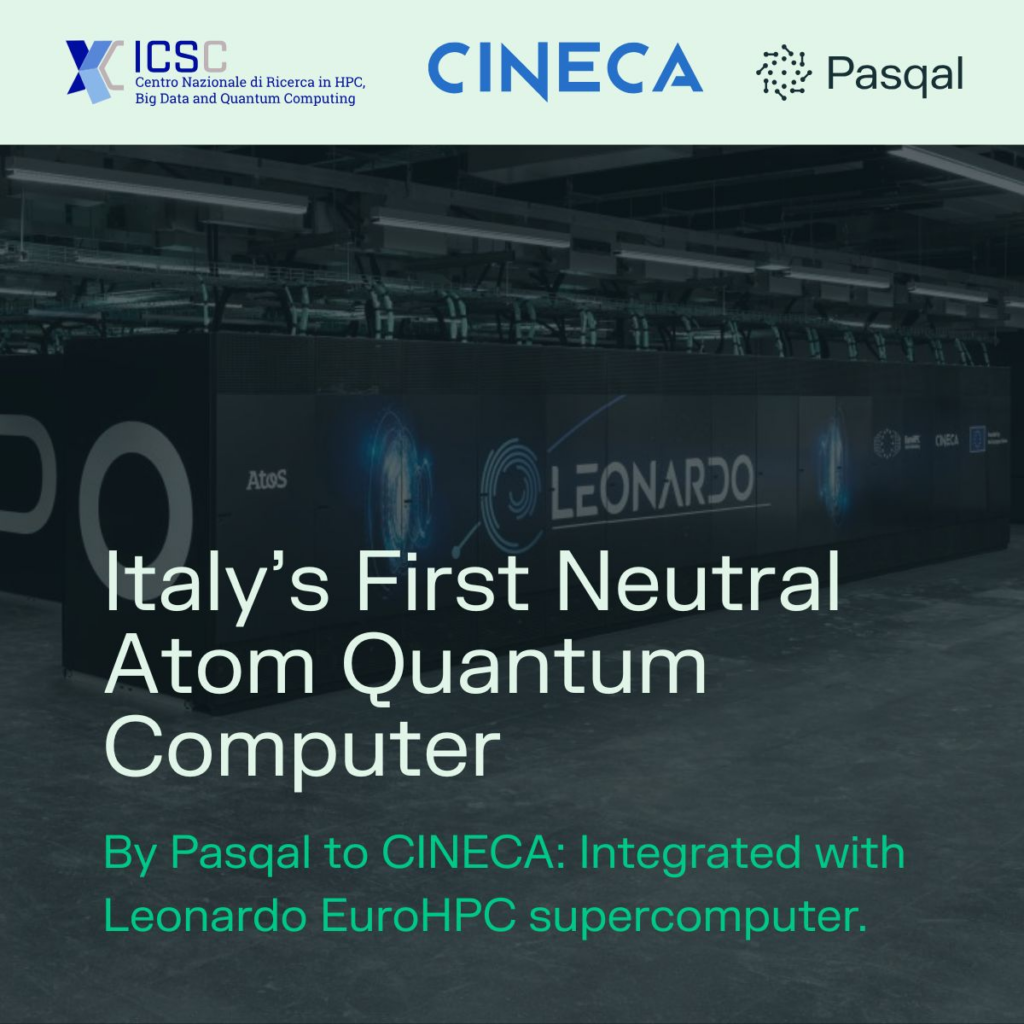
Pasqal Delivers Italy’s First Neutral Atom Quantum Computer
Pasqal has officially delivered a 140-qubit neutral atom quantum computer to the CINECA supercomputing center in Bologna, marking Italy’s first on-site system of this kind. This deployment is a strategic move to integrate quantum processing units (QPUs) with Leonardo, one of the world’s fastest supercomputers. By combining Pasqal’s hardware with Leonardo’s classical power, researchers can now tackle massive optimization and materials simulation problems that were previously out of reach.
-