
News
Company, funding, product and policy news from across the quantum industry, as it happens.
-
-
Qilimanjaro Launches EduQit: On-Site Modular Quantum Computing for Research and Education
Qilimanjaro Quantum Tech has released EduQit, a modular “build-your-own” quantum computer designed to bring physical hardware directly into university labs. Moving beyond remote cloud access, EduQit allows students to interact with the entire stack—from dilution refrigerators and microwave electronics to QPUs based on Qilimanjaro’s proprietary fluxonium qubits. This “lab-in-a-box” approach is intended to bridge the gap between quantum theory and the gritty operational reality of superconducting systems.
-
-
-
IonQ to Acquire Seed Innovations for AI-Driven Quantum Infrastructure Scaling
IonQ (NYSE: IONQ) has entered into a definitive agreement to acquire Seed Innovations, a Colorado-based R&D firm specializing in machine learning (ML) and cloud architecture. Closing on January 30, 2026, the acquisition integrates Seed’s AI-driven software expertise into IonQ’s Quantum Infrastructure division. Under the leadership of Frank Backes, the team will focus on using deep ML to predict system abnormalities and automate the scaling of quantum workloads across major cloud providers. This move continues IonQ’s aggressive “Full-Stack” verticalization strategy.
-
IonQ Completes Skyloom Acquisition to Enable Distributed Quantum Entanglement
IonQ (NYSE: IONQ) has officially finalized its acquisition of Skyloom Global Corp., a specialist in space-based laser communications. By integrating Skyloom’s SDA-qualified optical terminals (like the V’ger and Scotty models), IonQ is building the hardware foundation for distributed quantum entanglement. This acquisition allows IonQ to connect remote trapped-ion processors into a single unified network, reducing latency for space-to-ground quantum data and positioning the company to deliver full-stack, quantum-secure infrastructure for defense and aerospace markets.
-
-
-
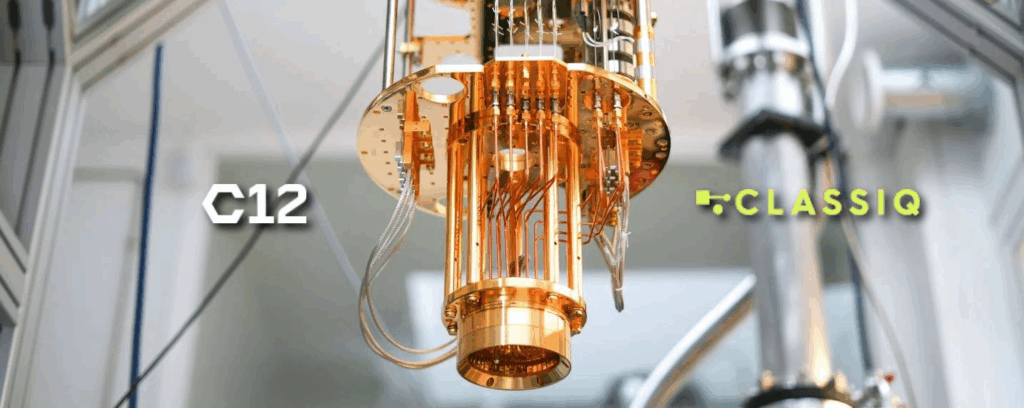
Classiq and C12 Integrate Software Platform with Spin Qubit Digital Twin
Classiq and C12 have integrated C12’s Callisto digital twin into the Classiq platform, allowing developers to design algorithms for carbon nanotube (CNT) spin qubits. Using Classiq’s Qmod language, researchers can now simulate up to 13 noisy qubits based on C12’s specific hardware parameters, including realistic models for phonon interaction and charge noise. This partnership makes CNT spin qubits a supported modality alongside superconducting and photonic backends, helping to bridge the gap between software design and C12’s unique cQED-based hardware.
-
D-Wave Announces HQ Relocation, $20M System Sale, $10M Fortune 100 Deal, and Dual-Platform Advancements
D-Wave Quantum Inc. utilized its Qubits 2026 conference to announce a major pivot toward industrial-scale deployment, headlined by a headquarters relocation to Boca Raton, Florida. The move is anchored by a $20 million agreement with Florida Atlantic University (FAU) to install an on-site Advantage2™ system. D-Wave also unveiled a breakthrough in national security, demonstrating that its hybrid solvers could plan missile defense intercepts 10x faster than classical methods, significantly improving threat mitigation in high-density simulations.
-
-
-
Qunova Launches HI-VQE Chemistry Algorithm on AWS Marketplace for Braket Integration
Qunova Computing has launched its HI-VQE (Handover Iterative Variational Quantum Eigensolver) algorithm on the AWS Marketplace, integrating it with Amazon Braket. This move allows industrial users in pharma and materials science to run high-precision chemistry simulations across multiple hardware types, including IonQ, Rigetti, and QuEra. By eliminating Pauli word measurements, the algorithm reportedly achieves a 1,000x improvement in efficiency, enabling “chemical accuracy” on current NISQ devices.
-
IonQ to Acquire SkyWater Technology in $1.8 Billion Vertical Integration Transaction
IonQ has announced a definitive agreement to acquire SkyWater Technology for $1.8 billion in a landmark vertical integration move. By merging its trapped-ion design expertise with SkyWater’s domestic foundry capabilities, IonQ has accelerated its roadmap, pulling forward the functional testing of its 200,000 physical qubit QPU to 2028. This deal secures a DMEA Category 1 Trusted domestic supply chain, positioning IonQ to lead high-stakes defense and government quantum initiatives while maintaining SkyWater’s pure-play foundry model.
-
-
-
Deep33 Ventures Launches $150 Million Fund for U.S.-Israel Deep Tech Corridor
Deep33 Ventures has emerged from stealth with a $150 million fund aimed at building a “deep tech corridor” between the U.S. and Israel. Focusing on the physical foundations of AI—Quantum, AI Infrastructure, Energy, and Robotics—the fund addresses hardware and energy bottlenecks. Led by an expert-heavy team including Col. (Res.) Joab Rosenberg, the firm has already backed five companies, including Quamcore (superconducting quantum chips) and CyberRidge (post-quantum encryption).
-
-
-
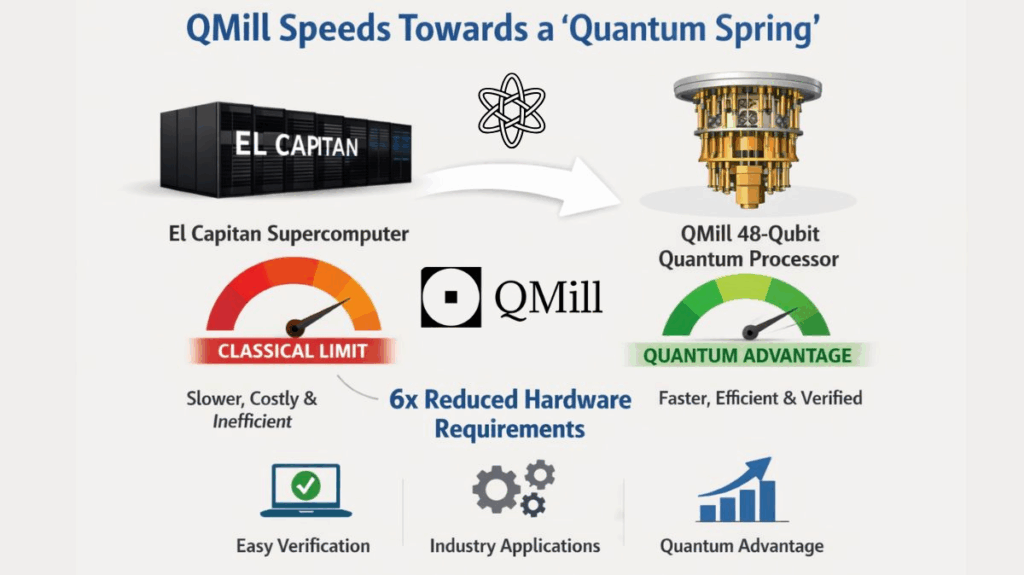
QMill: Projecting Verifiable Quantum Advantage via 48-Qubit NISQ Algorithms
QMill has announced simulation results for a 48-qubit algorithm that claims to achieve verifiable quantum advantage on near-term NISQ hardware. By requiring only 99.94% gate fidelity—a significant drop from the industry-standard 99.99%—the algorithm is designed to outperform exascale supercomputers like El Capitan while remaining classically verifiable on a standard laptop. Led by Mikko Möttönen, the team is now preparing to transition this “noise-resilient” architecture into cloud-integrated products for logistics and energy grid optimization.
-
Keyfactor and IBM Consulting Launch Joint Solution for Enterprise Quantum-Safe Modernization
Keyfactor and IBM Consulting have launched a joint enterprise solution to accelerate the transition to post-quantum cryptography (PQC). The partnership merges Keyfactor’s automated discovery and certificate lifecycle tools (including EJBCA and SignServer) with IBM’s Quantum Safe Migration Orchestrator to create a comprehensive Cryptographic Bill of Materials (CBOM). This solution helps organizations identify vulnerable assets, prioritize remediation with risk scoring, and establish Cryptographic Centers of Excellence (CCoEs) for long-term “crypto-agility.”
-
ZenaTech Advances Proprietary Quantum Hardware Platform for Defense and Government Sectors
ZenaTech, Inc. (Nasdaq: ZENA) has officially begun procurement for its first proprietary five-qubit quantum computer prototype, designed to handle the massive data volumes generated by its ZenaDrone systems. Targeted at U.S. Defense and Homeland Security, the platform aims to provide real-time, quantum-enhanced analysis for military surveillance and threat detection. Expected to be operational by late 2026, this vertically integrated hardware will anchor ZenaTech’s AI-driven defense projects, including Eagle Eye and Zena AI, moving the company toward end-to-end sovereign intelligence solutions.
-
Arqit Launches ‘Encryption Intelligence’ to Automate Discovery for Post-Quantum Migration
Arqit Quantum Inc. (Nasdaq: ARQQ) has commercially launched Encryption Intelligence (EI), an automated tool designed to build a real-time cryptographic inventory for enterprises. Developed to combat the “Store Now, Decrypt Later” (SNDL) threat, the platform identifies legacy algorithms and hidden risks across cloud and OT environments. Validated by its participation in the UK National Cyber Security Centre (NCSC) PQC Pilot, Arqit’s solution provides the continuous visibility necessary to create a prioritized, compliant migration roadmap.
-
Chicago State University Launches Illinois’ First Public University Quantum and Semiconductor Credentials
Chicago State University (CSU) has launched Illinois’ first public university programs in Quantum Information Science & Engineering (QISE) and Semiconductor Technology, approved by the Illinois Board of Higher Education. Designed to bridge a 100,000-job gap by 2030, these credentials provide a direct talent pipeline to the Illinois Quantum & Microelectronics Park (IQMP). With support from the NSF-backed Mic2ExL consortium and partners like PsiQuantum, CSU is focusing on making the quantum economy accessible to underrepresented students and adult learners through flexible, hands-on training.
-
-
-
Microsoft Opens Applications for 2026 Quantum Pioneers Program Targeting Measurement-Based Computing
Microsoft has opened applications for the 2026 Quantum Pioneers Program (QuaPP), a research initiative led by Dr. Chetan Nayak that focuses on measurement-based quantum computing (MBQC). The program aims to advance topological qubits by funding up to five research proposals with $200,000 USD each. Research areas include topological qubit dynamics, innovative readout components, and measurement-based error correction. Open to global university professors, the application deadline is January 31, 2026, with funding set to start in August.
-
IBM Releases Qiskit v2.3 with Expanded C API and Fault-Tolerant Primitives
IBM has officially launched Qiskit v2.3, a major update designed to bridge the gap between quantum software and High-Performance Computing (HPC) environments. The release centers on a significantly expanded C API, featuring new objects like QkDag and QkTarget that allow for low-level circuit optimization directly in C. By completing the internal refactor of its data model into Rust, IBM has also enhanced the speed and scalability of circuit-to-hardware mapping, ensuring Qiskit is prepared for the high-throughput requirements of fault-tolerant systems.
-
Microsoft Releases Open-Source Quantum Development Tools for Error Correction and Chemistry
Microsoft has released an updated, open-source Quantum Development Kit (QDK) specifically engineered for fault-tolerant applications. Integrated with VS Code and GitHub Copilot, the kit features a specialized QDK for Chemistry that utilizes “chemistry-aware” algorithms to drastically reduce circuit depth—sometimes shrinking gate counts from thousands to single digits. A major highlight is the introduction of a qubit-virtualization system that generates stable logical qubits from physical hardware. This system is currently being applied to Atom Computing’s neutral-atom platform to create the Magne system, with full performance benchmarks set for release on January 26, 2026, in Copenhagen.
-
Montana State University’s QCORE Secures $31.5 Million AFRL Contract for Quantum Infrastructure
Montana State University (MSU) has been awarded a $31.5 million contract by the Air Force Research Laboratory (AFRL) to expand its QCORE facility. This funding follows a $26.7 million grant from 2023, solidifying the Bozeman-based hub as a leader in transitioning quantum sensors, materials, and secure networking from lab prototypes to deployable hardware. With on-site hardware like the Rigetti Novera and ORCA PT Series, QCORE is one of the few global sites operating multiple quantum modalities alongside a dedicated network test bed.
-
Nexus Launches Global Platform for Verified Quantum and Deep-Tech Investment
Nexus has launched a global platform to connect quantum and deep-tech startups with verified investors, backed by a partnership with Global Quantum Intelligence (GQI). The platform provides a unique verification layer that audits technical claims and benchmarks startups to increase transparency in a complex market. With over 45 companies already registered and $350 million in available funding represented, Nexus aims to streamline capital acquisition through a specialized matchmaking algorithm.
-
SpinQ Technology Secures Hundreds of Millions of RMB in Series C Funding for Superconducting Scale-Up
SpinQ Technology, based in Shenzhen, has raised hundreds of millions of RMB in a Series C funding round to scale its superconducting quantum hardware. Co-led by a consortium including Longli Technology and Jadex Capital, the investment will drive the development of the “Shaowei” superconducting chip series, targeting a 100-qubit processor. SpinQ is unique in the industry for its “dual-driven” strategy: it maintains a steady revenue stream by exporting portable NMR quantum computers to 40+ countries while simultaneously deploying high-performance superconducting systems to markets in the Middle East and Europe.
-
-
-
Europe Launches €50 Million ($58.4 Million USD) ‘Photonics for Quantum’ (P4Q) Pilot Line to Industrialize Quantum Photonic Chips
Europe has launched the €50 million ($58.4 million USD) Photonics for Quantum (P4Q) pilot line to move quantum photonic technologies from the lab into industrial-scale production. Coordinated by the University of Twente and funded by the EU’s Chips Joint Undertaking alongside national governments, the project involves 29 partners—including imec, CEA-Leti, and Thales. P4Q focuses on maturing production for materials like silicon nitride and thin-film lithium niobate, aiming for high-level manufacturing readiness (MRL-8). This infrastructure will provide a standardized pathway for startups and SMEs to build the photonic chips required for quantum computing, sensing, and secure communications.
-
Saudi Arabia’s KAUST Establishes National Quantum Foundry for Quantum Hardware Fabrication
KAUST has launched the KAUST Quantum Foundry in Saudi Arabia, a dedicated facility aimed at transitioning quantum hardware from bespoke lab experiments to commercial-grade, reproducible manufacturing. By offering specialized cleanroom access and implementing Process Design Kits (PDKs), the Foundry provides a standardized framework for designing superconducting, photonic, and hybrid quantum systems. Integrated with the National Transformation Institute (NTI), the initiative is designed to accelerate the commercialization of quantum tech to solve national challenges in energy, health, and water security.
-
Ability Engineering Technology Joins Chicago Quantum Exchange to Strengthen Infrastructure Supply Chain
Ability Engineering Technology (AET) has joined the Chicago Quantum Exchange (CQE) as a corporate partner to scale the domestic supply chain for quantum-ready infrastructure. The Illinois-based manufacturer, specializing in high-precision cryogenic systems and vacuum chambers, will collaborate with members like Argonne National Laboratory and Fermilab to transition quantum hardware from lab prototypes to industrial deployment. As part of the Bloch Quantum Tech Hub, AET will also support regional workforce development and standardized manufacturing for next-generation systems.
-
Alice & Bob Introduce ‘Elevator Codes’ for Resource-Efficient Fault Tolerance
Alice & Bob has introduced “Elevator Codes,” a new quantum error correction (QEC) architecture that leverages the unique noise bias of cat qubits to achieve a massive reduction in hardware requirements. Detailed in a study by Diego Ruiz and Peter Shanahan, the architecture uses a “vertical” movement strategy—the “elevator”—to check for errors across different layers of the code. This approach allows Alice & Bob to target 100 logical qubits using only 1,500 physical qubits, a significantly smaller footprint than traditional 2D surface codes, while reducing logical error rates by 10,000x.
-
-
-
Coherent and Quside Demonstrate Scalable, Verifiable Quantum Entropy for Data Security
Coherent Corp. and Quside have successfully demonstrated a mass-manufacturable quantum entropy source, integrating Coherent’s 6-inch VCSEL manufacturing platform with Quside’s Quantum Random Number Generation (QRNG) technology. Unlike standard generators that rely on predictable algorithms, this system measures quantum phase fluctuations in lasers to provide “true” randomness. A key innovation is real-time entropy monitoring, which mathematically verifies that the randomness is truly quantum before generating cryptographic keys. This scalable, verifiable root of trust is designed to be integrated into consumer electronics and data centers, with a live demo scheduled for Photonics West 2026.
-
Lightwave Logic and QPICs Partner to Accelerate Photonic Quantum Chip Development
Lightwave Logic and QPICs have signed an MOU to integrate high-stability electro-optic (EO) polymers into photonic integrated circuits (PICs) for quantum computing and sensing. This collaboration, a key part of the Elevate Quantum Tech Hub in Colorado, focuses on creating Process Design Kits (PDKs) that allow customers to manufacture silicon-compatible quantum solutions with high-speed modulation and low power consumption. Led by Dr. Chris Myatt, QPICs aims to provide a turnkey fabrication service that moves quantum photonics from the lab to industrial-scale production.
-