
News
Company, funding, product and policy news from across the quantum industry, as it happens.
-
-
D-Wave Finalizes $550 Million Acquisition of Quantum Circuits to Accelerate Dual-Platform Roadmap
D-Wave Quantum Inc. has completed its $550 million acquisition of Quantum Circuits Inc., positioning itself as the industry’s first “dual-platform” provider. By merging its dominant quantum annealing technology with Quantum Circuits’ gate-model hardware, D-Wave aims to offer a 49-qubit system featuring dual-rail qubits by late 2026. This architecture uses hardware-integrated error detection to convert energy loss into “erasure” errors, potentially reducing physical qubit overhead by 200x. With Yale pioneer Dr. Rob Schoelkopf joining as Chief Scientist, D-Wave is set to unveil its integrated roadmap at the Qubits 2026 conference in late January.
-
Rigetti Computing Receives $8.4 Million Order for 108-Qubit Quantum Computer from India’s C-DAC
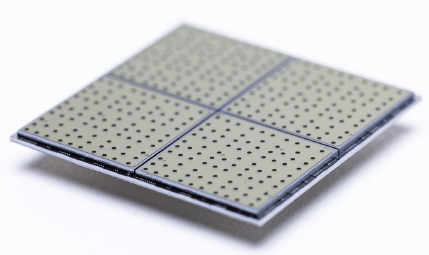
Rigetti Computing has received an $8.4 million order to deliver a 108-qubit quantum computer to India’s C-DAC (Centre for Development of Advanced Computing). The system, based on Rigetti’s modular chiplet-based architecture, will be installed on-premises at C-DAC’s Bengaluru facility in the second half of 2026. This acquisition is a cornerstone of India’s Hybrid HPC-Quantum Mission, enabling local researchers to develop sovereign, full-stack quantum solutions integrated directly into the nation’s supercomputing infrastructure.
-
Universidad Politécnica de Madrid and Q*Bird Launch Spain’s First Multi-Node MDI-QKD Network
Universidad Politécnica de Madrid (UPM) and QBird have launched Spain’s first multi-node MDI-QKD network, connecting sites at INTA and the Ministry of the Interior. Using a hub-and-spoke topology with QBird’s Falqon® Series hardware, the network removes the need for “trusted nodes” and eliminates detector-based vulnerabilities. This deployment within the MadQCI framework serves as a critical pilot for EuroQCI, demonstrating that scalable, quantum-secure communication is ready for metropolitan government and critical infrastructure.
-
Horizon Quantum and Alice & Bob Partner to Streamline Fault-Tolerant Software Development
Horizon Quantum Computing and Alice & Bob have formed a strategic alliance to integrate Alice & Bob’s cat qubit emulators into Horizon’s Triple Alpha development environment. This partnership allows developers to test quantum error correction (QEC) protocols on a “virtual version” of Alice & Bob’s hardware, which claims to reduce physical qubit overhead by 200x. The collaboration comes as Horizon Quantum prepares for a Nasdaq listing via a merger with dMY Squared Technology Group, backed by a $110 million PIPE that includes participation from IonQ.
-
-
-
Quobly and TNO Partner to Optimize Silicon Spin Qubit Manufacturing
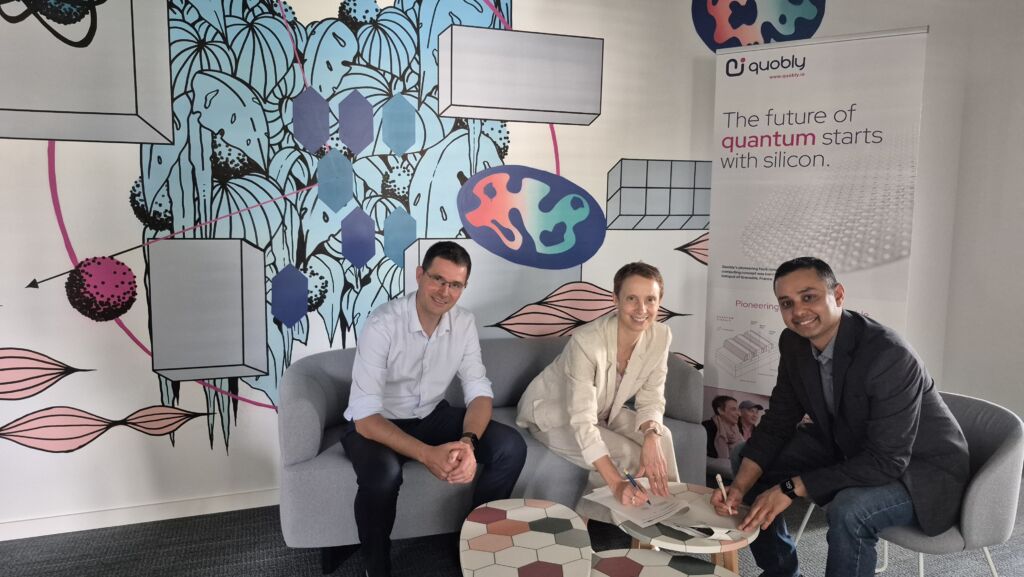
Quobly and TNO have joined forces to industrialize silicon spin qubits, focusing on the “materials-to-manufacturing” bottleneck. By combining Quobly’s CMOS-compatible designs with TNO’s advanced materials analysis and cryogenic testing (via its QITT facility), the partnership aims to mitigate hardware defects and accelerate development loops. This collaboration strengthens the quantum corridor between Grenoble and Delft, positioning silicon spin technology to transition from lab-scale prototypes to high-yield, industrial production.
-
SEEQC to Go Public via Merger with Allegro Merger Corp. at $1 Billion Valuation
SEEQC, the New York-based developer of digital quantum-classical chips, has announced a definitive merger agreement with Allegro Merger Corp. at a $1 billion valuation. Supported by a $65 million PIPE, the deal aims to scale SEEQC’s proprietary Single Flux Quantum (SFQ) technology, which integrates control and readout functions directly onto chips inside the cryostat. By eliminating the “wiring bottleneck” of bulky external electronics, SEEQC is positioning itself as a critical infrastructure provider for the broader quantum industry. The transaction is expected to close in Q2 2026.
-
-
-
Who’s News: Strategic Leadership Appointments at Infleqtion, Quantinuum, IonQ, and Xanadu
The quantum sector saw a massive wave of executive moves on January 16, 2026, as major players prepare for public listings and utility-scale deployment. From military veterans joining the sensing space to SaaS heavyweights moving into quantum field engineering, these appointments signal a shift from “R&D-led” to “commercial-ready” leadership.
-
-
-
Diffraqtion Secures $4.2 Million Pre-Seed to Bypassing Optical Limits in Space Imaging
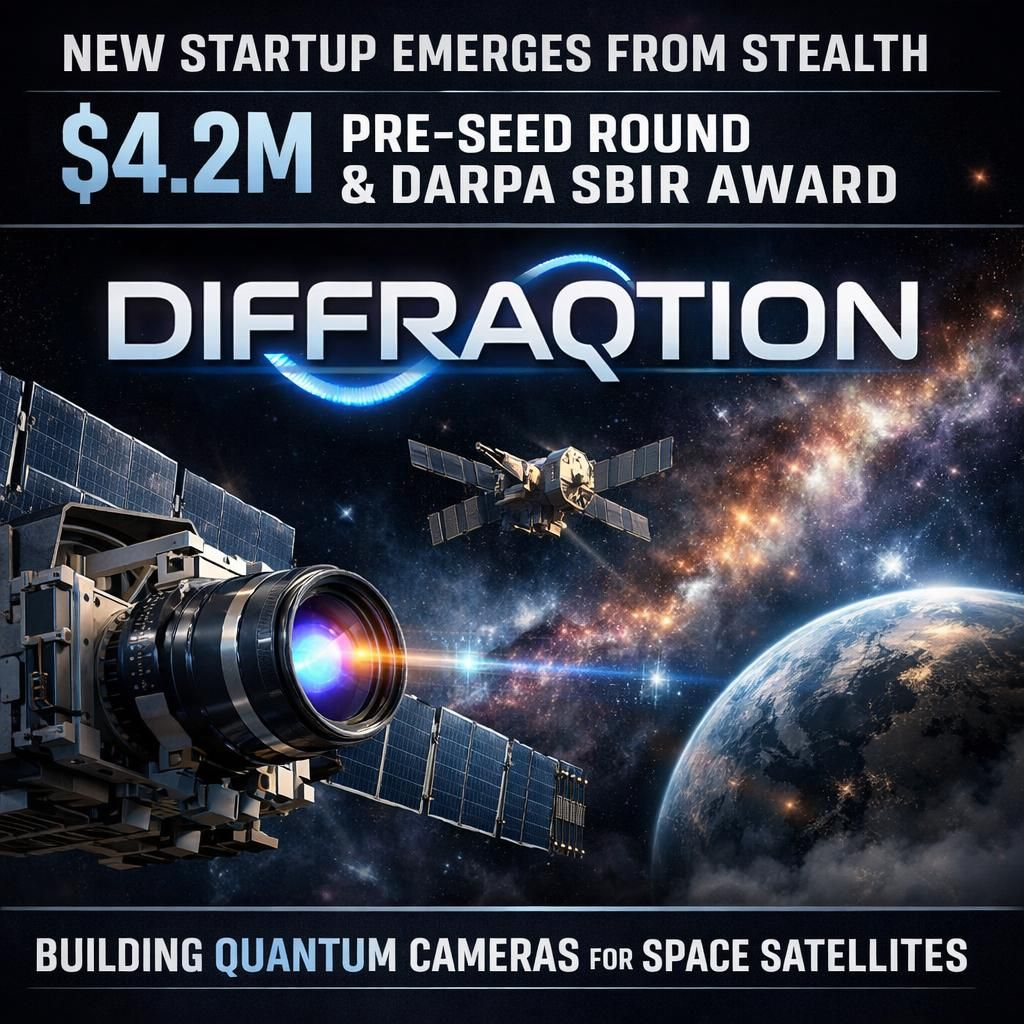
Diffraqtion, an MIT and University of Maryland spinout, has raised $4.2 million in pre-seed funding and non-dilutive contracts to deploy satellite constellations equipped with a novel quantum camera. The round was led by QDNL Participations, with a significant DARPA SBIR Direct-to-Phase 2 contract and a first-place win at SLUSH 100 contributing to the total. Based on the research of co-founder Prof. Saikat Guha, the technology offers 20x higher resolution and 1,000x faster processing than conventional systems, aiming to revolutionize space domain awareness and Earth observation.
-
SEALSQ and Kaynes SemiCon Establish SEALKAYNESQ Ltd to Secure India’s Semiconductor Supply Chain
SEALSQ Corp and Kaynes SemiCon have launched SEALKAYNESQ Ltd, a joint venture to build India’s first secure semiconductor personalization center in Gujarat. The facility will integrate SEALSQ’s Quantum Shield™ and post-quantum cryptography (PQC) into Indian-made silicon, specifically targeting mission-critical sectors like defense and finance. By combining SEALSQ’s QS7001 processors with Kaynes’ established manufacturing infrastructure—which recently shipped India’s first commercial packaged chips in late 2025—the JV aims to deliver “secure-by-design” hardware that is future-proofed against quantum threats. Commercial production of these quantum-resilient chips is slated for the second half of 2026.
-
SEALSQ and Quobly Announce Potential $200 Million Acquisition to Build Secure Silicon Quantum Systems
SEALSQ Corp has signed a non-binding MOU for the potential majority acquisition of French quantum pioneer Quobly in a deal that could reach $200 million. The move, funded by SEALSQ’s $100 million Quantum Fund, aims to merge Quobly’s CMOS-compatible silicon spin qubits with SEALSQ’s post-quantum security expertise. Based in Grenoble and leveraging CEA-Leti technology, Quobly is currently advancing its Q100T program to produce a 100-qubit chip by 2027 using standard 300mm manufacturing. This vertical integration targets a “secure-by-design” platform for sovereign European defense and financial infrastructure.
-
Colorado School of Mines Launches First Undergraduate Quantum Systems Engineering Degree in the United States
Colorado School of Mines is launching the first undergraduate Quantum Systems Engineering degree in the U.S., designed to address the specialized workforce shortage in the quantum sector. Starting in Fall 2026, the program shifts focus from traditional theoretical physics to a systems-level engineering approach, covering the full technology lifecycle from state preparation to readout. Supported by the Elevate Quantum consortium—including industry giants like IonQ and Quantinuum—students will engage in year-long, industry-sponsored capstone projects and utilize the Quantum Commons hub in Arvada for hands-on fabrication.
-
Equal1 Secures $60 Million to Deploy Silicon-Based Quantum Servers into High Performance Computing Environments
Equal1 has raised $60 million in a funding round led by the Ireland Strategic Investment Fund to deploy its silicon-based Bell-1 quantum servers into high-performance computing (HPC) environments. Utilizing its UnityQ hybrid quantum-classical silicon-on-chip (QSoC) architecture, Equal1 manufactures processors using standard CMOS techniques, allowing the hardware to operate in standard data center racks without massive dilution refrigerators. As a key milestone, the company is delivering a Bell-1 unit to the European Space Agency in Italy to demonstrate its utility as a modular accelerator for complex industrial workloads.
-
Project Eleven Secures $20 Million Series A to Protect Digital Assets from Quantum Threats
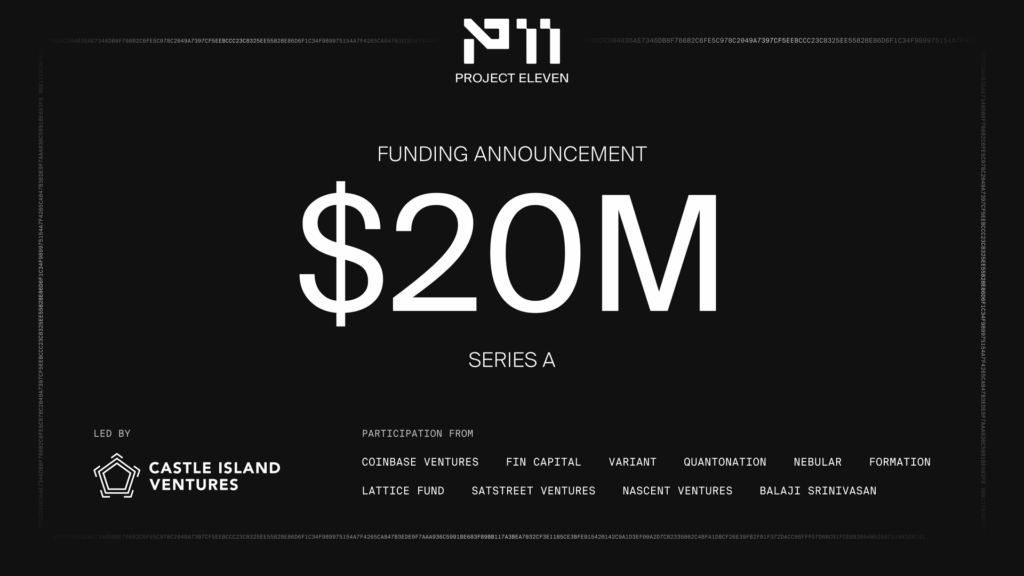
Project Eleven has secured $20 million in a Series A round led by Castle Island Ventures, valuing the firm at $120 million. The funding—supported by Coinbase Ventures and Quantonation—will be used to protect blockchain assets from quantum threats. Led by Alex Pruden and Conor Deegan, the startup has already launched “yellowpages,” a registry for post-quantum Bitcoin keys, and successfully open-sourced a quantum-resistant Solana testnet using ML-DSA signatures. Their goal is to lead the migration of decentralized networks away from elliptic curve cryptography toward a foundation based on quantum-resilient paradigms and “quantum money.”
-
PsiQuantum and Airbus Collaborate to Advance Fault-Tolerant Algorithms for Aerospace
PsiQuantum and Airbus have announced a strategic collaboration under the Airbus QuLAB project to develop fault-tolerant algorithms for aerospace. The partnership focuses on computational fluid dynamics (CFD), specifically utilizing a Quantum Lattice Boltzmann Algorithm (QLBM) to simulate incompressible fluid flows. By mapping fluid density directly onto qubits, this method aims to solve complex aerodynamic problems—like drag and vibration—faster than classical supercomputers. Airbus is utilizing PsiQuantum’s new Construct software suite to optimize these algorithms for photonic error-correction frameworks, preparing for the arrival of million-qubit systems.
-
EeroQ Demonstrates Scalable Control Architecture Capable of Controlling One Million Qubits with Less than 50 Control Lines
EeroQ has demonstrated a major breakthrough in quantum scalability, showcasing a control architecture capable of managing one million qubits with fewer than 50 control lines. Using its Wonder Lake chip—manufactured at SkyWater Technologies using 130nm process technology—EeroQ leverages electrons on superfluid helium as qubits. By utilizing an Addressable Gate Array (AGA) and CCD-like transport sequences, the team successfully shuttled electron packets across 128 channels using only 14 control voltages. This logarithmic scaling approach solves the “wire problem” that plagues other modalities, positioning electrons-on-helium as a highly manufacturable path toward large-scale, fault-tolerant quantum processors.
-
-
-
Honeywell Announces Quantinuum LLC Plan to Confidentially Submit Draft Registration Statement for Proposed Initial Public Offering
Honeywell has announced that its majority-owned subsidiary, Quantinuum LLC, plans to confidentially submit a draft registration statement on Form S-1 with the SEC for a proposed Initial Public Offering (IPO). This move marks a pivotal shift for the sector as the first major traditional IPO following a wave of SPAC listings. Formed from the 2021 merger of Honeywell Quantum Solutions and Cambridge Quantum, the company is backed by a powerhouse roster including J.P. Morgan, NVIDIA, IBM, and Amgen. The capital from the offering is intended to accelerate the scaling of Quantinuum’s H-Series trapped-ion hardware and its QCCD architecture toward universal, fault-tolerant quantum computing.
-
-
-
Welinq Executes First Commercial Sale of QDrive Quantum Memory to Slovak Academy of Sciences
Welinq has announced the first commercial sale of its QDrive quantum memory to the Slovak Academy of Sciences, marking a key transition from research to infrastructure. The rack-mountable system, which utilizes laser-cooled rubidium atoms and operates at room temperature, will be integrated into the Slovak Quantum Communication Infrastructure (skQCI). With a world-record 90% storage-and-retrieval efficiency, the QDrive acts as a critical buffer for synchronization across network nodes, supporting Slovakia’s goal of a quantum-secure backbone for national institutions and advancing Welinq’s vision for distributed quantum data centers.
-
Xanadu and Thorlabs Partner to Scale Optical Components for Photonic Quantum Computing
Xanadu Quantum Technologies has partnered with Thorlabs to develop custom optical fiber components designed to solve phase and polarization stability issues in photonic qubits. By leveraging Thorlabs’ industrial manufacturing, Xanadu aims to reduce optical loss and qubit overhead for its Aurora modular systems. This collaboration comes as Xanadu prepares for a public listing via a $3.1 billion merger with Crane Harbor Acquisition Corp (CHAC), a move expected to provide $500 million in proceeds to fund its roadmap toward a 100,000-qubit fault-tolerant system by 2029.
-
Haiqu Raises $11 Million Seed Round to Launch Hardware-Aware Quantum Operating System
Haiqu has raised $11 million in a seed round led by Primary Venture Partners to launch its hardware-aware quantum operating system. The software aims to reduce the cost of running near-term quantum applications by up to 100x through “error shielding” and circuit optimization at the middleware layer. This funding follows a successful 2025 pilot with IBM and the Bank of Montreal, where Haiqu loaded 500 data features onto a 128-qubit processor for anomaly detection. With the hiring of former Microsoft Quantum PM Antonio Mei, Haiqu is now opening an Early Access Program to help enterprises run complex workloads on existing NISQ hardware.
-
-
-
Q*Bird Secures €7.5 Million ($8.75 Million USD) in Blended Finance from EIC Accelerator to Scale Quantum Secure Networks
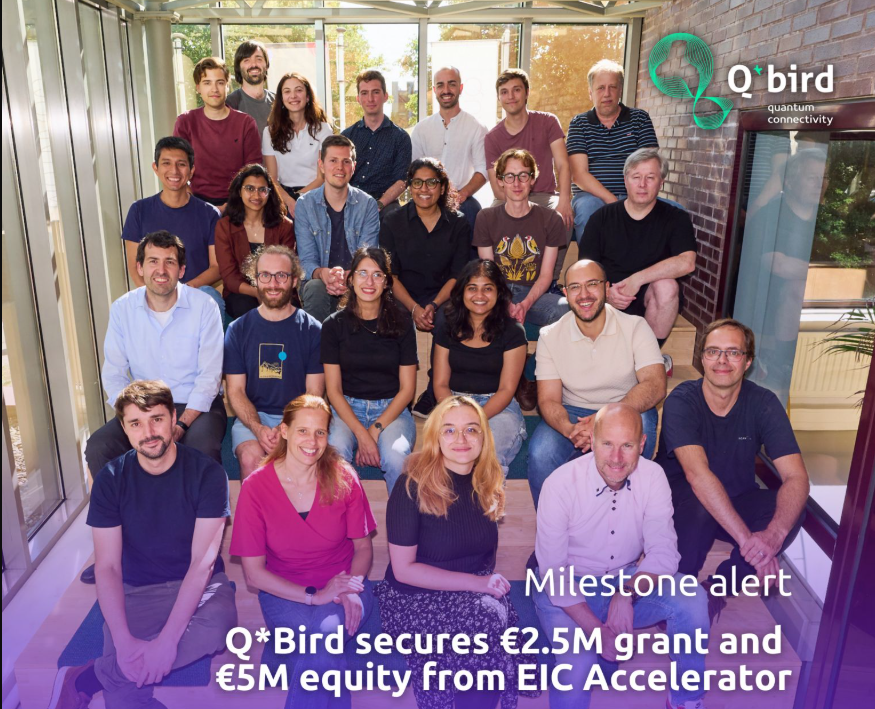
Q*Bird, a Delft-based quantum networking firm, has secured €7.5 million ($8.75 million USD) in blended finance from the EIC Accelerator to scale its NEXUS project. The funding supports the development of Measurement-Device-Independent Quantum Key Distribution (MDI-QKD), a hub-and-spoke architecture that eliminates detector-based vulnerabilities and removes the need for “trusted nodes.” Already deployed at the Port of Rotterdam, QBird’s technology aims to provide a sovereign, continental-scale quantum infrastructure for Europe, bridging the gap between isolated pilots and a federated quantum internet.
-
SEEQC Establishes US-Taiwan Quantum Technology Ecosystem to Accelerate Chip-Based Scaling
SEEQC has launched a strategic US-Taiwan quantum ecosystem to scale its chip-based Single Flux Quantum (SFQ) platform. The initiative pairs SEEQC’s digital control IP with Taiwan’s semiconductor manufacturing giants; Kinpo Group is co-developing room-temperature electronics, while ITRI handles the production of superconducting control processors. Additionally, National Taiwan University and UC Berkeley are collaborating on a TSMC tape-out to integrate classical and quantum logic on a single System-on-Chip (SoC). This “allied supply chain” aims to bypass the energy bottlenecks of current cryogenic systems and move quantum hardware into high-volume commercial production.
-
University of Maryland and Zapata Quantum Partner on Formal Verification for Quantum Algorithms
The University of Maryland and Zapata Quantum have launched a collaboration to introduce formal verification into quantum software, moving away from error-prone manual coding. Led by Yudong Cao and Runzhou Tao, the initiative uses mathematical proofs to ensure that high-level algorithms—starting with Shor’s algorithm—accurately match their executed quantum circuits. By establishing a “verification-first” model, the partnership aims to provide reliable resource benchmarks for fault-tolerant hardware and create a template for mission-critical applications in chemistry, finance, and materials science.
-
Forward Edge-AI Expands Global Partner Network to Accelerate Post-Quantum Migration
Forward Edge-AI has expanded its global partner network to accelerate the migration to post-quantum cryptography (PQC), adding major partners like Microsoft, Lumen, and Cubic. At the heart of this expansion is the Isidore Quantum® platform, a “plug-and-play” hardware solution that secures data without requiring a full network re-architecture. Validated through 23 military pilots, the system meets CNSA 2.0 standards, offers sub-0.5ms latency, and reduces total cost of ownership by 60%. This rollout aims to provide immediate protection against “Harvest Now, Decrypt Later” threats for critical infrastructure and defense sectors.
-
Polaris Quantum Biotech Study Demonstrates Quantum Advantage Over Generative AI in Drug Discovery
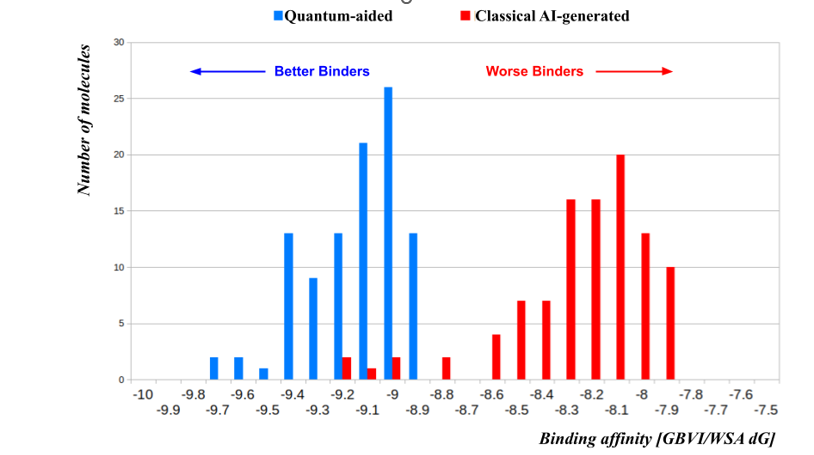
Polaris Quantum Biotech (PolarisQB) has published a study on ChemRxiv demonstrating that its QuADD platform, powered by D-Wave’s quantum annealing, significantly outperforms classical Generative AI in drug discovery. Using the blood-clotting enzyme Thrombin as a case study, QuADD generated 3,000 molecular candidates in just 30 minutes, compared to 40 hours for the AI-based BInD model. The quantum-generated molecules showed superior binding affinity and higher synthetic feasibility, prompting clinical-stage biopharma Auransa to adopt the platform to accelerate the design of “correct-first” molecular leads.
-
-
-
Rigetti Computing Announces a Delay in the General Availability of Its Cepheus-1-108Q Processor
Rigeiti has announced a delay in the general availability of their Cepheus-1-108Q processor which is a 108 qubit quantum computer consisting of 12 nine-qubit modules. It can be thought of as the extension of the company’s previous Cepheus-1-36Q processor which is composed of four nine-qubit modules that was deployed in August of last year.
-