
News
Company, funding, product and policy news from across the quantum industry, as it happens.
-
-
Mitsui, QSimulate, and Quantinuum Launch QIDO Platform for Quantum-Integrated Drug and Materials Discovery
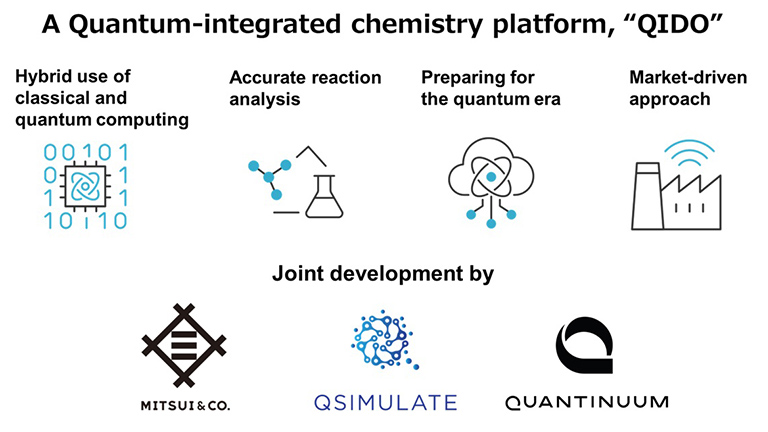
Mitsui & Co., Ltd., QSimulate, and Quantinuum have launched a new quantum-integrated chemistry platform called QIDO (Quantum-Integrated Discovery Orchestrator). The hybrid platform combines QSimulate's classical software with Quantinuum’s InQuanto to streamline workflows for high-precision chemical reaction modeling. The platform aims to reduce the time and cost of developing new drugs and materials, with use cases including catalyst and enzyme design and battery efficiency.
-
Palo Alto Networks Introduces PAN-OS 12.1 Orion with Post-Quantum Cryptography Features
Palo Alto Networks has introduced PAN-OS® 12.1 Orion, a new operating system with a focus on post-quantum cryptography (PQC) readiness. The release includes a Quantum Readiness assessment and a cipher translation feature for legacy applications, as well as new quantum-optimized Next-Generation Firewalls (NGFWs) designed to inspect PQC-encrypted traffic.
-
ORNL Selects IQM Radiance as First On-Premises Quantum Computer for HPC Integration
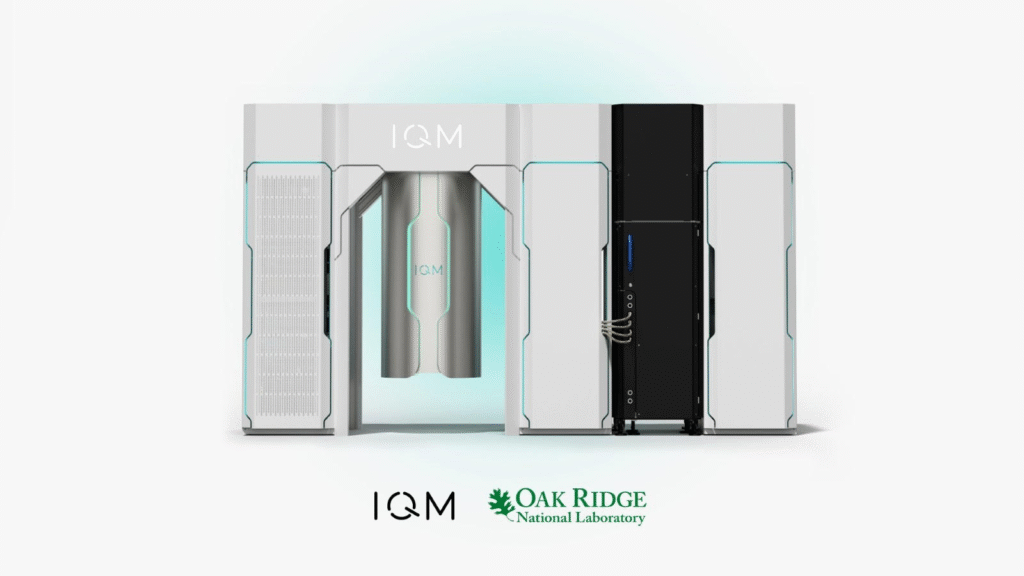
The U.S. Department of Energy’s Oak Ridge National Laboratory (ORNL) has selected IQM Radiance as its first on-premises quantum computer, with delivery slated for the third quarter of 2025. This 20-qubit superconducting quantum computer will be tightly integrated with ORNL’s high-performance computing (HPC) systems, providing researchers with hands-on access to advance hybrid quantum-classical application development and explore early quantum advantage.
-
ORCA Computing Deploys Two Photonic Quantum Systems at Montana State University
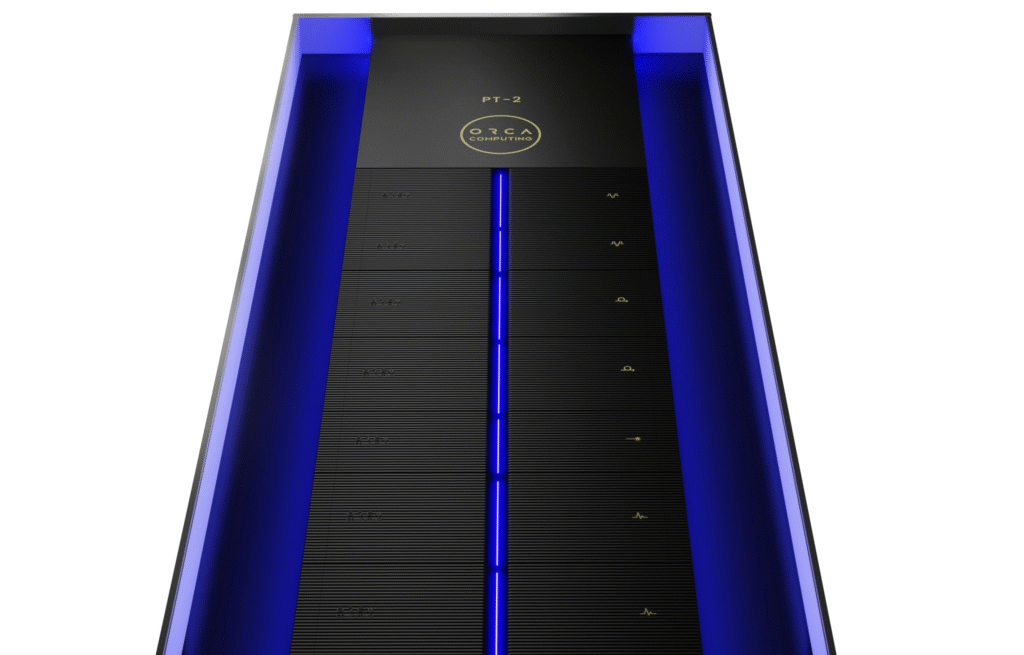
ORCA Computing has deployed two of its PT Series photonic quantum systems at Montana State University’s Applied Quantum CORE (QCORE) facility. The deployment, part of a $26.7 million U.S. Air Force-supported initiative, will provide researchers with access for applications research, including a demonstration of a hybrid quantum/classical generative machine learning algorithm for peptide generation.
-
-
-
Qunova Computing Closes $10 Million Series A Funding for HI-VQE Quantum Algorithm
Qunova Computing, a developer of quantum software applications based in Daejeon, South Korea, has announced a Series A funding round of $10 million USD (13.5 billion Korean Won). The round includes investments from GS Ventures, Korea Development Bank, GU Equity Partners, Company K, Quantum Ventures Korea, JB Investments, CKD Venture Capital and Daesung Private Equity. This funding is intended to support the company’s next phase of evolution, which includes deploying additional capital for team expansion.
-
-
-
Quantum Computing Inc. Reports on Its Q2 2025 Financial Results
Quantum Computing Inc. (QCi) has released its financial results for the second quarter of 2025, highlighting new customer wins, the launch of its chip foundry, and a strengthened balance sheet. The company reported second-quarter revenues of $61 thousand, marking a 56.4% increase from Q1 2025 but a significant 66.6% decline from the $183 thousand recorded in Q2 2024. The gross margin for the quarter was 43%, a notable change from the 32% margin in Q2 2024, which QCi attributed to a shift in revenue from customized R&D to consulting services in the prior period. For more about their Q2 2025 financial results, read the rest of our report on it here.
-
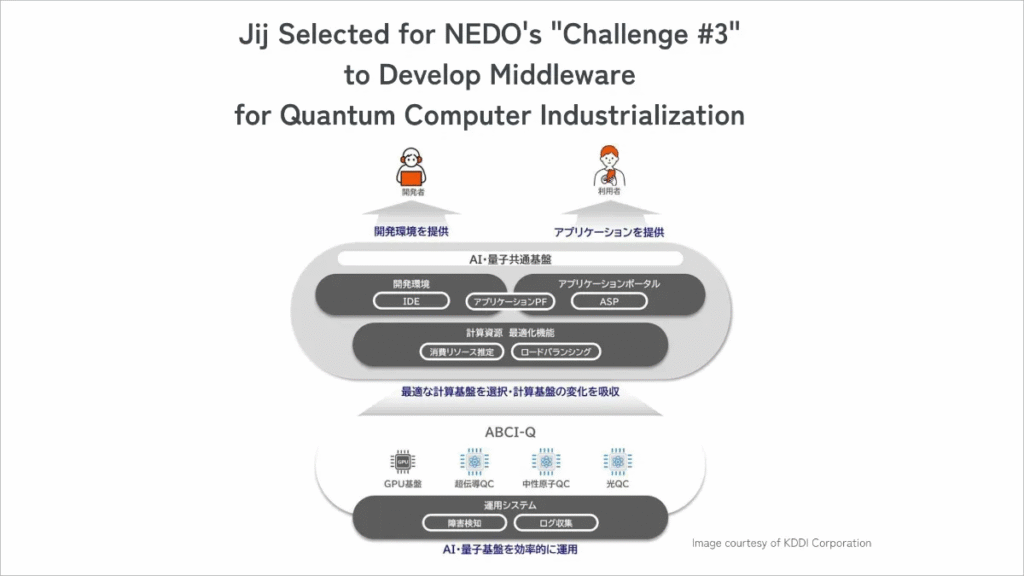
KDDI Selected by NEDO for Middleware Development to Industrialize Quantum Computers in Japan
KDDI Corporation has been selected by NEDO to lead a project for developing middleware to industrialize quantum computers in Japan. KDDI will lead a collaboration of ten domestic institutions to build an “AI-quantum common platform,” which aims to accelerate the industrial use of quantum computers and lower the barrier to entry for users by abstracting complex functions.
-
Terra Quantum Introduces QMM-Enhanced Error Correction, Validated on IBM Hardware
Terra Quantum has published a paper detailing QMM-Enhanced Error Correction, a new measurement-free method validated on IBM’s superconducting processors. This approach, which uses a Quantum Memory Matrix (QMM), reportedly increases logical fidelity to 94% and requires ten times fewer qubits than a distance-3 surface code, making it suitable for NISQ-era processors.
-
Caltech Researchers Develop Hybrid Quantum Memory Using Sound to Store Quantum Information
Researchers at Caltech have developed a new hybrid quantum memory that uses sound to store quantum information from superconducting qubits, as detailed in a paper in Nature Physics. The system, which uses a mechanical oscillator to translate electrical signals into sound waves, stores quantum states for a period up to 30 times longer than other techniques.
-
Quantum-Safe 360 Alliance, Including Keyfactor and IBM Consulting, Unveils PQC Transition Guidance
The Quantum-Safe 360 Alliance, with members Keyfactor, IBM Consulting, Thales, and Quantinuum, has released its first white paper to guide organizations through the transition to Post-Quantum Cryptography (PQC). The alliance, which formally debuted with this paper, aims to provide a strategic roadmap for adopting cryptographic agility and building a quantum-safe infrastructure through collaboration.
-
-
-
Rigetti Computing Reports on Its Q2 2025 Financial Results
Rigetti reported revenue of $1.8 million for Q2 2025, a 20.0% increase from the previous quarter, but a 41.9% decline from the year-ago quarter. The operating loss narrowed slightly to ($19.9) million from Q1, but the net loss for the quarter widened significantly to ($39.7) million, primarily due to a $22.8 million non-cash loss from the change in fair value of derivative warrant and earn-out liabilities. The most significant financial highlight was the company’s liquidity position, which was dramatically bolstered by a $350 million at-the-market (ATM) equity offering. The company also reported technical progress with commercial availability of its chiplet based Cepheus-1-36Q system and continued improvement in its two-qubit gate error rate.
-
Amazon Braket Launches Program Sets to Accelerate Quantum Algorithm Execution
Amazon Braket has launched a new feature called “program sets,” which allows customers to bundle up to 100 quantum circuits into a single task. This new capability is intended to accelerate quantum algorithm execution, with a reported speedup of up to 24x on Rigetti and IQM superconducting QPUs, by reducing processing overhead.
-
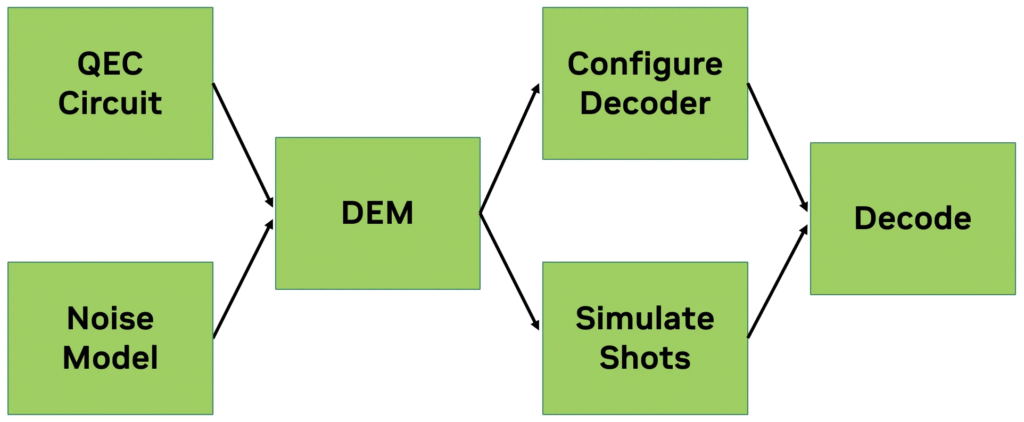
NVIDIA Releases CUDA-QX 0.4 to Streamline Quantum Error Correction and Application Development
NVIDIA has released CUDA-QX 0.4, a new software development kit to streamline quantum error correction (QEC) and application development. The release introduces a new GPU-accelerated tensor network decoder, the Generative Quantum Eigensolver (GQE), and the ability to automatically generate a detector error model (DEM) to accelerate the path to large-scale quantum computers.
-
Quantinuum and IonQ Receive Investments from Quanta and Amazon, Signaling Increased Venture Capital in Quantum Sector
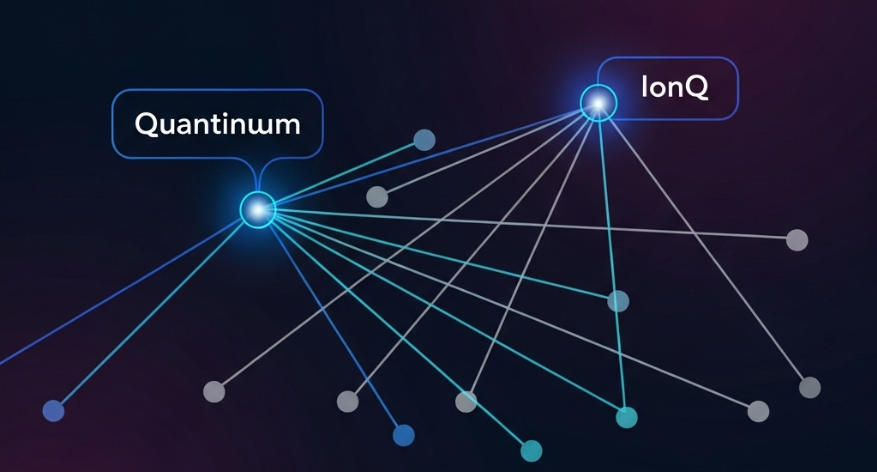
Quantinuum has received a $50 million Series B investment from Quanta Computer Inc., while Amazon has acquired a $36.7 million stake in IonQ. These concurrent investments from a hardware manufacturer and a major tech company signal increased confidence and financial support for the quantum computing sector.
-
-
-
Who’s News: Leadership Updates at Qomputing.AI, Oxford Quantum Circuits, QuSecure, and IonQ
In this edition of "Who's News," Qomputing.AI has been founded by Saurabh Sharma, who will serve as CEO. Oxford Quantum Circuits (OQC) appointed Gerald Mullally as its new CEO and Robert Coutts as CFO to support global expansion. QuSecure named Jennifer Leggio as Senior VP of Marketing and Revenue Operations, while IonQ added several new leaders, including Dr. Marco Pistoia as Senior VP of Industry Relations, and four new VPs to its engineering and business teams.
-
SignQuantum and ITTI Partner to Secure Digital Signatures with Post-Quantum Cryptography and Blockchain in Latin America
ITTI, a digital transformation provider in Paraguay, has signed an exclusive distribution agreement with SignQuantum for Latin America. The partnership will deliver a quantum-resistant e-signature add-on to ITTI's clients in the financial and public sectors. The solution uses a NIST-recommended post-quantum algorithm and leverages the QANplatform blockchain for immutable time-stamping, which addresses vulnerabilities from future quantum computers.
-
K1 Semiconductor Joins Chicago Quantum Exchange as Corporate Partner
K1 Semiconductor, a deep tech startup with a semiconductor wafer-splitting technique, has joined the Chicago Quantum Exchange (CQE) as a corporate partner. The company’s process, which enables up to 20x wafer reuse for materials like diamond and silicon carbide, aims to bridge materials research with scalable, U.S.-based manufacturing to support a domestic quantum supply chain.
-
Oxford Ionics Installs Full-Stack Trapped-Ion Quantum Computer at UK’s National Quantum Computing Centre
Oxford Ionics has delivered and installed QUARTET, a full-stack trapped-ion quantum computer, at the UK’s National Quantum Computing Centre (NQCC). The system leverages the company’s proprietary Electronic Qubit Control technology, which uses electronics instead of lasers, to support scalability. This installation is a pivotal step for the NQCC’s testbeds initiative and the UK’s Quantum Missions program.
-
Xanadu and DISCO Collaborate on Advanced Wafer Processing for Photonic Quantum Computing
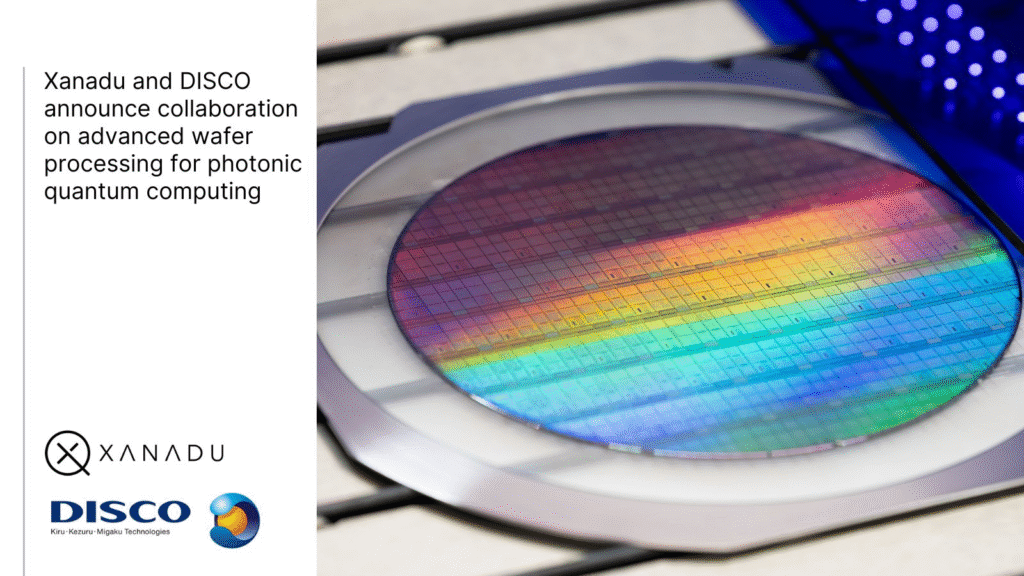
Xanadu and DISCO Corporation have partnered to develop advanced wafer processing techniques for ultra-low loss photonic integrated chips, a step towards scaling photonic quantum computing. The collaboration leverages DISCO’s Kiru (cutting), Kezuru (grinding), and Migaku (polishing) technologies to improve wafer dicing and polishing, which reduces optical losses and streamlines manufacturing.
-
-
-
OPTIA and Patero Launch PQC-Enabled GPU Compute Platform for Defense and Edge Applications
OPTIA and Patero have launched a joint solution that integrates Patero’s CryptoQoR™ encryption suite into OPTIA’s NVIDIA-based GPU systems. This PQC-enabled GPU server is designed for mission-critical defense and commercial applications, aligning with federal mandates like Executive Order 14028 and National Security Memo 10.
-
Polaris Quantum Biotech Launches QuADD Platform for Quantum-Aided Drug Discovery
Polaris Quantum Biotech (PolarisQB) has launched QuADD (Quantum-Aided Drug Design), a new SaaS platform for drug discovery that uses quantum computing and artificial intelligence. The platform, which leverages D-Wave quantum annealers, is designed to solve combinatorial library optimization problems and explore a chemical space of up to 10³⁰ theoretical molecules to accelerate drug candidate identification.
-
Wave Photonics Launches PDK Management Platform with CORNERSTONE to Streamline Photonic Chip Design
Wave Photonics has launched its PDK Management Platform, with CORNERSTONE as the first foundry adopter. The platform integrates foundry PDKs with major Electronic Design Automation (EDA) tools, automatically generating S-parameters and documentation to streamline the design process for photonic integrated circuits (PICs).
-
-
-
DARPA’s QuANET Program Demonstrates First Functioning Quantum-Augmented Network
DARPA's Quantum-Augmented Network (QuANET) program has demonstrated the first functioning quantum-augmented network, successfully integrating quantum systems into classical infrastructure. The demonstration reduced message transmission time from five minutes to 0.7 milliseconds, achieving a bit rate of 6.8 Mbps. The program aims to improve security, efficiency, and resiliency in global communications.
-
-
-
Africa Quantum Consortium Launches to Unify and Coordinate Africa’s Quantum Ecosystem
The Africa Quantum Consortium (AQC), a new pan-African initiative, has officially launched as a platform to coordinate quantum science, education, innovation, and policy across the continent. Organized around four strategic pillars—Unify, Clarify, Influence, and Fund—the AQC aims to build a sovereign and sustainable quantum ecosystem that reflects African priorities.
-
-
-
Japan Launches Fully Domestically Produced Quantum Computer in Collaboration with RIKEN and Fujitsu
Japan has launched a fully domestically produced superconducting quantum computer at the University of Osaka’s QIQB, a collaboration with RIKEN and Fujitsu. The project achieved technological self-reliance by replacing previously imported components with domestic alternatives, demonstrating the nation’s capacity to design, manufacture, and integrate a complete quantum system.
-