
News
Company, funding, product and policy news from across the quantum industry, as it happens.
-
-
D-Wave Quantum Advances Cryogenic Packaging for Multichip Quantum Processor Interconnect
D-Wave Quantum Inc. has announced a new strategic initiative for advanced cryogenic packaging to scale its quantum processors. Leveraging expertise from NASA Jet Propulsion Laboratory (JPL), D-Wave has demonstrated superconducting interconnect between chips using JPL’s bump-bond process. This effort aims to accelerate the development of both their annealing and fluxonium-based gate-model architectures toward 100,000 qubits.
-
Keyfactor Report Indicates Nearly Half of Enterprises Unprepared for Post-Quantum Cryptography Threats
Keyfactor's Digital Trust Digest: The Quantum Readiness Edition reports that 48% of surveyed organizations are unprepared for Post-Quantum Cryptography (PQC) threats, which could render current encryption obsolete. Challenges include a lack of skilled personnel and unclear industry standards. The study highlights a disconnect in risk perception between C-suite executives and VPs/Directors.
-
Classiq Expands Series C Round with Investments from SoftBank Vision Fund 2 and CDP Venture Capital
Classiq, a quantum software company, has expanded its Series C funding round with new investments from SoftBank Vision Fund 2 and CDP Venture Capital. The new capital will accelerate product development and global partnerships for Classiq's high-level development platform, which designs and optimizes quantum circuits by abstracting hardware complexities using proprietary algorithmic quantum circuit compilation technology.
-
-
-
Horizon Quantum Joins QuEra Quantum Alliance to Strengthen Neutral-Atom Software Ecosystem
Horizon Quantum has joined the QuEra Quantum Alliance, aiming to integrate its software development tools with QuEra’s technologies. This partnership will enable users to code, compile, and deploy quantum applications on neutral-atom quantum computers, strengthening the neutral-atom software ecosystem.
-
-
-
Who’s News: Leadership Updates at Q-CTRL, IonQ, University of Maryland, eleQtron, and JPMorgan Chase
In "Who's News," Q-CTRL expanded its Board with Nicole Conner (Airbus Ventures) and Per Roman (Bullhound Capital). IonQ strengthened its leadership, appointing Dr. Rick Muller as VP of Quantum Systems Accelerator and Paul T. Dacier as Chief Legal Officer. The University of Maryland named Dr. Gretchen Campbell Associate VP for Quantum Research and Education, while eleQtron hired Kaoru Naganuma as Chief Product Officer. Finally, JPMorgan Chase appointed Rob Otter to lead its quantum computing research team.
-
SuperQ Quantum Announces Initial Revenue from D-Wave Collaboration on Robotic Motion Planning
SuperQ Quantum has announced its first revenue contract, generated through a collaboration with D-Wave Quantum Inc. and Verge Ag on an agricultural quantum optimization project. This project focuses on robotic motion planning to optimize robot movement in agricultural fields using quantum annealing. Canada’s DIGITAL cluster is co-investing, calling it the "world's first customer-facing, real-world product powered by quantum computing."
-
-
-
Universal Quantum Joins Open Quantum Institute for Endometriosis Drug Discovery via Quantum Computing
Universal Quantum has joined the Open Quantum Institute (OQI) to apply quantum computing to global health challenges. The collaboration begins with a drug discovery project focused on endometriosis, investigating how quantum simulations can accelerate the discovery of non-hormonal therapeutics.
-
University of Chicago and IBM Provide IBM Quantum System Two Access and Resources for Illinois Quantum Startups
IBM and the University of Chicago plan to offer Duality startups access to an IBM Quantum System Two at the Illinois Quantum and Microelectronics Park (IQMP). Selected startups will also receive IBM Ventures funding and cloud access to IBM's quantum computers, expanding support for Illinois' quantum ecosystem.
-
Quantum Brilliance and Collaborators Outline Path for Scalable Diamond Quantum Technology via Bottom-Up Fabrication
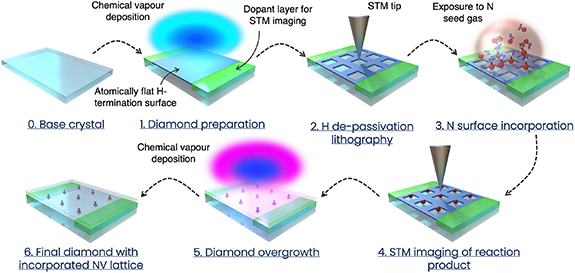
Quantum Brilliance, RMIT University, La Trobe University, and Fraunhofer IAF have published research in Mater. Quantum Technol. outlining a path for scalable diamond quantum technology via bottom-up fabrication. The paper proposes atomic scale fabrication (ASF), specifically a hydrogen depassivation lithography (HDL) technique, for precisely creating Nitrogen-Vacancy (NV) centers as qubits in diamond. This method aims to enable integrated room-temperature quantum computing and sensing devices.
-
Aegiq and Pixel Photonics Combine Single-Photon Sources and WI-SNSPDs for Scalable Photonic Quantum Computing
Aegiq, a UK-based photonic quantum computing company, and Pixel Photonics, a single-photon detection company, have signed an MoU to integrate their technologies. The collaboration will combine Aegiq’s single-photon sources with Pixel Photonics’ waveguide-integrated superconducting nanowire detectors (WI-SNSPDs) on a shared photonic platform. This aims to build a scalable and practical quantum computing stack.
-
Diraq Secures $500,000 AUD ($330,000 USD) CTCP Funding to Explore Quantum Applications in Energy Networks
Diraq has secured AU$500,000 ($330,000 USD) in Critical Technologies Challenge Program (CTCP) funding from the Australian Government. This grant will support a project to explore how quantum computers can optimize energy networks, integrating Diraq's software with real-time simulation tools and involving partners like UNSW Sydney and the Australian Energy Market Operator.
-
Q.ANT Secures €62 Million ($73 Million USD) Series A Funding to Advance Quantum Sensor Development and Commercialization
Q.ANT, a German photonic processing company, has secured €62 million ($73 million USD) in Series A funding. Concurrently, Q.ANT has delivered its Native Processing Server (NPS), a photonic AI co-processor, to the Leibniz Supercomputing Centre (LRZ) in Germany. This marks the first integration of an analog photonic co-processor into an operational HPC environment, aiming for significantly lower power consumption and increased data center capacity.
-
IonQ and Emergence Quantum Collaborate to Advance Quantum Hardware in Australia
IonQ has announced a strategic collaboration with Emergence Quantum, an Australian R&D company, to advance quantum hardware in Australia. This partnership will focus on co-developing next-generation electronics and materials for ion trap technology, including application-specific integrated circuits for qubit control. The initiative aims to strengthen Australia's quantum capabilities and supports IonQ's global expansion in the APAC region.
-
BTQ Technologies Introduces Léonne: A Topological Consensus Framework for Quantum-Secure Blockchains
BTQ Technologies Corp. (BTQ) has launched Léonne, a new blockchain consensus framework designed to address the "blockchain trilemma" of scalability, security, and decentralization. Léonne introduces Topological Consensus Networks and a Proof-of-Consensus system, integrating Quantum Random Number Generation (QRNG), Quantum Key Distribution (QKD), and quantum-enhanced trust matrices for information-theoretic security.
-
-
-
Infleqtion to Lead $50 Million Neutral Atom Quantum Technology Program in Illinois
Infleqtion will lead a new neutral atom quantum technology program in Illinois, established as a public-private partnership with the Illinois Quantum and Microelectronics Park (IQMP) and the National Quantum Algorithms Center (NQAC). This initiative aims to build a utility-scale, neutral atom quantum computer in Illinois, with the system targeting 100 logical qubits and leveraging thousands of neutral atom qubits. This partnership will span over the next four years with an expected budget of $50 Million.
-
Strangeworks Extends Quantum and AI Technologies to India and Sri Lanka
Strangeworks is expanding its global presence by entering the Indian and Sri Lankan markets, adding to its existing footprint in the US, Europe, and Japan. This move aims to provide quantum and AI technologies to enterprises and research institutions, leveraging India's National Quantum Mission (NQM) and building on existing collaborations, such as with BQP.
-
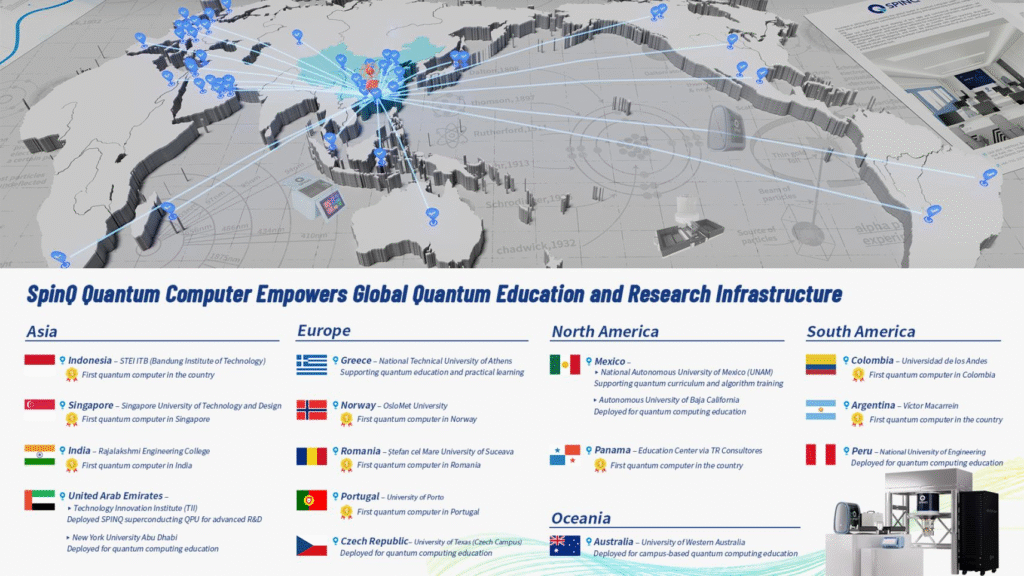
SpinQ Secures Several Hundred Million RMB in Series B Funding for Technological Upgrades and Commercial Expansion
SpinQ Technology Inc. (SpinQ) has closed a Series B funding round, securing several hundred million RMB from investors including government-backed funds like CCB Private Equity Investment Management Company and institutional investors such as StarsUp Investment. This financing aims to accelerate SpinQ’s technological upgrades and commercial expansion, supporting its presence in superconducting quantum computers, NMR quantum computers, and its quantum computing cloud platform.
-
-
-
Amazon Braket Launches IQM Emerald 54-Qubit Superconducting Quantum Processor
Amazon Braket has launched IQM Quantum Computers' Emerald, a 54-qubit superconducting QPU featuring the Crystal 54 architecture. Now generally available in the Europe (Stockholm) Region, Emerald offers higher fidelity gates and full square lattice connectivity, natively supporting surface-code error correction. It will be available for 19 hours daily, alongside IQM's Garnet device, expanding hardware options for quantum algorithm development.
-
Riverlane and OQC Advance Fault-Tolerant Quantum Computing with Deltaflow 2 QEC Integration
Riverlane has integrated its Deltaflow 2 quantum error correction (QEC) technology at a commercial data center with an Oxford Quantum Circuits (OQC) quantum computer in the UK. This marks the first such deployment in a UK commercial setting, leveraging streaming quantum memory for real-time error correction. This initiative, part of the UK Government-funded DECIDE project, advances towards scalable, fault-tolerant quantum computing.
-
-
-
Alchemist Accelerator and University of Chicago Launch Deep Tech Accelerator for Foundational Innovation to Enhance Chicago’s Duality Accelerator Program
Alchemist Accelerator and the University of Chicago’s Polsky Center have launched Alchemist Chicago, a new deep tech accelerator. This program will support early-stage ventures in quantum, AI, cleantech, and robotics, aiming to transition scientific breakthroughs from lab to market. It offers coaching, mentorship, and investment to global founders, with initial phases in late 2025 and early 2026.
-
D-Wave Study Reports Over One-Quarter of Business Leaders Expect Quantum Optimization ROI of $5 Million or Higher
D-Wave Quantum Inc. has released a new study indicating that over one-quarter of business leaders (27%) expect an ROI of more than $5 million from quantum optimization within the first 12 months. The study, surveying 400 leaders, found that 81% believe classical optimization limits have been reached, with 19% having already integrated quantum computing and an additional 53% planning adoption.
-
-
-
Moderna and IBM Demonstrate Quantum-Classical Approach for mRNA Secondary Structure Prediction
Moderna and IBM have demonstrated a quantum-classical approach for mRNA secondary structure prediction, detailed in a new case study. Their collaboration applies Conditional Value at Risk (CVaR) to enhance Variational Quantum Algorithms (VQAs) on IBM Quantum Heron processors, achieving record scales for quantum secondary structure simulation.
-
Forescout Research Details PQC Adoption Status and Associated Cybersecurity Risks
Forescout Research – Vedere Labs reports that Post-Quantum Cryptography (PQC) adoption is uneven, with only 6% of 186 million SSH servers globally using quantum-safe encryption. While adoption of ML-KEM and SNTRUP has surged, nearly three-quarters of OpenSSH versions and most TLS servers (which only support PQC in TLSv1.3) do not support quantum-safe encryption, posing future compliance and cybersecurity risks.
-
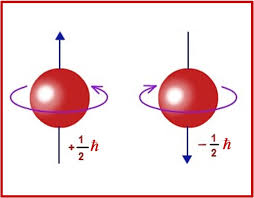
New Hebrew University Technique Extends Atomic Spin Coherence Time by Ninefold
Researchers at Hebrew University, in collaboration with Cornell University, have unveiled a novel method to significantly enhance the coherence of atomic spins, a critical advancement for the stability and precision of quantum memory systems, sensors, and navigation technologies. Published in Physical Review Letters, their work demonstrates a ninefold increase in the spin orientation retention time of cesium atoms.
-
-
-
Oxford Ionics and Iceberg Quantum Partner to Design Fault-Tolerant Quantum Architecture
Oxford Ionics and Iceberg Quantum have partnered to design a fault-tolerant quantum architecture, collaborating as part of DARPA’s Quantum Benchmarking Initiative (QBI). The collaboration leverages Oxford Ionics' trapped-ion technology with Iceberg Quantum's Quantum Low-Density Parity-Check (qLDPC) codes, which are known for combining error protection with reduced qubit overhead, aiming to accelerate scalable fault-tolerant quantum computing.
-