We had reported last month that Quantinuum had submitted a confidential S-1 filing with the U.S. Securities and Exchange Commission (SEC). But now, Quantinuum has now updated the filing to publicly release most of the material, with the exception of details related to the proposed number and pricing of the shares and ownership percentages. Quantinuum was formed in 2021 through the merger of Honeywell Quantum Solutions and Cambridge Quantum, the company is a vertically integrated, full-stack quantum computing company. Although the final valuation of the company hasn’t been determined yet, it is expected be in the many billions of dollars.
While Quantinuum has previously shared its technical milestones that we had reported in previous articles in the Quantum Computing Report by GQI, this S-1 document discloses significant new information regarding its financial health, organizational restructuring, and product roadmap.
Financial Disclosures
The filing provides the first comprehensive look at Quantinuum’s financial performance as a standalone entity:
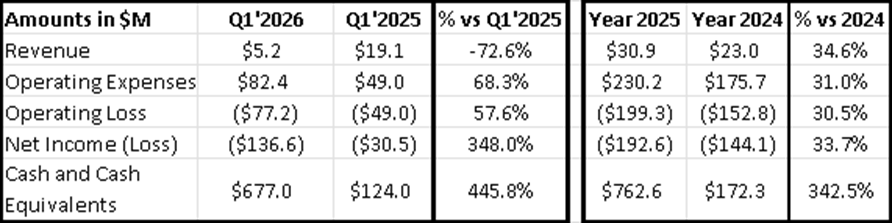
- Revenue and Losses: For the fiscal year ended December 31, 2025, Quantinuum reported $30.9 million in net revenue and a net loss of $192.6 million. The company anticipates continued losses as it scales manufacturing and R&D.
- Bookings: In 2025, the company achieved $79.3 million in bookings, representing the aggregate value of customer contracts executed that year.
- Capital Investment: Quantinuum has invested more than $2 billion in R&D over the last decade. As of March 31, 2026, it held $677 million in cash and cash equivalents.
The table below provides a comparison between key financial metrics for Q1 2026 and Q1 2025 as well as a comparison for year-end 2025 versus 2024.
The “Up-C” Reorganization
Quantinuum will utilize an “Up-C” structure for its IPO. Under this arrangement:
- Quantinuum Inc. will be a holding company whose sole asset is a managing interest in Quantinuum Holdings, LLC.
- Tax Receivable Agreement (TRA): A significant previously non-public detail is the TRA, which requires Quantinuum Inc. to pay “Continuing Common Unitholders” (primarily Honeywell and Cambridge Quantum) 85% of the cash tax savings realized from the IPO and future unit exchanges. These payments are expected to be “substantial”.
- Dual-Class Stock: The company will have Class A (public) and Class B (voting only, no economic rights) common stock.
Strategic Governance and Honeywell Influence
- Current Shareholders: Honeywell is the controlling shareholder with 55% ownership. Post-IPO, Honeywell will retain significant influence. Preexisting Cambridge Quantum Computing shareholders have 34% ownership, with the remaining 11% held by minority investors.
- Governance Rights: Honeywell has the right to designate up to two board members so long as it owns at least 40% of its pre-IPO interest.
- Transaction Committee: The filing reveals the creation of a “Transaction Committee.” Quantinuum’s Board cannot approve major actions—such as acquisitions over $10 million, taking on significant debt, or changing the scope of business—without a recommendation from this committee, which requires the vote of at least one Honeywell-designated director.
Product Roadmap
The company has added one additional processor to its roadmap codenamed Lumos. It is projected that this processor will contain over 1,000,000 million physical qubits and be available in the 2030+ timeframe.
Risk Factors and Dependencies
Besides the types of risk factors one normally sees in an S-1 filing, Quantinuum identifies several other critical dependencies that may be specific to them:
- Customer Concentration: A single customer (RIKEN) accounted for 60% of 2025 revenue.
- National Security Agreement (NSA): Due to the sensitivity of quantum technology, the company is subject to an NSA with the U.S. government that restricts hiring foreign nationals and requires government non-objection for certain executive appointments.
- Supply Chain: The company relies on the U.S. Department of Energy for a specific isotope of an atomic element used as qubits; there are no commercial long-term contracts for this supply.
For more information about this filing, you can view our article about their previous confidential S-1 filing here, a press release that announces this new filing here and the full preliminary S-1 document located on the SEC website here.
May 11, 2026
