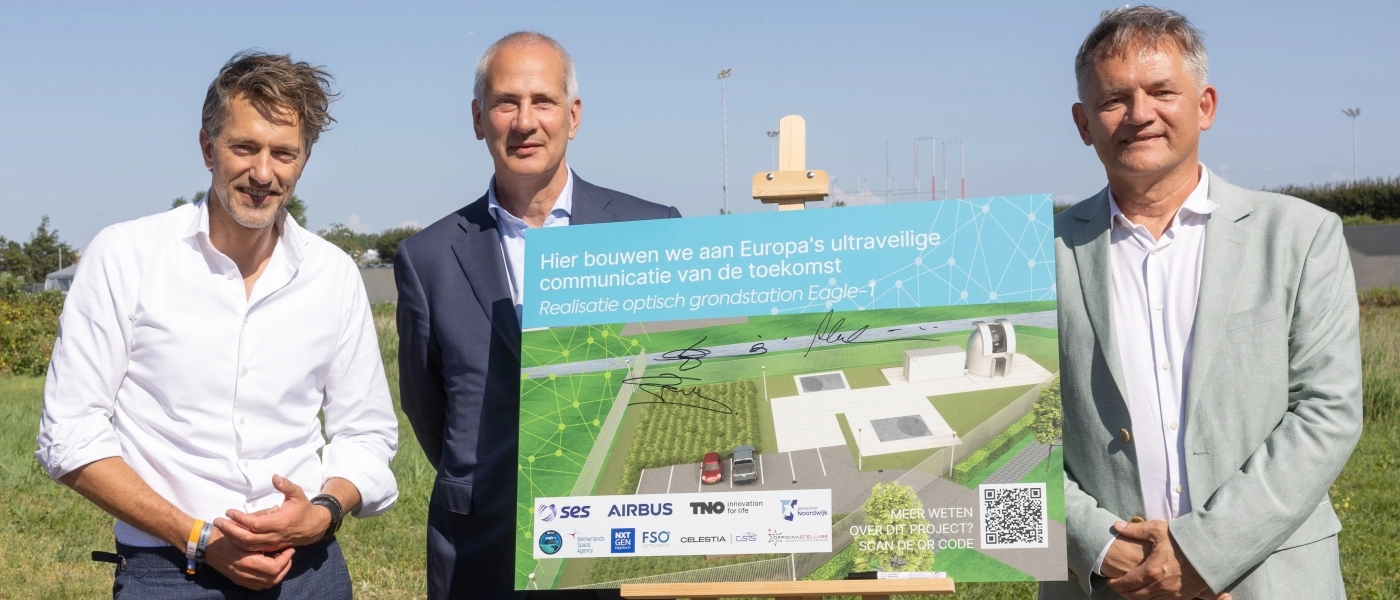
Satellite operator SES and Airbus Netherlands B.V. have signed an official ground lease agreement with the Dutch municipality of Noordwijk to begin constructing a dedicated optical ground station (GS). Located at the NL Space Campus—directly adjacent to the European Space Agency’s (ESA) technical hub, ESTEC—the facility will serve as the primary terrestrial link for the upcoming EAGLE-1 satellite, Europe’s premier end-to-end demonstration platform for space-based Quantum Key Distribution (QKD).
                         [ EAGLE-1 Terrestrial Architecture ]
  Network Operator    ──► SES (Public-private partnership with ESA & the European Commission).
  Station Constructor ──► Airbus Netherlands B.V. (Integrating the real-time control array).
  Optics Prime        ──► TNO (Netherlands Organisation for Applied Scientific Research).
  Technical Core      ──► Dynamic atmospheric turbulence correction and optical modem links.
  Security Mechanism  ──► Free-space, line-of-sight laser transmission of quantum-safe keys.
Unlike traditional satellite infrastructure that relies on radio frequencies, the EAGLE-1 architecture transmits highly secure cryptographic keys via focused laser beams to safeguard against future quantum decryption threats. However, optical links through the Earth’s atmosphere are highly vulnerable to local air movement, temperature gradients, and density fluctuations, which cause signal scattering. To counteract this atmospheric turbulence, the Noordwijk station will feature advanced adaptive optics engineered by prime contractor TNO and active tracking control loops from Airbus Netherlands to monitor wavefront distortions and dynamically realign the laser path in real time.
The project integrates a highly specialized European supply chain to deliver the required terrestrial hardware. Officina Stellare will supply the physical telescope assembly and automated protective dome, FSO Instruments will deliver the high-sensitivity tracking sensor, and Celestia STS is manufacturing the optical digital modem. This ground infrastructure will manage free-space communication with the satellite payload to provide un-tappable cryptographic key exchanges for sensitive telecommunications networks, financial institutions, and government data centers.
Operating as a public-private partnership backed by ESA and the European Commission, the EAGLE-1 testbed serves as the foundational technical precursor for the broader European Quantum Communication Infrastructure (EuroQCI). While the space segment has faced shifting development timelines due to payload integration complexities—with the launch currently rescheduled to late 2027 or early 2028 on an Arianespace Vega C rocket—the terrestrial ground segment is moving directly into active assembly. Construction on the Noordwijk site is scheduled to begin in August, laying the groundwork for upcoming European secure satellite constellations.
Review the official institutional rollout statement here, and explore the space cluster profiles via the regional municipal hub here.
July 15, 2026

Leave A Comment