Category: Uncategorized
-
-
Classiq, INGL, and IonQ Advance Quantum Optimization for Natural Gas Transmission Networks
Classiq Technologies and Israel Natural Gas Lines (INGL) have published research on using hybrid quantum-classical optimization for natural gas pipeline networks. Their study, detailed on arXiv (arXiv:2609.00825), demonstrates a Quantum Approximate Optimization Algorithm (QAOA) workflow to maximize gas throughput, validated on the IonQ Forte-1 quantum computer. This approach, which complements existing engineering tools, shows how quantum processors can address complex energy infrastructure challenges.
-
CGI and D-Wave Partner to Commercialize Enterprise Quantum Optimization Across Transportation, Logistics, and Retail
CGI and D-Wave have partnered to bring quantum optimization solutions to enterprises, integrating D-Wave's quantum hardware into CGI's IT services. This collaboration aims to develop quantum-powered applications for complex challenges in transportation, logistics, and retail, leveraging CGI's global reach and D-Wave's annealing quantum technology. The initiative focuses on moving clients from proof-of-concept to full production deployment of hybrid quantum-classical solutions.
-
Global Survey Finds 90% of Quantum Companies Rely on Cross-Border Supply Chains
A global study conducted by various international quantum industry consortia found that 90% of quantum companies rely on cross-border supply chains for hardware and software, with 74% serving international customers. The report, based on data from 160 quantum enterprises across 15 countries, highlights the interconnectedness of the global quantum economy and the challenges this poses for national protectionist trade policies. It emphasizes the need for multilateral frameworks to maintain trusted trade channels while safeguarding sensitive technologies.
-
Independent Cross-Stack Benchmark Evaluates Commercial Quantum Error Management on 156-Qubit IBM Heron Hardware
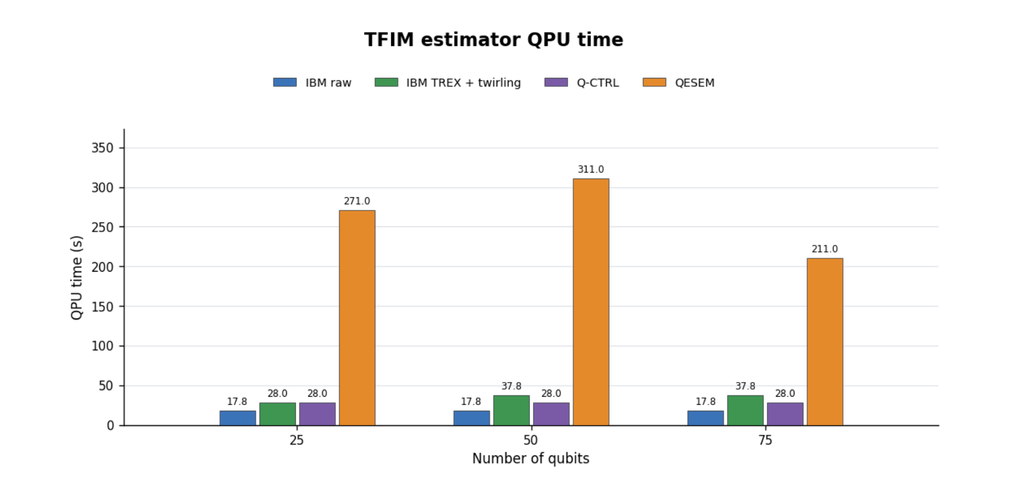
An independent benchmark on IBM Heron hardware evaluated commercial quantum error management tools. Q-CTRL and Qedma QESEM significantly reduced errors compared to IBM's native Qiskit Runtime, with Qedma achieving the highest precision at a higher QPU time cost, while Q-CTRL offered a balance of error reduction and runtime. The study highlights varying resource-accuracy profiles among the tested solutions.
-
Q-CTRL Executes 100-Qubit Quantum Fourier Transform Using Convolutional Compilation Strategy
Q-CTRL has successfully executed the Quantum Fourier Transform (QFT) on up to 100 qubits using a novel Convolutional Compilation Strategy, demonstrating the largest functional QFT on quantum hardware to date. This method eliminates routing overhead on linear nearest-neighbor topologies by leveraging identity cancellations and incorporating an ancilla qubit, resulting in a compact, translation-invariant kernel. The experimental execution on the IBM Heron R3 processor achieved significant process fidelity and consistent signal output, even at 100 qubits.
-
German Government Selects QUDORA-Led Consortium for €122 Million ($138.8 USD) NFQC-1k Trapped-Ion Quantum Computer Project
The German government has selected a QUDORA-led consortium for the €122 million NFQC-1k project to build a fault-tolerant trapped-ion quantum computer with at least 1,000 physical qubits. This five-year initiative aims to establish a semiconductor pilot line for high-performance quantum processing units and is a key milestone under Germany's High-Tech Agenda Deutschland, targeting the deployment of advanced quantum computers by 2030. QUDORA's Near Field Quantum Control (NFQC®) technology will be central to overcoming scaling barriers in quantum computing.
-
IonQ Selected as First On-Premise QPU Deployment at NVIDIA’s Accelerated Quantum Research Center
IonQ's Superion 256 quantum computer will be the first on-premise QPU at NVIDIA's Accelerated Quantum Research Center, integrating with NVIDIA's GB200 NVL72 accelerated computing rack via NVQLink. This collaboration aims to advance quantum-GPU architectures and hybrid software frameworks for applications in finance, materials science, and drug discovery, utilizing IonQ's EQC technology for scalable quantum computing.
-
Photonic Inc. and Microsoft Partner to Advance Quantum Resource Estimation for Distributed Architectures
Photonic Inc. and Microsoft are collaborating to integrate Photonic's distributed quantum computing models and QLDPC error correction algorithms into Microsoft's Quantum Resource Estimator. This partnership aims to provide researchers and developers with a more accurate way to model quantum algorithms for modular, multi-chip quantum computing systems, addressing limitations of current monolithic frameworks. The integration of Photonic's SHYPS QLDPC codes, which utilize optically linked silicon spin qubits, is expected to significantly reduce the physical-to-logical qubit overhead and account for inter-module optical latencies, offering a more realistic assessment of hardware requirements for future quantum applications.
-
The Geography of Quantum: What Maryland Is Actually Building
Most states compete for quantum companies by offering incentives. Maryland appears to be doing something in addition.
-
Yenepoya University and Edutecnicia Partner to Establish Quantum AI Catalyst Lab in Mangaluru India
Yenepoya University and Edutecnicia (through REYRA AI) have partnered to establish a Quantum AI Catalyst Lab at Yenepoya School of Engineering & Technology (YSET) in Mangaluru. This collaboration aims to advance research, certification, and hardware development in Quantum Computing, Quantum AI, and Quantum-inspired AI, with a focus on creating FPGA-based hardware accelerators and medical AI models. YSET will also offer certification courses in QML and Quantum AI.
-