
News
Company, funding, product and policy news from across the quantum industry, as it happens.
-
-
Kipu Quantum Demonstrates Neutral-Atom Quantum Feature Extraction for Molecular Toxicity Classification on QuEra Hardware
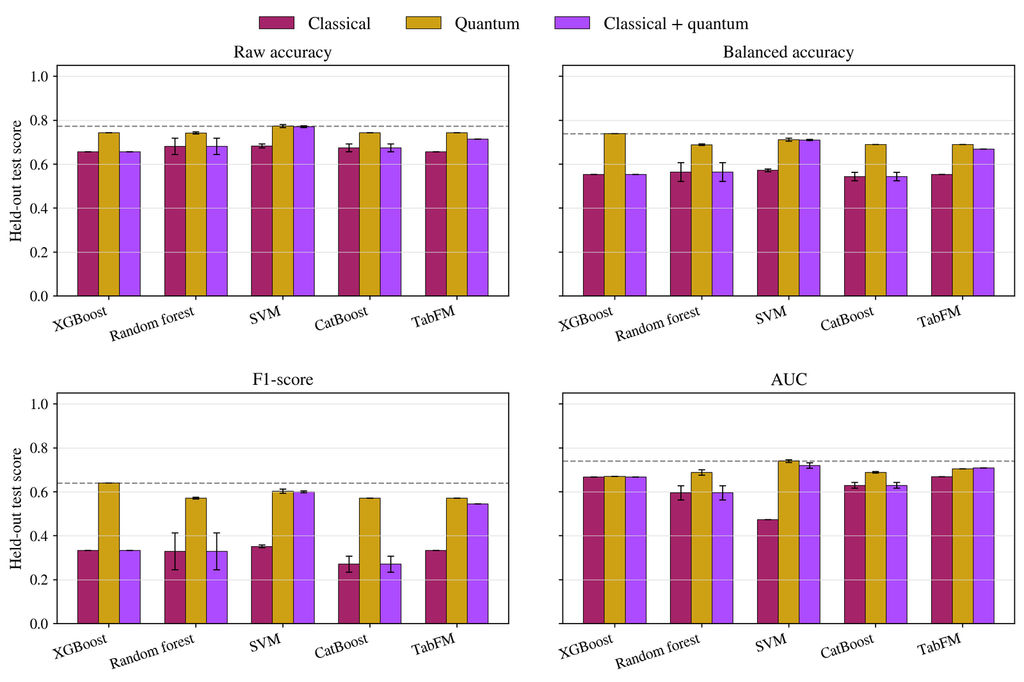
Kipu Quantum demonstrated a novel method for molecular toxicity classification using analog quantum feature extraction on QuEra's 256-qubit Aquila neutral-atom quantum processor. This approach, detailed in their technical report, utilizes 200-qubit neutral-atom arrays to generate high-dimensional quantum features. These quantum features significantly improved performance over classical methods, particularly on imbalanced datasets, doubling the F1-score and raising balanced accuracy for drug discovery and chemical safety.
-
-
-
Kipu Quantum and NTT DATA Partner to Scale Enterprise Quantum Computing and QML Applications
Kipu Quantum and NTT DATA have partnered to advance enterprise quantum computing and QML solutions. The collaboration will integrate quantum algorithms into existing enterprise technology, leveraging Kipu Quantum's expertise in hardware-specific compression techniques. This partnership, which began with a pilot program at Komatsu Peru, aims to develop and deploy commercial algorithms for various applications, including supply chain logistics and financial risk modeling, initially in Latin America and then globally.
-
University of Oxford Entangles Multi-Species Atom Network and Extends Memory Storage Beyond 10 Seconds
Physicists at the University of Oxford have developed a quantum network using different atomic elements, strontium and calcium, to create entangled states. They successfully generated up to 4-qubit Greenberger-Horne-Zeilinger (GHZ) states and stored this entanglement in calcium memory qubits for over 10 seconds. This significantly extends entanglement lifetimes, marking a major step forward for distributed quantum computing and sensing.
-
QuIC Publishes Position Paper Calling for Harmonized EU Dual-Use Controls on Quantum Technologies
The European Quantum Industry Consortium (QuIC) has published a position paper urging the European Commission to harmonize EU dual-use controls on quantum technologies. They warn that fragmented national implementations of export controls on quantum technologies are causing administrative difficulties, shipment delays, and revenue loss for European quantum companies. QuIC proposes reforms focusing on single market harmonization, expanded allied trade, clearer rules for intangible transfers and cloud access, and differentiated scrutiny for supply chain components to ensure European competitiveness.
-
-
-
EMode Photonix Raises $1M Pre-Seed Round Led by Ground State Ventures for Photonic Circuit Simulation Stack
EMode Photonix, a quantum integrated photonics software startup, has successfully raised $1 million in pre-seed funding. This investment, led by Ground State Ventures, will enable the company to expand its engineering team and accelerate the development of its enterprise software. EMode Photonix specializes in a multi-physics simulation platform for non-linear integrated photonic circuits, offering significantly faster modeling capabilities for various applications including quantum computing and optical sensing.
-
Google Quantum AI Demonstrates Magic State Cultivation on Willow Processor in Science Milestone
Google Quantum AI has successfully demonstrated magic state cultivation on its Willow quantum processor, achieving a 40-fold error reduction and producing T-states with 99.99(1)% logical fidelity. This breakthrough addresses a major bottleneck in fault-tolerant quantum computing by significantly reducing the physical qubit footprint required for generating these essential states, directly validating Google's 2024 cultivation theory framework.
-
Google Quantum AI & DeepMind Demonstrate Modular Hyperbolic Codes for Over 30x QEC Overhead Reduction
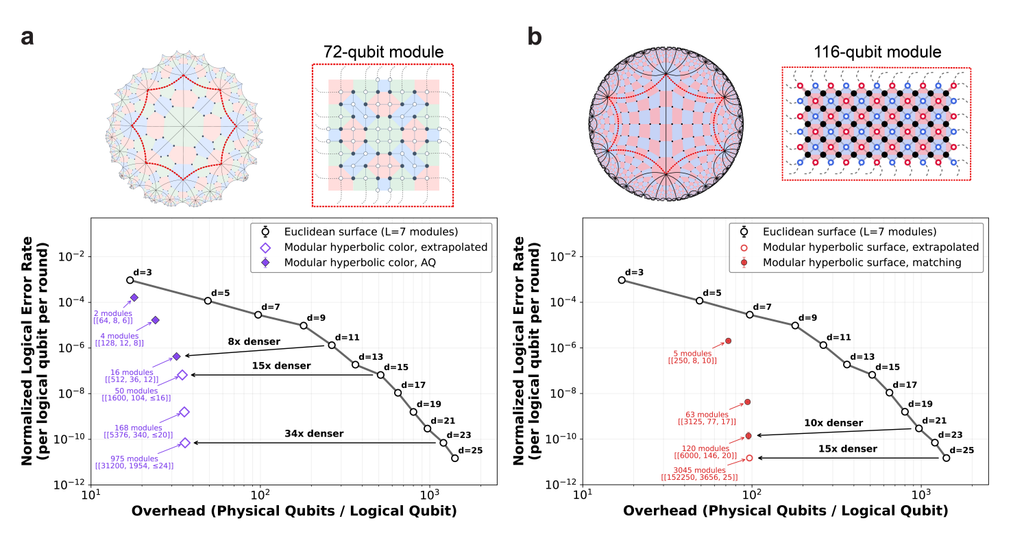
Researchers from Google Quantum AI, Google DeepMind, and MIT have developed a modular quantum error correction (QEC) architecture that significantly reduces the physical qubit overhead required for quantum computing. This new approach, detailed in a technical manuscript on arXiv, utilizes modular hyperbolic codes to achieve over 30x savings in qubit overhead compared to standard 2D surface codes. The architecture allows for high encoding rates without complex on-chip wiring, demonstrating high tolerance to noise in simulations.
-
Germany Issues Joint Federal PQC Migration Guidelines to Align with EU Post-Quantum Roadmap
Germany has released national guidelines for migrating to Post-Quantum Cryptography (PQC), aligning with the EU's roadmap. The strategy, driven by advancements in AI and threats to classical encryption, outlines a three-phase migration timeline, prioritizing high-risk systems by 2030 and aiming for full migration by 2035. This initiative mandates hybrid cryptographic mechanisms and PQC readiness in risk management for critical infrastructure.
-
IBM Research Automates QEC Decoder Chip Design Using Open AI Agent Factories at 11.5x Lower Inference Cost
IBM Research has developed an AI agent factory to automate the design of QEC decoder chips, achieving up to 204x hardware speedup and 11.5x lower AI inference costs. This system utilizes autonomous multi-agent search and open-weight models, making QEC chip design more economically practical for fault-tolerant quantum systems. The agent factory explores architectural transformations to optimize decoding algorithms for high-rate qLDPC codes.
-
FirstQFM Foundation Model Cuts Quantum Gate Times by 33% on QuantWare QPU via NVIDIA Computing
FirstQFM AB has achieved a 33% reduction in single-qubit gate execution times on QuantWare’s 21-qubit Contralto-D21 superconducting quantum processor, without compromising gate fidelity. This was accomplished using their patented quantum foundation model technology, which integrates with Quantum Machines’ OPX control hardware and QUA calibration stack. The model, developed with NVIDIA’s accelerated computing infrastructure, also improved two-qubit Bell-state fidelities.
-
Classiq Partners with FreeYa Mind Campus to Launch Quantum Applications Hub in Romania
Classiq has partnered with FreeYa Mind Campus to open a Quantum Applications Hub in Iași, Romania, which will serve as Classiq's regional headquarters. This hub integrates Classiq's quantum software platform with the campus's IBM Quantum System Two. The collaboration aims to drive quantum software development, education, and enterprise projects across Eastern Europe.
-
Anderon Releases First Superconducting Quantum PDK for 300mm Wafer Fabrication
Anderon, a quantum foundry operator, has released its first Superconducting Quantum Process Design Kit (PDK) for 300mm wafer fabrication. This PDK provides standardized design rules and building blocks for manufacturing superconducting quantum devices on their 300mm wafer line at the Albany NanoTech Complex. Anderon, backed by $2 billion in funding, offers various superconducting wafer types, including qubit, I/O signal, and amplifier/filter wafers.
-
ORCA Computing Launches PT-3 Photonic Quantum System in London for Hybrid AI and Industrial Optimization
ORCA Computing has launched its PT-3 photonic quantum system in London, integrating it with NVIDIA GPU-accelerated computing infrastructure. This room-temperature system, consuming 6 kW, uses 64 photons across 128 qumodes to enhance classical machine learning models. The PT-3 is designed for generative AI in scientific research and large-scale industrial optimization, demonstrating improved protein designability and a 12x speedup in energy scheduling benchmarks.
-
DOE ARPA-E Launches $37 Million QC3 Program Across Ten Quantum Chemistry Performers
The U.S. Department of Energy’s ARPA-E has launched the $37 million Quantum Computing for Computational Chemistry (QC3) program, funding ten research teams for three years. This initiative aims to achieve a 100-fold speedup over classical computation in high-impact energy applications by focusing on full-stack co-design across algorithms, error correction, and quantum hardware. Notably, QuEra Computing is a key hardware and algorithm co-design partner for three of the selected projects.
-
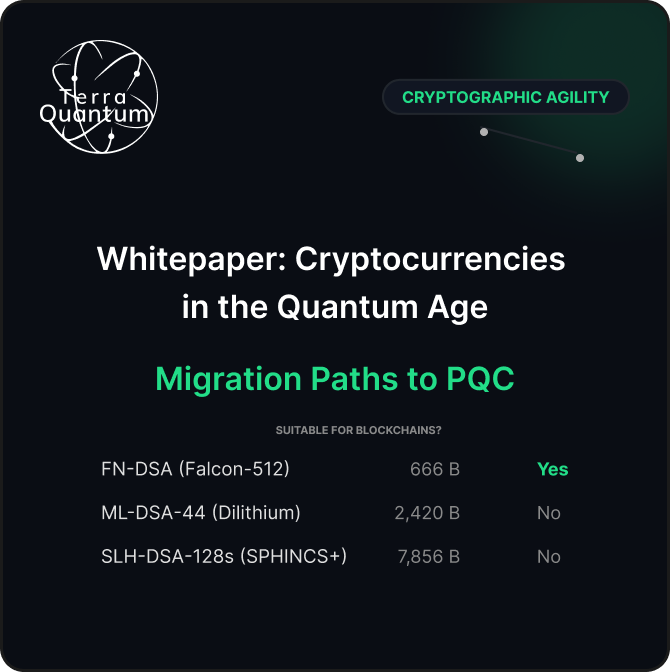
Terra Quantum Publishes White Paper Detailing Post-Quantum Cryptography Migration Paths for Blockchain Ecosystems
A white paper by Terra Quantum AG analyzes the vulnerability of major blockchain platforms like Bitcoin, Ethereum, and Solana to post-quantum cryptography (PQC) threats, highlighting the risks posed by Shor's algorithm to digital signature algorithms. The study evaluates PQC migration strategies, emphasizing signature payload size as a critical factor for high-throughput ledgers, and suggests FN-DSA (Falcon-512) as a viable solution due to its compact signature footprint. The paper also reviews mitigation frameworks, including Solana's WOTS vaults, Algorand's Falcon account roadmaps, and Ethereum's EIP-8052 proposal.
-
Terra Quantum and Schaeffler Publish Peer-Reviewed Study on Hybrid Quantum Machine Learning for Materials Modeling
Terra Quantum and Schaeffler have published a peer-reviewed study in Computational Materials Science on hybrid quantum machine learning for materials modeling. Their research demonstrates that a hybrid quantum-classical Allegro model, incorporating Quantum Depth-Infused (QDI) variational quantum circuit layers, significantly improves the accuracy of atomic energy and force predictions, particularly for copper-lithium structures relevant to battery anode research. This hybrid approach offers a substantial reduction in computational overhead while maintaining high accuracy, even when transferring hyperparameters to new datasets.
-
Terra Quantum Joins QuEra Quantum Alliance to Expand Neutral-Atom Software Layer
Terra Quantum has joined the QuEra Quantum Alliance to advance neutral-atom quantum computing. Terra Quantum, a quantum software and algorithm developer, will contribute its TQ42 platform to the alliance, offering a Python SDK, APIs, and command-line interfaces for various industry applications. This collaboration aims to strengthen the software and applications tier of the alliance and prepare enterprises for QuEra's fault-tolerant hardware roadmap, including the 256-logical-qubit "Libra" system.
-
Argonne and UIUC Demonstrate First On-Chip Coupling of Propagating Spin Waves to Superconducting Circuits
Scientists from Argonne National Laboratory and UIUC have developed the first-of-its-kind hybrid circuit, integrating propagating spin waves with a superconducting resonator on a single chip. This innovation allows for strong coupling between microwave photons and spin waves, addressing issues of signal noise in quantum devices. By using a rare-earth-free YSGG substrate, the team achieved significant power isolation, paving the way for compact, on-chip microwave isolators for quantum circuits.
-
IonQ and the University of Cambridge Open Quantum Innovation Centre at Cavendish Laboratory
IonQ and the University of Cambridge have opened the IonQ Quantum Innovation Centre at the Cavendish Laboratory, deploying a 256-qubit Superion quantum computer and a quantum network. This initiative, supported by Innovate UK and aligning with the UK National Quantum Strategy, will host nine inaugural research projects and aims to expand the regional quantum workforce.
-
D-Wave Delivers Italy’s First Annealing Quantum Computer to Lombardy Infrastructure Hub
D-Wave has installed Italy's first on-premises Advantage2 annealing quantum computer at Villa Saporiti in Como. Funded by Swiss Quantum Technology SA (SQT) with a €10 million agreement, this 4,400+ qubit system will be accessible to European researchers and businesses both on-site and remotely via D-Wave's Leap cloud service. This initiative supports the Volta Declaration's goals for quantum computing and AI development in Europe, coinciding with the bicentennial of Alessandro Volta's death.
-
Dirac Labs Joins Wisconsin Security Research Consortium to Advance Quantum PNT for Autonomous Defense Platforms
Dirac Labs has joined the Wisconsin Security Research Consortium (WSRC) to advance quantum-enabled Positioning, Navigation, and Timing (PNT) systems. They are developing a quantum universal positioning system using diamond-based quantum sensors and AI to provide GPS-independent navigation for autonomous defense platforms. This partnership aims to overcome cost and scaling barriers in quantum sensing through standard manufacturing processes and integration.
-
-
-
Riverlane and NVIDIA Demonstrate Accelerated QEC Decoder Calibration Using GPU Processing
Riverlane and NVIDIA have demonstrated significant acceleration in quantum error correction (QEC) decoder recalibration using NVIDIA's H100 GPU. By adapting Riverlane's Local Clustering Decoder for GPU processing, they achieved up to 71x raw throughput gain and reduced training epochs from minutes to seconds. This advancement allows for more frequent and efficient recalibration, improving the accuracy of QEC systems and highlighting the growing role of GPUs in quantum computing.
-
New York City and NYU Partner to Launch $284 Million Quantum Fabrication Facility
New York City and NYU are partnering to launch the $284 million Quantum Fabrication Facility (QFab) at 770 Broadway, set to open in 2030. The facility will focus on quantum chip development and aims to foster startups, provide fabrication services, and support workforce development through CUNY and NYC Public Schools. This initiative features a unique public-equity model, granting NYC a 15% share in IP generated with city-funded equipment and seats on the QFab Executive Advisory Board.
-
SAXON Q and Fraunhofer IWU Demonstrate Record 3-Qubit Grover Search on Commercial Room-Temperature Quantum Computer
SAXON Q and Fraunhofer IWU have achieved a record-breaking 3-qubit Grover search on a commercial room-temperature quantum computer, outperforming previous room-temperature quantum searches and nearing cryogenic superconducting processors' benchmarks. The experiment, detailed in a pre-print paper, utilized a nitrogen-vacancy center diamond quantum computer operating at ambient conditions, showcasing a significant advancement in quantum computing hardware.
-
IonQ Announces Pricing of $2.0 Billion Equity Offering Purchased by Heights Capital Management
IonQ announced a $2.0 billion equity offering purchased by Heights Capital Management, consisting of common stock and pre-funded warrants priced at a 15% premium. The deal also includes seven-year warrants for additional shares at a 100% premium. IonQ plans to use the capital to accelerate the commercialization and deployment of its quantum platform.
-