
News
Company, funding, product and policy news from across the quantum industry, as it happens.
-
-
Quantum Source Alpha Labs Proposes Hybrid Photon-Atom Blueprint for Fault-Tolerant Computing
Quantum Source Alpha Labs has proposed a hybrid quantum computing architecture combining photons and Rubidium-87 atoms to overcome scaling limitations. This blueprint utilizes cavity QED for near-deterministic gates, a Measurement-Based Quantum Computing framework with atomic reuse for efficiency, and photonic long-range connectivity to enable hardware-efficient quantum Low-Density Parity-Check (qLDPC) codes. The system demonstrates a fault-tolerance threshold of ~2.6% photon loss per physical gate, providing a roadmap for future fault-tolerant quantum computers.
-
ESA Installs Its First On-Premises Quantum Computer to Boost Earth Observation Capabilities
The European Space Agency (ESA) has installed its first on-premises quantum computer, the Bell-1, at its Earth Observation Centre in Italy. This system, developed by Equal1, utilizes silicon spin qubits and a compact, rack-mounted design to integrate with existing High-Performance Computing (HPC) infrastructure. The Bell-1 will serve as a research testbed for hybrid classical-quantum algorithms to manage vast Earth observation data for climate modeling, satellite planning, and weather forecasting.
-
IBM Improves Qubit Reset by 25x and Releases Qiskit v2.5
IBM has announced a major quantum advance with its 120-qubit Nighthawk r2 processor, achieving a 25x faster qubit reset speed that drastically boosts system throughput and aids error correction. Alongside this hardware advancement, the company has released Qiskit v2.5, introducing key performance upgrades and renaming its runtime platform to the IBM Quantum Compute Service.
-
-
-
AT&T Business and Palo Alto Networks Partner to Deliver Quantum-Resilient SASE Fabric
AT&T Business and Palo Alto Networks have partnered to create a quantum-resilient Secure Access Service Edge (SASE) fabric. This collaboration integrates Palo Alto Networks’ Prisma SD-WAN with AT&T’s network, offering protection against “Harvest Now, Decrypt Later” threats by using hybrid cryptography, universal control plane hardening, and geofenced telemetry. The software-defined solution allows for automatic updates with new post-quantum cryptography standards and secures distributed branch edges with Hybrid PKI and hardware-level root of trust.
-
Bloq Quantum Partners with MIUUL to Expand Quantum Machine Learning in Turkey
Bloq Quantum has partnered with MIUUL to introduce quantum machine learning to Turkey, providing MIUUL students with access to Bloq Quantum’s enterprise platform. This collaboration aims to bridge the gap between theoretical quantum concepts and practical application by offering a low-code environment for building and deploying hybrid quantum-classical models, thereby accelerating R&D and fostering a new generation of quantum-ready professionals in Turkey.
-
Arq Quantum Technologies Secures $1.4M Pre-Seed for Multiplexed Quantum Repeaters
Arq Quantum Technologies, a Spanish startup founded in 2025 by Samuele Grandi and Emanuele Distante, has secured $1.4 million in pre-seed funding. This investment, led by Ground State Ventures with participation from Big Sur Ventures, will accelerate the development of their long-distance quantum communication hardware. Arq’s technology focuses on highly scalable, multiplexed quantum repeaters utilizing rare-earth doped crystal memories to overcome the limitations of traditional quantum communication.
-
enQase Achieves FIPS 140-3 Overall Level 1 Validation for Cryptographic Module
enQase has achieved FIPS 140-3 Overall Level 1 Validation for its cryptographic module, receiving Certificate #5346 from the Cryptographic Module Validation Program (CMVP). This validation, independently verified by DEKRA Cybersecurity Certification Laboratory, establishes a regulatory-approved cryptographic engine for organizations transitioning to post-quantum cryptography. The enQase module offers crypto-agility, unifying classical and quantum cryptography, and ensures verified implementation protection, serving as a trusted compliance foundation for the enQase Platform.
-
Quantum eMotion’s SecureKey Module Enters NIST Testing for FIPS 140-3 Validation
Quantum eMotion’s SecureKey Cryptographic Module has been designated “Implementation Under Test” by NIST, a crucial step towards FIPS 140-3 security compliance. This module, integrated with the Sentry-Q platform, uses a “memory-less” cryptographic design to prevent key exposure, a major vulnerability in data security. The company expects the module to transition to “Modules in Process” status within 3-4 months, which is essential for deployments in highly regulated sectors.
-
-
-
Post-Quantum’s Classic McEliece Achieves Global ISO Standardization
The Classic McEliece algorithm, developed by Post-Quantum and an international team, has achieved global ISO standardization (ISO/IEC 18033-2), becoming the first post-quantum cryptography (PQC) algorithm to do so. This milestone provides an internationally recognized framework to protect against “Harvest Now, Decrypt Later” data theft, with applications in quantum-safe VPNs, long-shelf-life data, and tactical edge drones. Unlike lattice-based PQC, Classic McEliece uses the mathematical complexity of decoding general linear codes, offering small ciphertext payloads despite large public keys.
-
SES and Airbus Secure Site for Europe’s Flagship EAGLE-1 Quantum Optical Ground Station
SES and Airbus Netherlands B.V. are building an optical ground station in Noordwijk, Netherlands, for the EAGLE-1 satellite. This station will be Europe’s first end-to-end demonstration platform for space-based Quantum Key Distribution (QKD), designed to transmit highly secure cryptographic keys via laser to safeguard against quantum decryption threats. Construction starts in August, preparing for the satellite’s launch in late 2027 or early 2028.
-
High Q Technologies Partners with Creative Biostructure to Scale Quantum-Enabled EPR Protein Mapping
High Q Technologies has partnered with Creative Biostructure to integrate its FATHOM quantum-enabled EPR spectroscopy platform into Creative Biostructure’s global contract research workflow. This collaboration, supported by Canada’s National Quantum Strategy, allows for the nanoscale mapping of dynamic protein structures, addressing limitations of traditional methods. The FATHOM platform uses superconducting quantum resonators to capture all protein configurations, streamlining the analysis process and optimizing pharmaceutical simulation pipelines by providing rapid pre-screening capabilities.
-
NSF Awards $15 Million to Launch Connecticut’s “QuantumCT” Innovation Engine
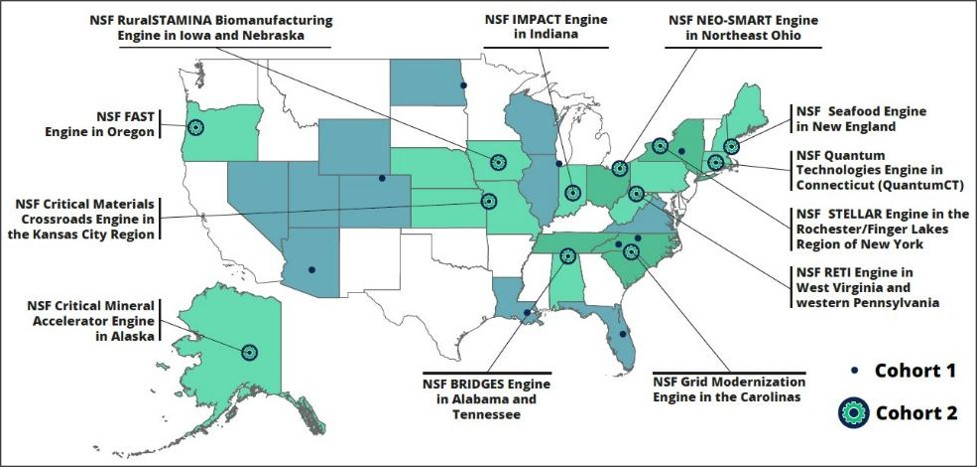
The NSF has awarded $15 million to Connecticut’s “QuantumCT” Innovation Engine, a collaborative effort between the University of Connecticut and Yale University, with the potential to receive $160 million in federal funding over the next decade. This initiative, supported by $121 million in state co-investment, aims to translate quantum research into marketplace innovations by establishing a public-private development ecosystem, fostering partnerships with tech innovators and corporate adopters, and developing a skilled workforce through institutions like Southern Connecticut State University. QuantumCT is the only engine in its cohort exclusively dedicated to quantum technology information science, seeking to secure the domestic quantum supply chain and establish the region as a global quantum market hub.
-
Photon Queue Secures $500,000 Grant to Establish Quantum Memory Operations in New Mexico
Photon Queue, a quantum hardware startup spun out of UIUC in 2024, has secured $500,000 to establish a quantum memory operation in Albuquerque, New Mexico. This funding, including a $200,000 grant from the New Mexico Quantum Technologies Award program, will support the development of their room-temperature, free-space quantum memories that address synchronization challenges in distributed quantum computing. The company’s expansion is part of a larger $1.2 million state initiative to foster quantum technology, with Photon Queue focusing on hardware verification and leveraging New Mexico’s growing deep-tech cluster.
-
Logical Qubit Technology Unveils AGate Quantum Cloud Platform and Multi-Year Roadmap
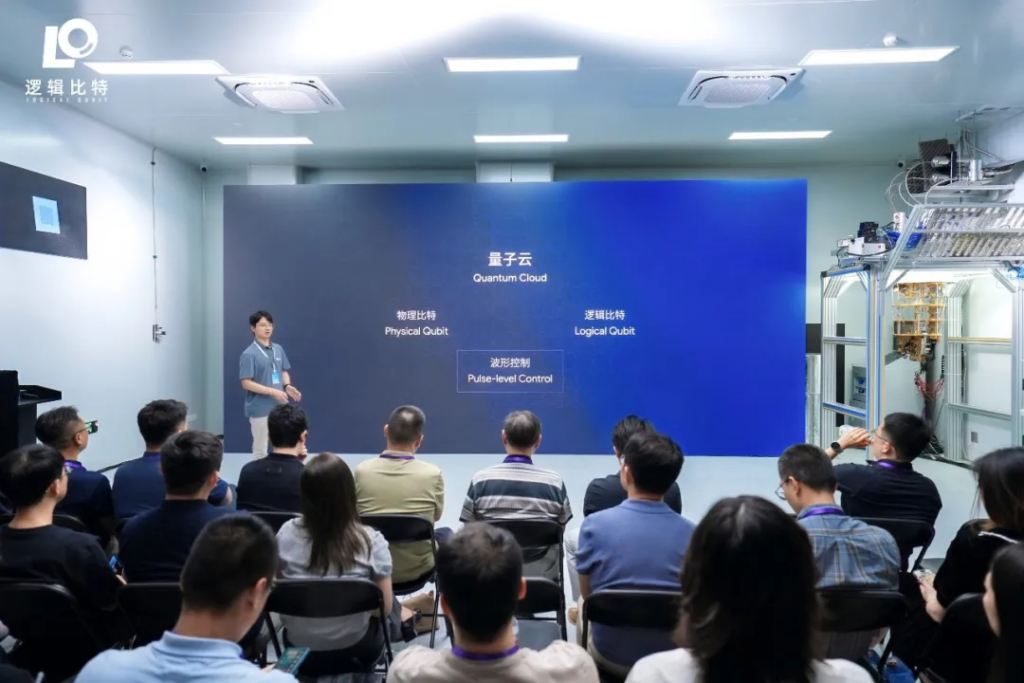
Logical Qubit Technology has launched its AGate Quantum Cloud Platform, offering access to 30-qubit and 100-qubit superconducting chips with high-fidelity gates and parallel readout. The platform also provides pulse-level control for advanced research and has a roadmap targeting fault-tolerant systems by 2030+, with key partnerships in biopharma and quantum software.
-
Classiq and ParityQC Partner to Streamline Hardware-Aware Circuit Optimization
Quantum software company Classiq and quantum architecture developer ParityQC have partnered to integrate ParityQC’s Parity Twine compiler with Classiq’s quantum software engineering platform. This collaboration, supported by the German Federal Ministry for Economic Affairs and Climate Action, aims to overcome the scalability challenge of running complex algorithms on quantum processors with limited qubit connectivity. By combining Classiq’s optimization with ParityQC’s compilation, the partnership seeks to minimize SWAP gates, preserve software portability, and improve quantum computing performance.
-
Planckian Partners with Quantum Elements to Model Superconducting Hardware Noise
Planckian and Quantum Elements have partnered to develop architecture-specific noise models and “digital twins” for Planckian’s superconducting quantum processor. This collaboration will utilize Quantum Elements’ AI-powered Constellation platform to create a hardware-calibrated virtual model, enabling Planckian to characterize unique noise channels, accelerate quantum error correction decoding, and efficiently simulate complex error-syndrome extraction rounds using a Quantum Monte Carlo algorithm. The partnership aims to establish a verified development path toward fault-tolerant computing by stress-testing error-mitigation schemes against a highly accurate representation of Planckian’s physical hardware.
-
-
-
NTHU and Top Taiwan Venture Capital Launch NT$1 Billion ($34M USD) “NTHU Future Fund” for Deep Tech Startups
National Tsing Hua University (NTHU) and Top Taiwan Venture Capital have launched the NT$1 Billion NTHU Future Fund, a 15-year investment vehicle aimed at commercializing deep-tech research in semiconductors, quantum technology, AI, clean energy, and biotech. This fund, managed by Top Taiwan Venture Capital, prioritizes NTHU spin-offs and startups within the NTHU University Science Park, leveraging university assets and industry expertise to bridge the funding gap for long-horizon technologies and accelerate their market entry.
-
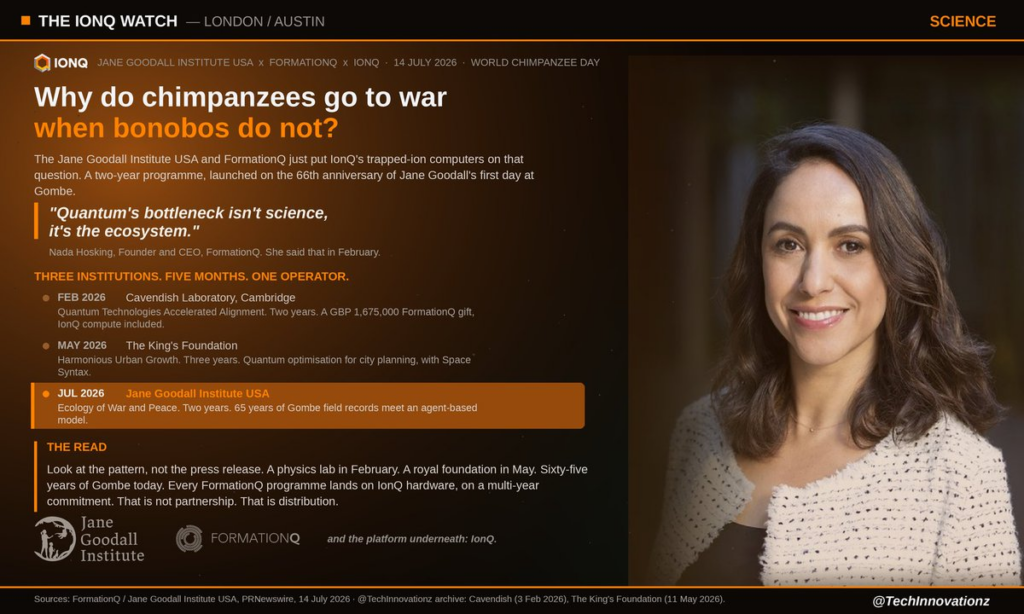
Jane Goodall Institute and FormationQ Launch Quantum-Enhanced Primate Behavior Study
The Jane Goodall Institute (JGI) USA and FormationQ are partnering on a two-year research program, “Ecology of War and Peace,” using quantum computing to study primate behavior. They will use IonQ’s quantum computers to analyze decades of data from Dr. Jane Goodall’s research to understand why chimpanzees exhibit intergroup aggression while bonobos coexist peacefully, hoping to apply these findings to conservation efforts.
-
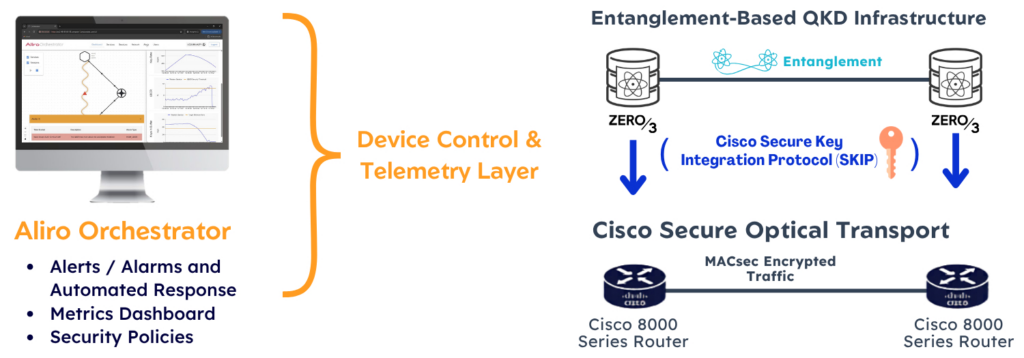
Aliro, zerothird, and Cisco Demonstrate Operational Entanglement-Based QKD on Enterprise Routers
Aliro Technologies, zerothird, and Cisco have successfully demonstrated an entanglement-based Quantum Key Distribution (eQKD) network operating on Cisco’s production-grade routers. This deployment showcases real-time orchestration, monitoring, and automated security controls for eQKD, integrating it into standard enterprise infrastructure. The system feeds quantum keys directly into Cisco 8000 Series routers, enabling quantum-safe MACsec encrypted sessions and proving the scalability of quantum-safe security as a standard IT service.
-
Deutsche Telekom and AIT to Spearhead EU Quantum Communication Infrastructure via PETRUS2 and HarmoniQCI
Deutsche Telekom and AIT will lead the development of the European Quantum Communication Infrastructure (EuroQCI) through two new EU-funded projects: PETRUS2 and HarmoniQCI. PETRUS2, led by Deutsche Telekom, will focus on evolving pan-European quantum communication, including cross-border Quantum Key Distribution (QKD) networks. HarmoniQCI, led by AIT, will concentrate on standardizing and ensuring the interoperability of these quantum communication infrastructures across Europe.
-
Quantinuum, Rolls-Royce, Riverlane, and EPCC Partner to Accelerate Fluid Dynamics Simulations
Quantinuum, Rolls-Royce, Riverlane, and EPCC are collaborating to advance fluid dynamics simulations for gas turbine design. This multi-year project will transition from classical emulators to Quantinuum’s physical quantum hardware, integrating hybrid quantum-classical workflows to address computational bottlenecks in simulating fluid dynamics. The initiative aligns with the UK’s quantum strategy to develop advanced quantum computing systems.
-
Xanadu and Lockheed Martin Integrate PennyLane into Quantum Training Program
Xanadu and Lockheed Martin have partnered to integrate Xanadu’s PennyLane quantum programming stack into Lockheed Martin’s Quantum Talent Pipeline (QTP) program. This collaboration aims to train Lockheed Martin engineers in practical quantum machine learning for aerospace and defense R&D, utilizing PennyLane’s tools for designing, optimizing, and testing quantum algorithms. The initiative focuses on building in-house quantum readiness and preparing engineers for future utility-scale quantum processors.
-
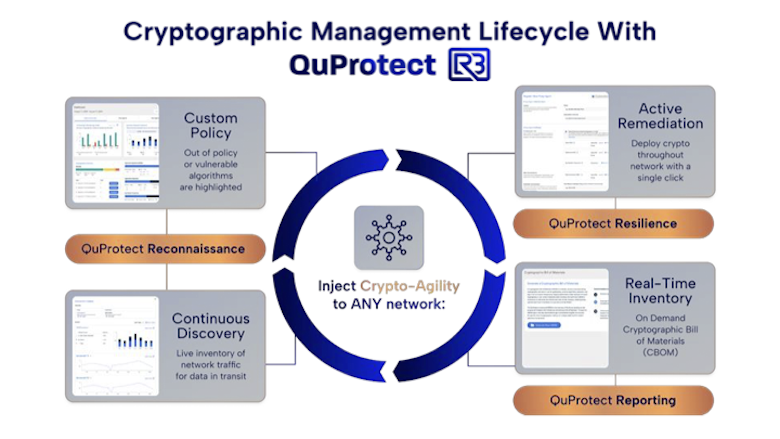
QuSecure Places “QuProtect R3” Cryptographic Agile Platform on AWS Marketplace for U.S. Intelligence Community
QuSecure Inc. has launched its QuProtect R3 cryptographic agile platform on the AWS Marketplace for the U.S. Intelligence Community. This platform provides post-quantum cryptography (PQC) and data-security software, enabling federal defense and intelligence agencies to deploy quantum-resilient protections without extensive network overhauls. QuProtect R3 offers automated crypto-agility, continuous cryptographic inventory, active policy remediation, and on-demand compliance reporting, costing $20,000 per month for a standard public contract.
-
QuiX Quantum Delivers “Carina” Core Hardware to DLR QCI for Universal Photonic Computing
QuiX Quantum has delivered “Carina,” a room-temperature universal photonic quantum computing architecture, to DLR QCI for integration and testing. This system utilizes Measurement-Based Quantum Computing (MBQC) with on-chip cluster-state generation and operates within standard data center infrastructure, aiming to shift quantum hardware from labs to enterprise racks. Carina serves as a validation layer for QuiX Quantum’s future Dedalo architecture.
-
-
-
Yaqumo Expands Seed Extension Round with Backing from Government-Funded JIC VGI and Toyota
Yaqumo Inc. has expanded its seed extension round with new investments from government-backed JIC Venture Growth Investments (JIC VGI) and Toyota Invention Partners (TIP). This funding will accelerate the commercialization of Yaqumo’s neutral-atom quantum processors, leveraging JIC VGI’s capital for R&D and Toyota’s manufacturing expertise for applications in automotive and smart-city technologies. Founded in April 2025, Yaqumo specializes in scalable quantum computers using cold ytterbium atom architecture.
-