
News
Company, funding, product and policy news from across the quantum industry, as it happens.
-
-
Oxford Quantum Circuits Expands to Barcelona with €92 Million ($98M USD) Global Manufacturing and R&D Hub
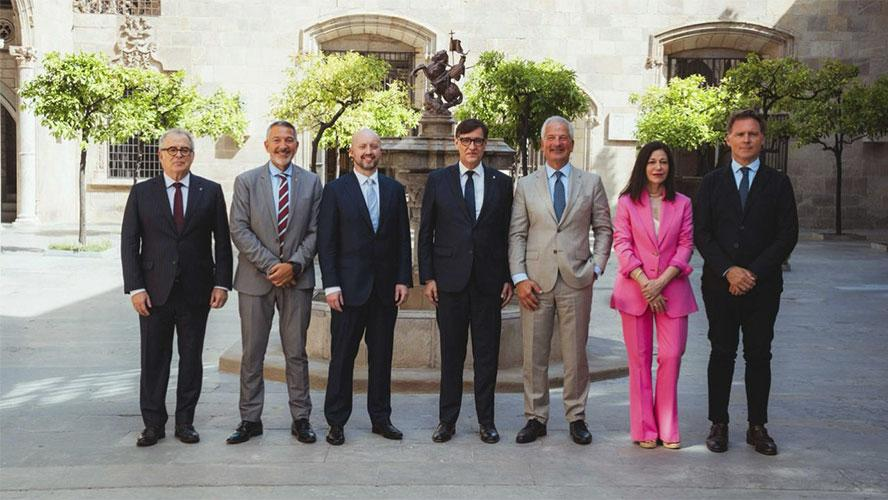
Oxford Quantum Circuits (OQC) is investing €92 million ($98M USD) to establish its first EU facility in Barcelona, creating 210 jobs and serving as its primary global hub for superconducting quantum hardware. This expansion follows a £260 million Series C funding round and aims to scale OQC’s Quantum Computing as a Service (QCaaS) offerings, solidifying Barcelona’s position in the deep-tech and quantum ecosystem.
-
Who’s News: Strategic Leadership Appointments at Nord Quantique, IQM Quantum Computers, Quantum Industry Canada, EPB, and QuSecure
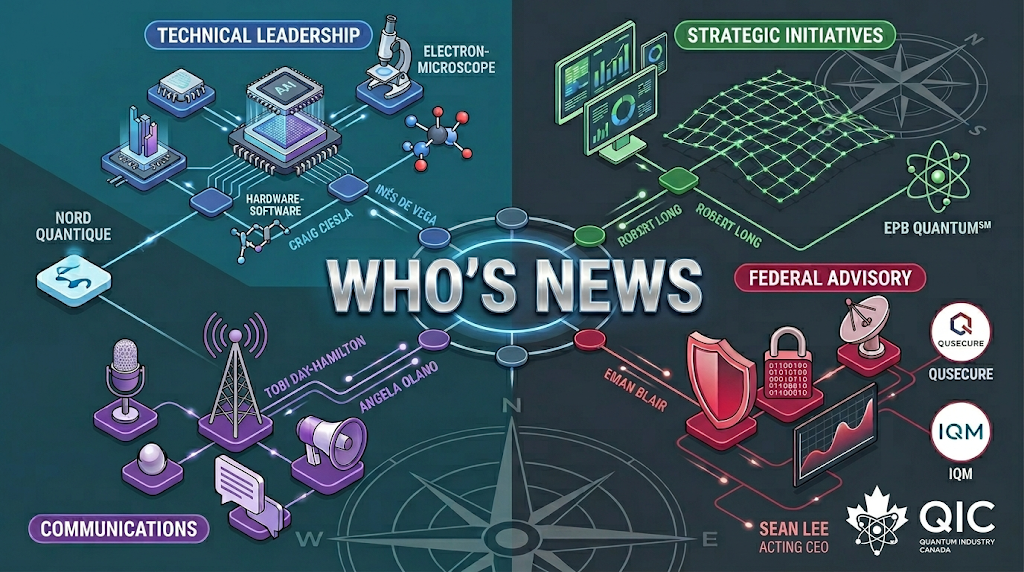
This article announces several key leadership appointments across the quantum technology industry. Nord Quantique appointed Tobi Day-Hamilton and Angela Olano to lead communications and marketing, respectively. IQM Quantum Computers strengthened its technical leadership with Dr. Craig Ciesla as CTO and Dr. Inés de Vega as Chief Scientist. Quantum Industry Canada will see Sean Lee step in as interim CEO following Lisa Lambert’s departure, while EPB named Robert Long as President of Strategic Initiatives. Finally, QuSecure, Inc. appointed former CIA officer Eman Blair to its Federal Advisory Board.
-
-
-
Bipartisan Coalition Introduces Legislation to Establish National Security Commission on Quantum Computing
U.S. Representatives Mike Lawler and Pat Ryan have introduced the National Security Commission on Quantum Computing Act of 2026 (H.R. 9318) to establish an 11-member bipartisan commission. This commission will evaluate global quantum technology advancements, focusing on foreign dependencies, supply chain vulnerabilities, public-private collaboration, and workforce development. The bill aims to create a roadmap for post-quantum cryptography readiness and safeguard national security in the face of evolving technological landscapes.
-
Diraq Expands U.S. Infrastructure Operations with Palo Alto, California Headquarters
Diraq, an Australian quantum hardware company, has opened a U.S. office in Palo Alto, California, with plans for further expansion in the U.S. The company utilizes silicon spin qubits fabricated with standard CMOS processes, allowing for high-density integration and operation at a higher temperature than superconducting qubits, thus reducing cooling complexity. Diraq aims to deliver a quantum computer by 2029 and achieve utility-scale performance by 2033, supported by a $38 million funding investment under the Chips and Science Act.
-
Sandia National Laboratories and Quantinuum Validate 98-Qubit Helios Trapped-Ion Framework
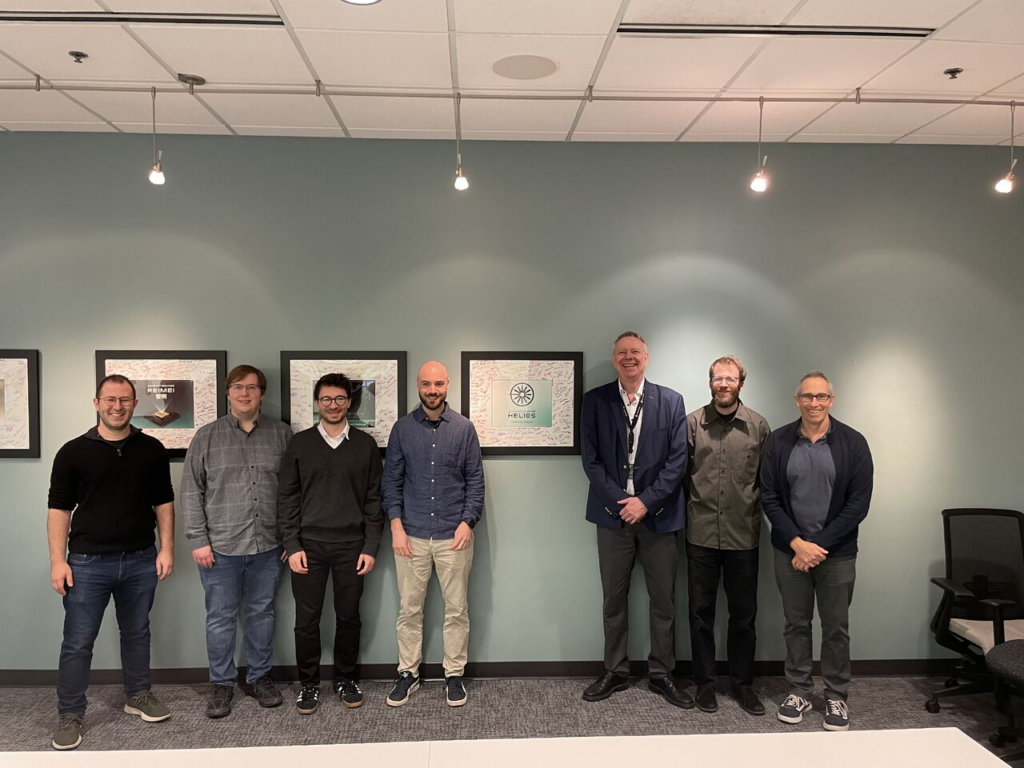
Sandia National Laboratories and Quantinuum have validated Helios, a 98-qubit trapped-ion quantum computer, demonstrating high fidelity rates for single and two-qubit gates and State Preparation and Measurement. Its QCCD architecture, featuring a rotatable ion storage ring and real-time control software, enables complex operations beyond classical simulation. Volumetric benchmarks confirm the system’s capabilities and highlight the extreme computational resources needed to classically simulate its operations.
-
University of Southern Denmark Secures Access to Quantinuum Helios for Fault-Tolerant Algorithm R&D
The University of Southern Denmark (SDU) has partnered with Quantinuum and DeiC to integrate the Quantinuum Helios quantum computing platform into Denmark’s national research infrastructure. This collaboration grants SDU researchers cloud access to the system for developing fault-tolerant algorithms and evaluating quantum error-correction protocols. The Helios platform, with its 98 physical qubits and a 2:1 physical-to-logical qubit ratio, will be used by SDU’s Centre for Quantum Mathematics to test topological surface codes and compute knot invariants.
-
Hexaware Technologies Allocates £25 Million ($33 Million USD) for UK R&D Expansion and Quantum Computing Initiatives
Hexaware Technologies is investing £25 million ($33 million USD) to expand its UK operations, creating 1,200 jobs and establishing new R&D centers in Manchester and Leeds. These centers will focus on advanced technologies like cloud migration, AI, and quantum computing, aiming to develop quantum-resilient software and leverage local talent. This expansion aligns with UK government initiatives and strengthens Hexaware’s deep-tech capabilities.
-
Central New Mexico Community College Exports Quantum Technician Training Architecture Nationwide
Central New Mexico Community College (CNM) has established a national framework for scaling its Quantum Technician Bootcamp, an intensive 10-week program designed to train entry-level technicians without traditional math or science prerequisites. This initiative, developed in collaboration with Sandia National Laboratories and supported by the Elevate Quantum consortium, has successfully placed graduates into high-paying field engineering roles at companies like Qunnect, demonstrating a scalable solution to the quantum industry’s talent deficit.
-
Boeing Advances Its Space-Based Quantum Networking Project with Successful Q4S Lab Tests
Boeing has successfully completed ground testing for its space-qualified Q4S payload, a significant step in developing a space-based quantum network. The payload, designed to enable entanglement swapping, demonstrated leading performance in lab tests while adhering to strict size, weight, and power constraints for spacecraft. This achievement moves Boeing closer to a 2027 launch for the Q4S mission, which aims to test quantum networking hardware in space and establish a global quantum internet.
-
QTREX Quantum Fabricates Cryogenic Chip Carrier via Single-Build Additive Process
QTREX Quantum has successfully fabricated a cryogenic chip carrier using its proprietary single-build Additively Manufactured Electronics (AME) process. This advancement allows for localized signal fan-out paths and dense routing interfaces within cryogenic environments, transitioning QTREX into the processor-interface layer of quantum hardware. The technology integrates conductive pathways, shielding, and dielectric transitions into a single unit, eliminating traditional connectors and improving signal integrity while addressing spatial constraints and electromagnetic cross-talk in superconducting quantum processors.
-
QTREX Quantum Transfers Additively Manufactured Electronics System to Commercial Production Floor
QTREX Quantum Ltd. has successfully moved its Additively Manufactured Electronics (AME) system to a U.S. interconnect manufacturer’s production floor after a rigorous validation program. The system demonstrated a 97% manufacturing yield and the ability to create complex, three-dimensional internal routing channels, offering a significant advancement over traditional PCB etching for high-density computing. Discussions are underway for expanding factory-floor operations and acquiring additional hardware systems.
-
QTREX Awarded Government Grant to Advance RF Dielectric Material for Superconducting Quantum Systems
QTREX Quantum Ltd. secured a $1 million grant from the Israel Innovation Authority to develop a specialized dielectric material for high-density, low-loss RF and microwave signal routing in cryogenic environments. This initiative aims to overcome interconnect limitations in scaling superconducting quantum processors by integrating the custom dielectric into an Additively Manufactured Electronics (AME) framework, creating monolithic interconnect structures. This move signifies QTREX’s strategic shift from medical technology to advanced hardware manufacturing, focusing on quantum connectivity solutions.
-
D-Wave Introduces Gate-Model Quantum Simulator for Error-Aware Programming
D-Wave Quantum Inc. has introduced a gate-model quantum computing simulator designed for error-aware programming, allowing developers to analyze and mitigate hardware imperfections. This simulator, integrated with D-Wave’s Ocean SDK, will support up to 21 qubits and is set to launch in September 2026 via the Leap quantum cloud platform. It aims to accelerate the development of quantum applications by providing tools for error correction and performance modeling under real hardware constraints.
-
-
-
China’s Superconducting Quantum Computer Integrates Post-Quantum Cryptography Architecture
China’s third-generation superconducting quantum computer, Origin Wukong, has successfully integrated a post-quantum cryptography (PQC) security framework, completing over a million computing tasks. This 72-qubit system, featuring the Origin Rock cryptographic module, provides a “spear-and-shield” computing service to protect sensitive data against quantum and classical decryption attempts. This advancement positions China to establish national PQC standards within three years, securing critical infrastructure and demonstrating a reliable, scalable, and secure programmable quantum processing testbed.
-
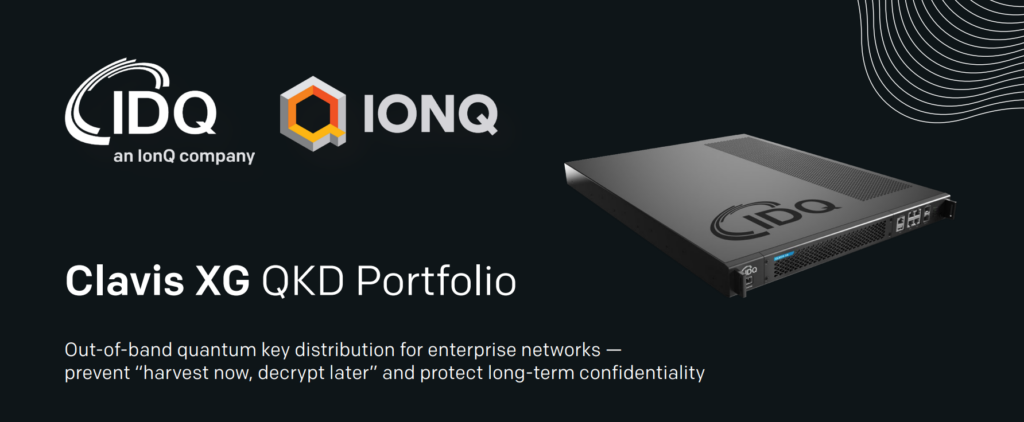
ID Quantique and IonQ Introduce Clavis XG Multiplex to Deploy Quantum Key Distribution Over Metro Networks
ID Quantique and IonQ have launched Clavis XG Multiplex, a hardware solution enabling Quantum Key Distribution (QKD) over existing metropolitan fiber networks. This innovation allows quantum keys and classical data to share the same fiber, eliminating the need for dedicated lines and enhancing security against future decryption threats. The system integrates with existing encryption infrastructures and offers advanced key management, providing a robust defense-in-depth security solution.
-
PsiQuantum Sharpens Quality Control via Griffith University Test & Validation Lab
PsiQuantum opened a Test & Validation Lab at Griffith University, featuring the Poseidon cryogenic system for simultaneously testing multiple Omega silicon photonic chipsets. This facility ensures component quality and reliability before shipping to the main manufacturing site, fostering academic synergy by providing STEM career pathways for students and researchers.
-
PsiQuantum Breaks Ground on Utility-Scale Photonic Hardware Hub at Moreton Bay Central
PsiQuantum has begun construction on a utility-scale quantum computing facility at Moreton Bay Central in Queensland, Australia, backed by a joint $940 million (AUD) investment. This facility, a pivot from an earlier planned site, will house tens of thousands of silicon-photonic chips and a massive industrial cryoplant for cooling. The project aims to create a deep-tech talent pipeline by co-locating with educational institutions and is strategically positioned in a developing precinct set to host events for the Brisbane 2032 Olympics.
-
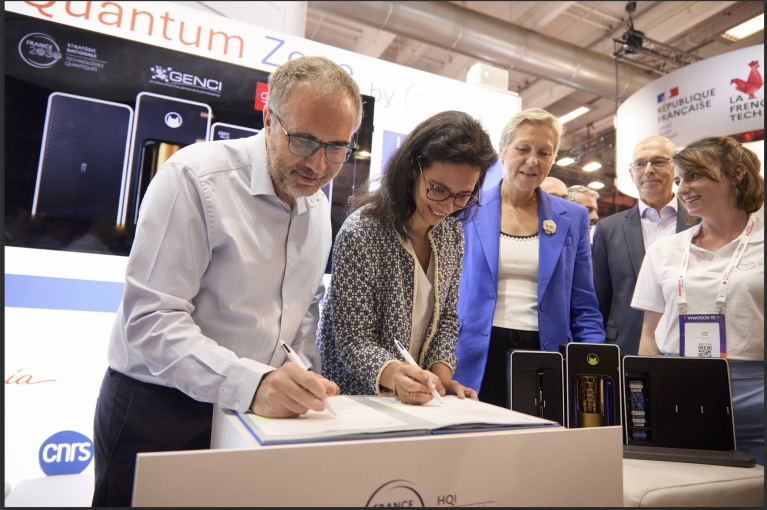
France Finalizes World-First Acquisition of Alice & Bob Cat-Qubit Quantum Computer Under HQI Initiative
France, through its HQI initiative and France 2030 investment plan, has made the world’s first state acquisition of an 18-cat-qubit quantum computer from Alice & Bob. This system, to be deployed at the CEA’s TGCC facility and integrated with existing supercomputers, will provide a foundational infrastructure for European quantum research. Its cat-qubit architecture offers significant advantages in error correction, paving the way for future fault-tolerant quantum computing and open science research.
-
EigenQ to Go Public via $3 Billion SPAC Merger with Silicon Valley Acquisition Corp.
Quantum trust infrastructure developer EigenQ Inc. will go public via a $3 billion SPAC merger with Silicon Valley Acquisition Corp., listing on Nasdaq as EIGQ in late 2026. This move capitalizes on federal cybersecurity mandates (CNSA 2.0) requiring a shift from legacy cryptography, with EigenQ providing NIST-compliant solutions and planning expansion into Quantum AI, Communications, Sensing, and Computing. The company uses a channel distribution model through partnerships with HPE, AMD, WNC, and TD SYNNEX, with existing equity holders and the founder group, led by Dr. Jesse Van Griensven Thé and Dr. José R. Rosas-Bustos, maintaining their roles.
-
SandboxAQ Secures $500 Million CHIPS Act R&D Award to Insulate Semiconductor Supply Chains
SandboxAQ has been awarded \$500 million under the CHIPS Act to bolster semiconductor supply chains. The company will use its AI and quantum technologies, including Large Quantitative Models (LQMs) and the ReAQT platform, to rapidly develop new materials and chemical formulations. This initiative aims to replace “forever chemicals” (PFAS) and reduce reliance on foreign rare earth elements for manufacturing, thereby enhancing domestic semiconductor production and national security.
-
Atom Computing and Nu Quantum Form Transatlantic Alliance to Network Neutral-Atom QPUs
Atom Computing and Nu Quantum have partnered to develop distributed quantum computing architectures by interconnecting neutral-atom systems, aiming to overcome the limitations of single-chip QPUs and reach the GigaQuOp threshold. Their collaboration focuses on optimizing qubit-photon entanglement interfaces, constructing integrated photonic network switches, and modeling distributed quantum error-correction protocols. This transatlantic alliance brings together two well-funded leaders in the quantum hardware space to advance scalable quantum computing.
-
OVHcloud Partners with Welinq and Adds Quobly to Expand Sovereign European Quantum Infrastructure
OVHcloud has expanded its sovereign European quantum infrastructure through a dual announcement: an R&D collaboration with Welinq to develop decentralized quantum networking architectures using neutral-atom quantum memories, and an integration agreement with Quobly to bring its silicon-spin qubit processor onto OVHcloud’s cloud platform by 2026. These additions diversify the company’s Quantum Platform, which already offers access to Pasqal’s neutral-atom and Quandela’s photonic systems, providing enterprise users with unified, vendor-agnostic access to multiple quantum modalities alongside classical HPC resources.
-
OVHcloud Expands Sovereign QaaS Platform via Quandela’s Belenos Photonic System
OVHcloud has commercially launched Quandela’s Belenos, a 12-qubit photonic quantum computer, on its European public cloud infrastructure, offering a fully sovereign Quantum-as-a-Service platform free from U.S. CLOUD Act jurisdiction. The room-temperature light-based processor integrates into OVHcloud’s existing quantum sandbox with 15 emulators, providing enterprise teams with per-second billing access to accelerate quantum machine learning, image classification, and physical modeling workloads.
-
Element Six and Orbray Scale Up Wafer-Scale Single Crystal Diamond Production
Element Six and Orbray have advanced their strategic partnership to volume manufacture wafer-scale single crystal diamond substrates, successfully producing 3-inch synthetic substrates with significantly improved uniformity and developing 4-inch options for semiconductor lines. The companies are finalizing production for 2-inch substrates optimized for epitaxial growth and thermal bonding, with volume manufacturing based at Element Six’s Oregon CVD facility to alleviate supply bottlenecks for next-generation infrastructure. This scale-up aims to accelerate adoption of diamond electronics across 6G wireless, high-power RF military components, deep-space sensing, thermal management, and quantum hardware platforms.
-
Quantum Machines Establishes Budapest R&D Hub Through Acquisition of PCB Design Ltd.
Quantum Machines has expanded its European footprint by acquiring Hungarian hardware design firm PCB Design Ltd. to establish an R&D hub in Budapest, adding 40 specialized engineers to accelerate its hybrid quantum-classical control solutions, following its recent acquisition of QHarbor in the Netherlands.
-