
News
Company, funding, product and policy news from across the quantum industry, as it happens.
-
-
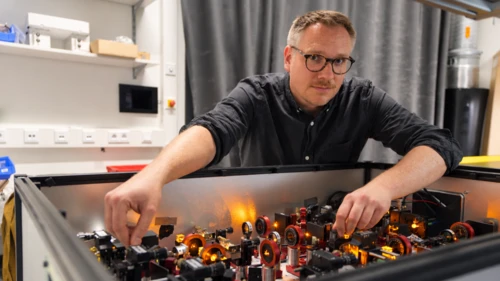
IonQ Demonstrates 1 kHz Memory-Enhanced Quantum Interconnect Connecting Trapped Ions and Diamond Color Centers
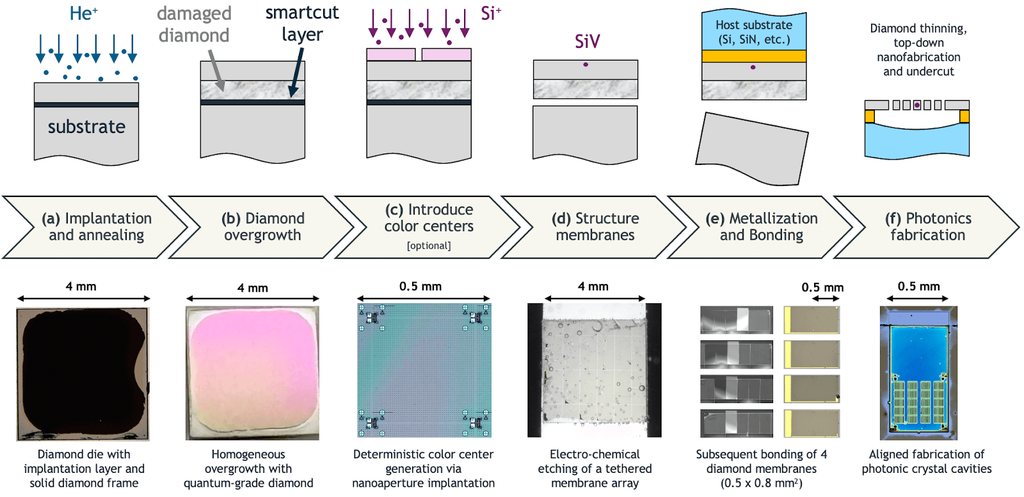
IonQ has achieved a breakthrough in quantum computing with a memory-enhanced quantum interconnect, linking a trapped ion qubit with a diamond-based quantum memory. This system operates at a record-breaking entanglement rate of over 1 kHz with high fidelity, significantly improving upon previous benchmarks. This advancement, supported by collaborations with Element Six and AWS, addresses photon-loss bottlenecks and is a crucial step towards scalable distributed quantum computing networks.
-
NTT DOCOMO BUSINESS Partners with Classiq to Expand Enterprise Quantum Software Adoption in Japan
NTT DOCOMO BUSINESS has partnered with Classiq to distribute Classiq's quantum software development platform in Japan, aiming to expand quantum computing adoption across various enterprise sectors. This collaboration leverages NTT DOCOMO BUSINESS's existing quantum-safe security infrastructure, including a 600-kilometer quantum cryptography communication network, to offer a comprehensive solution for quantum application development and secure communication. The partnership seeks to identify, co-develop, and validate industrial gate-based quantum computing applications for Japanese enterprises.
-
-
-
U.S. Department of Energy Unveils Quantum Genesis Priority Applications to Guide Fault-Tolerant Scientific Utility
The U.S. Department of Energy (DOE) Office of Science has released the Quantum Genesis Priority Applications (QGPAs), outlining eight key scientific problems to assess the relevance of fault-tolerant quantum computers. This framework supports the federal Quantum Genesis initiative, including the $215M Q Competition and a National Quantum Computing User Facility. The QGPAs focus on areas where classical computing faces limitations, such as chemistry, materials, subatomic physics, and applied mathematics.
-
U.S. Department of Energy Allocates $159 Million in Phase II Genesis Mission Awards for Quantum Error Correction and Materials Co-Design
The U.S. Department of Energy has awarded $159 million in Phase II Genesis Mission awards to 12 projects. These projects focus on quantum error correction, materials co-design, and custom microelectronics, leveraging AI and high-performance computing. Key initiatives include Harvard's ASQC project for quantum error correction, Oak Ridge National Laboratory's AI-Empowered Design of Functional Quantum Magnets, and Fermilab's AXESS project for accelerating chip design for extreme environments.
-
NVIDIA Commits $1 Billion over Five Years to Accelerate U.S. Scientific Computing and Quantum Infrastructure
NVIDIA is investing $1 billion over five years to advance U.S. scientific computing and quantum infrastructure. This commitment supports research institutions, cloud providers, and national laboratories, focusing on hybrid quantum-classical hardware integration, fault-tolerant quantum software, fusion energy, and microelectronics design. A key aspect is expanding access to high-performance computing and NVIDIA's open-source CUDA-Q platform for quantum processor simulation and control.
-
U.S. Department of War Announces $350 Million Quantum Package, Highlighted by $150 Million OSC Loan Commitment for PsiQuantum
PsiQuantum has secured a conditional loan commitment of up to $150 million from the U.S. Office of Strategic Capital to expand its PsiFactory in Milpitas, California. This funding will support the development of a domestic supply chain for quantum computing and follows other significant investments from DARPA and the U.S. Department of Commerce. PsiQuantum is also developing facilities in Illinois and Australia.
-
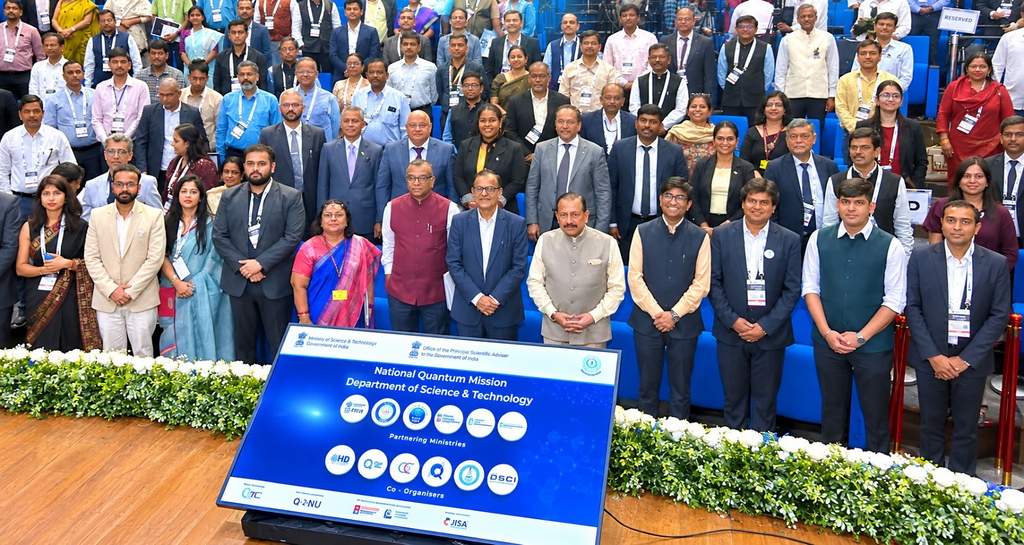
India’s MeitY Sanctions ₹99.94 Crore ($10.3 Million USD) for IIT Madras and izmo Microsystems Silicon Photonics Program
India's MeitY has sanctioned ₹99.94 crore (approx. $10.3 million USD) for Phase II of the SPECTRA program at IIT Madras, in partnership with izmo Microsystems. This five-year initiative focuses on developing silicon photonics for high-bandwidth data centers, AI compute clusters, and quantum communications, including chip-scale QRNG and integrated QKD photonic circuits. The collaboration aims to establish an end-to-end solution for photonic integrated circuits from fabrication to system integration.
-
Quantum Source Introduces Memory-Assisted Photonic Interconnect to Unify Multi-Modal Quantum Computing
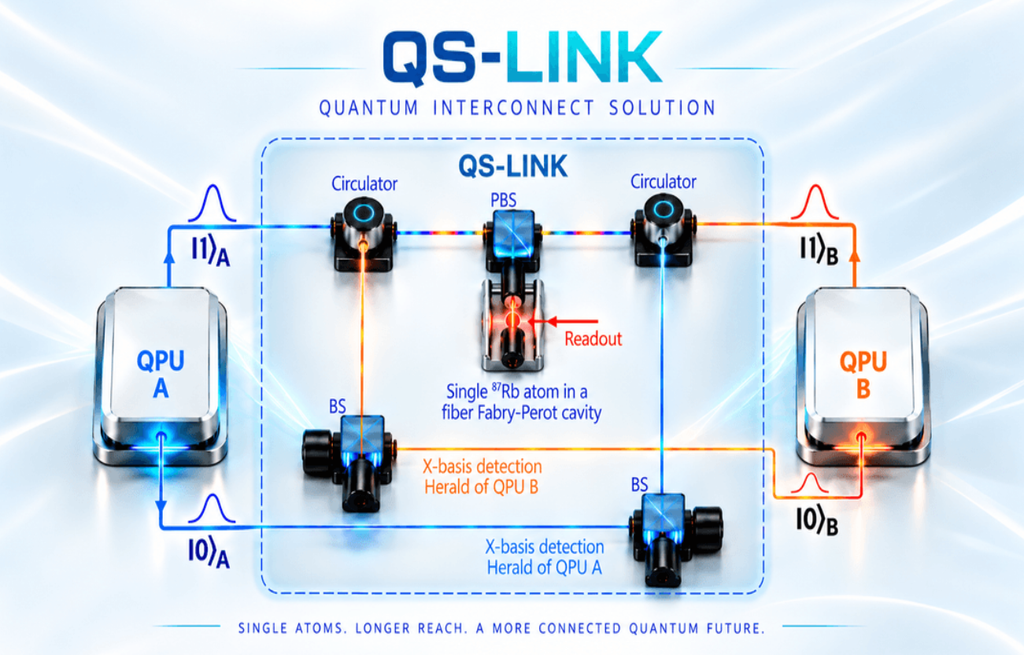
Quantum Source has introduced QS-LINK, a memory-assisted photonic interconnect that unifies multi-modal quantum computing. This technology overcomes scaling limitations in multi-processor quantum networks by using a single cavity-trapped rubidium-87 atom as an asynchronous quantum memory buffer to establish remote entanglement between separate quantum processing units (QPUs). QS-LINK significantly reduces the attempts needed to achieve entanglement compared to traditional methods, operating at room temperature and supporting various hardware modalities.
-
Universal Quantum Closes $100 Million Series A to Accelerate Modular Trapped-Ion Architecture Scaling
Universal Quantum, a UK-based hardware developer specializing in trapped-ion quantum processors, has successfully closed a $100 million Series A funding round. This investment will fuel their international expansion, including operations in Europe, Singapore, the U.S., and Japan, and support their $77 million contract with the German Aerospace Center. Their technology utilizes modular silicon chiplets connected by micro-electric ion-shuttling links, operating at a mild cryogenic temperature of 70 Kelvin, which reduces error rates and avoids complex sub-Kelvin cooling systems.
-
Neutral-Atom Developer Oratomic Secures $775 Million in Cumulative Funding for Fault-Tolerant System R&D
Oratomic, a Pasadena-based quantum hardware developer, has secured $775 million in cumulative funding to advance its fault-tolerant quantum computing systems. The company focuses on neutral-atom arrays and quantum error correction, aiming for utility-scale quantum computers.
-
-
-
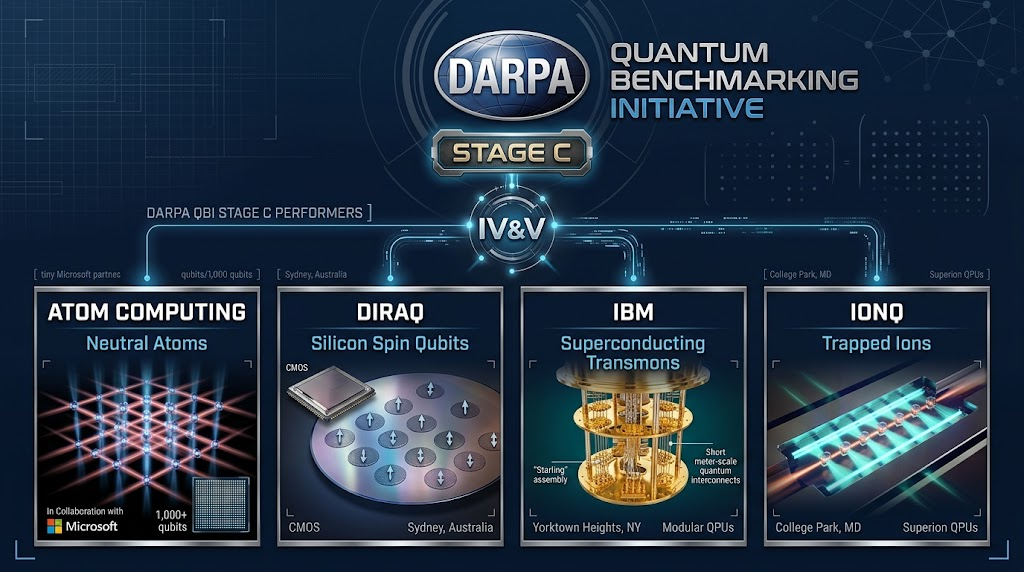
DARPA Selects Atom Computing, Diraq, IBM, and IonQ for Final Stage C Verification under Quantum Benchmarking Initiative
DARPA has selected Atom Computing, Diraq, IBM, and IonQ for Stage C of its Quantum Benchmarking Initiative (QBI) to verify the performance of their fault-tolerant quantum computing architectures. This stage involves direct physical testing and empirical validation of their hardware, aiming to assess their potential for utility-scale operation by 2033. The chosen companies represent diverse qubit technologies, including neutral atoms, silicon spin qubits, superconducting transmons, and trapped ions.
-
Cisco Releases Quantum Network Controller and Network-Aware Compiler v0.2.0 for Distributed Quantum Infrastructure
Cisco's Outshift division has launched the Quantum Network Controller and Network-Aware Quantum Compiler v0.2.0 to manage multi-node quantum networks. The Controller offers Entanglement-as-a-Service, enabling on-demand entanglement across diverse quantum hardware. The Compiler integrates circuit compilation, qubit partitioning, and distributed quantum error correction, optimizing for physical network limitations.
-
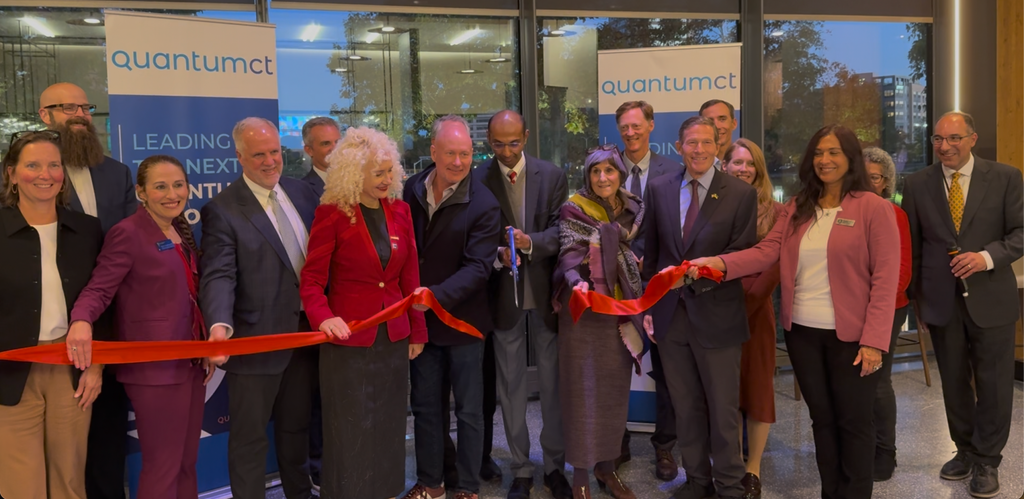
QuantumCT Opens 4,500 Sq. Ft. Innovation Headquarters in New Haven to Anchor Connecticut Quantum Corridor
QuantumCT has opened its 4,500-square-foot innovation headquarters in New Haven, serving as a central hub for quantum computing research, talent development, and startup incubation. This initiative, backed by significant public and private funding, aims to establish Connecticut as a leading U.S. quantum commercialization center. Key funding includes a $50.5 million state allocation and a $15 million NSF grant, alongside institutional research from Yale and UConn, and industry investment from D-Wave.
-
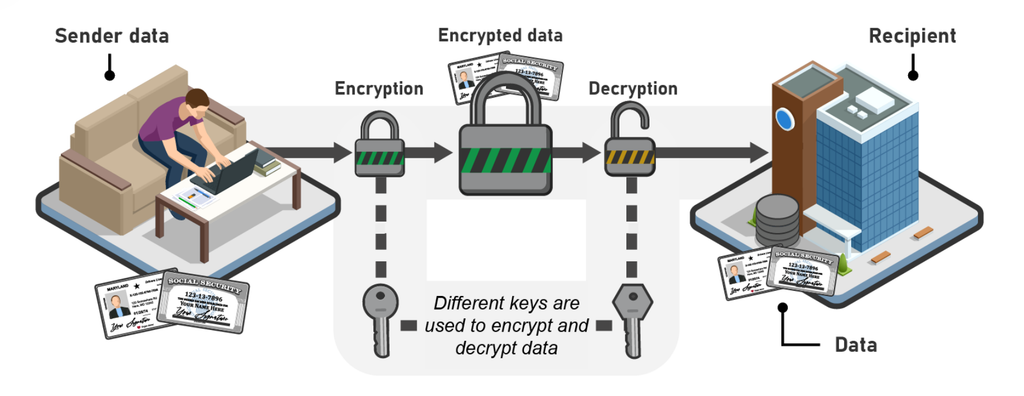
GAO Audit Finds All 24 CFO Act Federal Agencies Unprepared for Post-Quantum Cryptography Migration
A GAO audit found that all 24 CFO Act federal agencies are unprepared for post-quantum cryptography migration, with none having fully implemented the required preparatory practices. The audit, publicly released in October 2026, revealed significant deficits in cryptographic asset inventory, migration funding assessments, and operational PQC testing. This lack of readiness leaves critical federal data vulnerable to future quantum attacks, particularly from "harvest now, decrypt later" tactics by hostile nation-states.
-
Chandigarh University’s CUBIC Partners with 247VC to Expand Investment Framework for Deep-Tech Startups
Chandigarh University's CUBIC has partnered with 247VC Investment Trust to create an investment and mentorship pipeline for quantum and deep-tech startups. This collaboration, established during the PRAGATI Q-Foundry 2026, aims to transition academic quantum research into industrial and commercial deployment. CUBIC will identify eligible seed and early-stage ventures, facilitating their access to funding and mentorship from 247VC.
-
Project Eleven Launches Strongpoint Post-Quantum Custody Platform with Zcash Foundation as Initial Development Partner
Project Eleven has launched Strongpoint, an institutional custody platform designed for post-quantum digital asset security, with the Zcash Foundation as a development partner. The platform aims to provide a crypto-agile control layer for blockchain networks transitioning to post-quantum cryptography. Strongpoint is expected to be deployed in Q4 2026, building on Project Eleven's earlier funding and acquisition of Riva Labs.
-
Zumo and Quantum Chain Partner to Deploy Quantum-Secure Financial Infrastructure in the UK
Zumo, a UK-based digital asset platform, has partnered with Quantum Chain to build quantum-safe financial infrastructure in the UK. This collaboration aims to protect regulated institutions, private networks, and digital payments from quantum computing and AI-driven cyber threats. The initiative will deploy post-quantum cryptography across central bank digital currencies (CBDCs), tokenized deposits, stablecoins, and private financial networks, aligning with the UK's upcoming cryptoasset regulations.
-
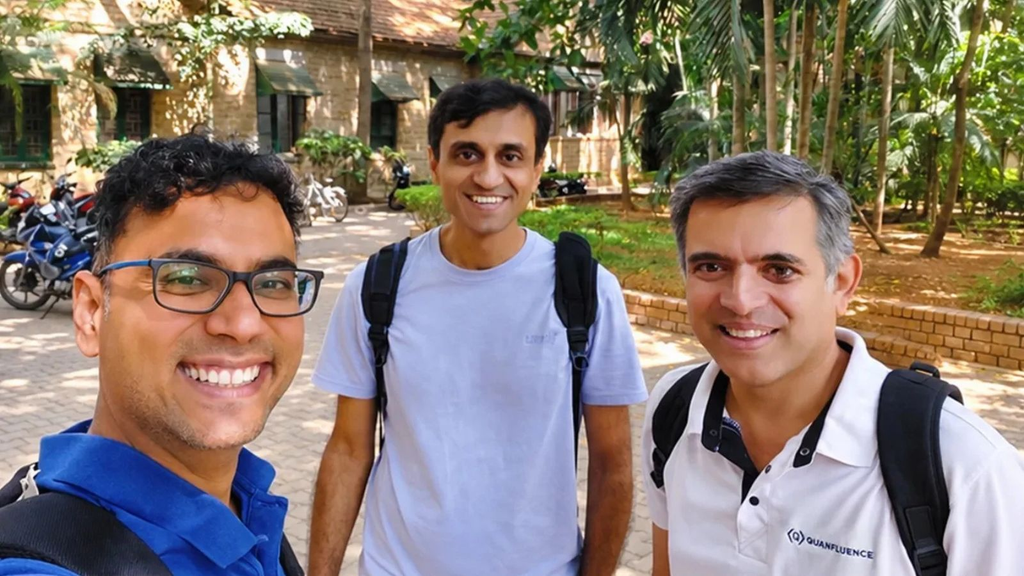
Quanfluence Secures $10 Million to Build Full-Stack Photonic Quantum Computer Architecture
Quanfluence, a Bengaluru-based deep technology startup, has secured $10 million in Series A funding led by Chiratae Ventures, with participation from Pi Ventures and Rainmatter by Zerodha. The company will use the investment to develop a full-stack photonic quantum processing system, integrating its photonic integrated circuits, electronic control silicon, and software algorithms. Quanfluence aims to launch initial photonic processors by 2027 and scalable fault-tolerant systems by 2029, reinforcing India's quantum ecosystem.
-
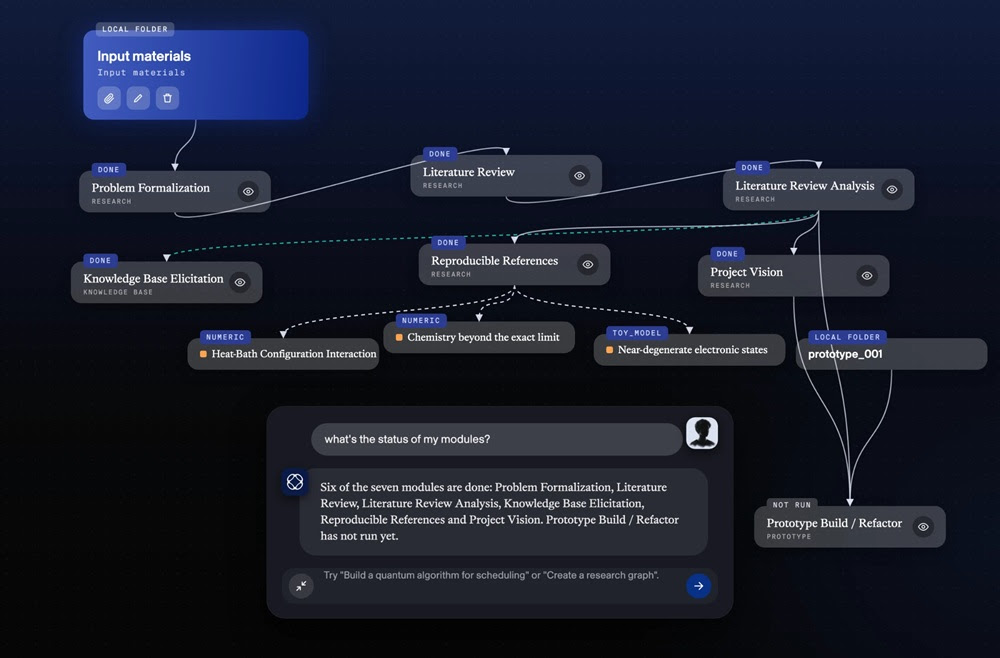
Haiqu Unveils AgenticOS Platform for Automated, Scientifically Verified Quantum Research Workflows
Haiqu has launched AgenticOS, an AI-driven platform that automates quantum computing research workflows. It uses specialized AI agents and a test-driven development approach to prevent errors and ensure scientific accuracy in complex calculations. The platform has successfully simulated a proton-transfer problem and a Fermi-Hubbard model, demonstrating its ability to deliver accurate results and optimize quantum circuits.
-
Infineon and ZuriQ Deepen Partnership to Industrialize 2D Trapped-Ion Penning Micro-Trap Chips
Infineon Technologies and ZuriQ AG have expanded their partnership to industrialize 2D trapped-ion Penning micro-trap chips for quantum computing. This collaboration aims to scale trapped-ion quantum processing units by combining ZuriQ's 2D Penning micro-trap designs with Infineon’s semiconductor fabrication and packaging capabilities. Their joint efforts have successfully demonstrated a 3x3 array of nine individually controlled ion qubits, paving the way for scalable quantum hardware.
-
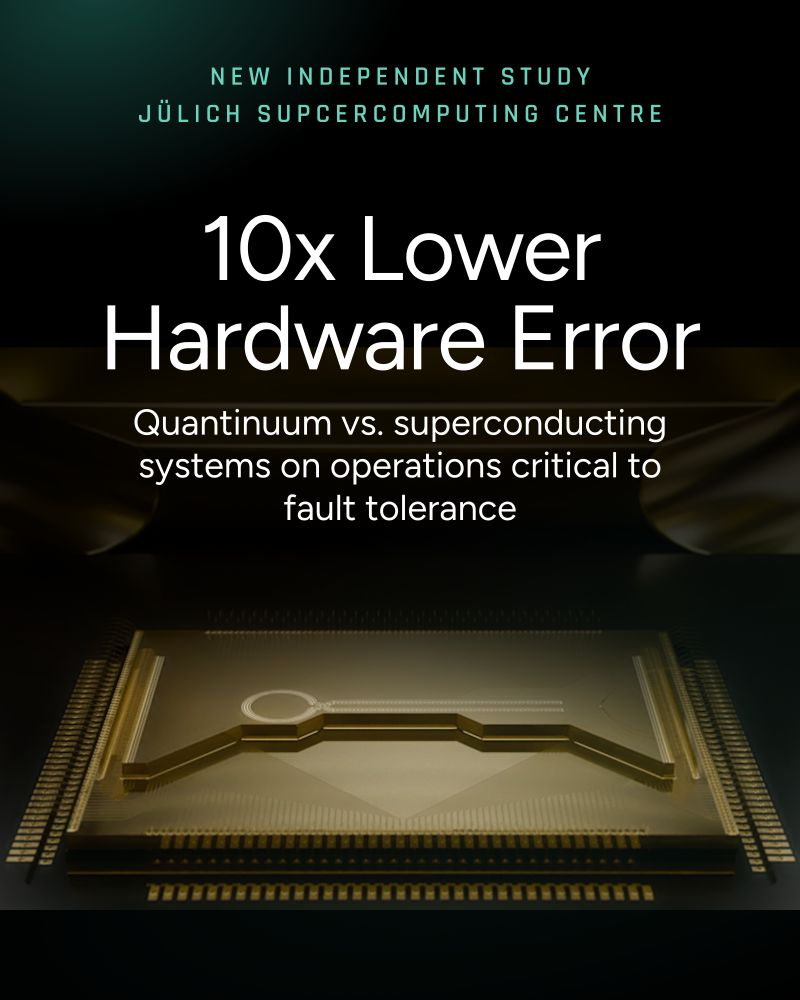
Jülich Supercomputing Centre Benchmark Evaluates Quantum Error Correction Primitives Across Quantinuum, IBM, and IQM Hardware
A Jülich Supercomputing Centre benchmark evaluated Quantum Error Correction (QEC) primitives on hardware from Quantinuum, IBM, and IQM. Quantinuum's trapped-ion systems showed the best performance, maintaining algorithmic signal clarity on a 91-data-qubit color code. The study used a low-sampling algorithmic benchmark with a Linear-Ramp Quantum Approximate Optimization Algorithm (LR-QAOA) framework.
-
Korea Quantum Computing (KQC) to Go Public on Nasdaq via $80 Million SPAC Merger with Charlton Aria
KQC Quantum, an enterprise quantum computing and post-quantum cybersecurity developer, is going public on Nasdaq through an $80 million SPAC merger with Charlton Aria Acquisition Corporation. The merger, expected to close in the first half of 2027, will result in the combined company trading under the ticker symbol "KQC." KQC Quantum's flagship product is Qubiteer™, an AI-driven hybrid quantum engine, and the company also provides post-quantum cybersecurity solutions.
-
-
-
Leibniz University Hannover Launches €5.8 Million ($6.53 Million USD) HybriQCS Project to Develop Hybrid Molecule-Rydberg Quantum Systems
The HybriQCS project, led by Dr. Kai Voges at Leibniz University Hannover, has secured €5.8 million to develop hybrid quantum computing architectures. This 5-year project, running until February 2031, aims to combine ultracold polar molecules for quantum memory with Rydberg atoms for fast multi-qubit gate operations. The primary goal is to execute the first two-qubit quantum logic gate operations using this hybrid system.
-
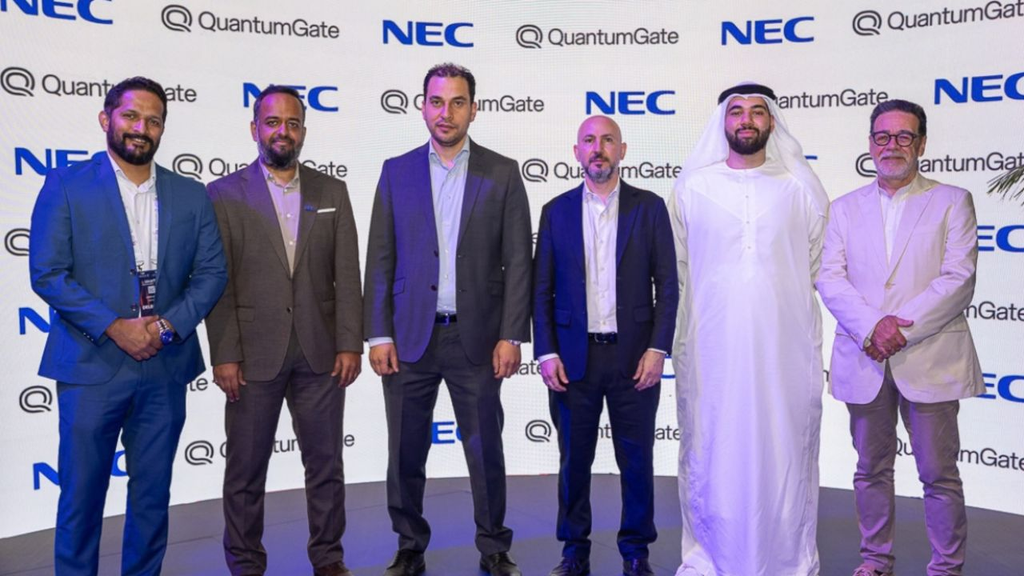
QuantumGate and NEC GCC Partner to Deploy Sovereign Post-Quantum Cybersecurity Across UAE Critical Infrastructure
QuantumGate and NEC GCC are partnering to implement sovereign post-quantum cybersecurity solutions across critical infrastructure and telecommunications in the UAE. The collaboration will deploy QuantumGate's cryptographic software, including QSphere, with NEC GCC leading systems integration. This initiative supports national quantum security directives to protect government, energy, transport, and telecommunications sectors.
-
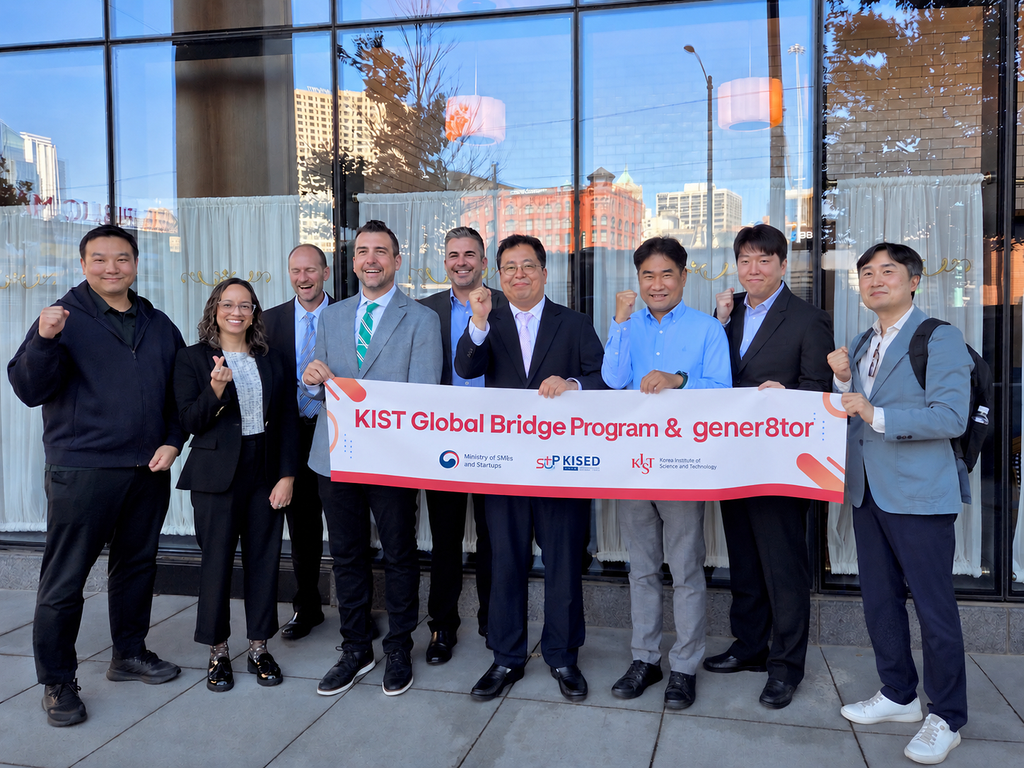
KIST Connects South Korean Quantum Startups to Midwest Ecosystem Across Wisconsin and Chicago
Four South Korean quantum startups, as part of the KIST Global Bridge Program, expanded their U.S. commercial strategy across Wisconsin and Illinois after Quantum World Congress 2026. The delegation engaged with various organizations to foster cross-border technology partnerships and market entry. This initiative is part of South Korea’s Deeptech Incubator Project for Startups (DIPS).
-