
News
Company, funding, product and policy news from across the quantum industry, as it happens.
-
-
Horizon Quantum and Quantum Machines Partner to Advance Real-Time Quantum Calibration
Horizon Quantum Computing and Quantum Machines are partnering to advance real-time quantum calibration. They will integrate Quantum Machines’ control systems with Horizon’s software to create lightweight calibration routines for quantum computing hardware, aiming to reduce system downtime and improve operational stability on Horizon’s Ember-1 quantum computer. This collaboration seeks to enable dynamic system calibration without taking the processor offline, increasing operational uptime for users.
-
QED-C and Center for Quantum Networks Release Quantum Networking Roadmap
A new roadmap by QED-C and CQN outlines the current state and future of quantum networking, identifying critical gaps and key technologies needed for widespread commercialization. The report details 10 high-impact use cases, noting that only two are currently supported, and projects varying timelines for commercial maturity, with short-distance applications within 5 years and long-distance distributed quantum computing around a decade away. This blueprint aims to guide funding and development to overcome technical hurdles and unlock the full potential of quantum systems.
-
ZuriQ Secures $25.5M Seed Round and Advances 2D Trapped-Ion Fabrication with Infineon
ZuriQ, a Swiss quantum hardware startup, has secured $25.5 million in seed funding to advance its 2D trapped-ion quantum computing architecture. This funding, led by Quantonation, will enable ZuriQ to scale its micro-Penning trap technology, which allows for higher qubit density compared to traditional systems. The company plans to expand its team and accelerate the development of its 40-ion processor, leveraging its partnership with Infineon for chip fabrication.
-
IonQ Clears Final Regulatory Hurdle to Complete Acquisition of SkyWater Technology
IonQ has received final regulatory approval to acquire SkyWater Technology for $1.8 billion, with the deal set to close on July 31, 2026. This acquisition will make IonQ the first vertically integrated, full-stack quantum platform company, giving it direct control over its hardware supply chain and accelerating its technical roadmap, including advancing its QPU development and quantum chip architecture. SkyWater will continue to operate as a subsidiary, serving its existing customers and distributing IonQ’s quantum solutions.
-
Four Quantum Firms Join ABQ-Net to Validate Defense and Security Technologies
Four quantum companies—Infleqtion, Aliro Technologies, Tensora, and Bandelier Technologies—have joined ABQ-Net, the first open-access, entanglement-based quantum network testbed in the U.S. This initiative allows these firms to validate defense and security technologies using live metropolitan fiber testing environments, leveraging Qunnect’s hardware and New Mexico’s $450 million quantum technology commercialization effort. Their work includes integrating atomic clocks for precise timing, deploying secure key generation, advancing quantum-inspired geosensing, and evaluating quantum entanglement with AI for network hardening.
-
Riverlane and Unitary Foundation Launch Deltakit Community Fund for Open-Source QEC
Riverlane and Unitary Foundation have launched the Deltakit Community Fund, a microgrant initiative offering $2,000-$4,000 awards to accelerate open-source quantum error correction (QEC) software development. The fund incentivizes global developers to contribute production-grade features to Riverlane’s Deltakit toolkit, focusing on foundational infrastructure challenges in quantum error management. This collaboration aims to expand developer participation and strengthen the software layer for fault-tolerant quantum computing, with applications for the first review cohort due by August 17th.
-
-
-
QTREX Quantum Partners with Northeastern University to Advance Cryogenic Interconnects
QTREX Quantum is collaborating with Northeastern University to develop advanced micro-system structures for cryogenic quantum interconnects. This partnership will focus on creating three-dimensional, additively manufactured interconnects capable of operating at sub-Kelvin temperatures, aiming to replace bulky wiring in quantum processors. This initiative marks QTREX’s continued pivot into quantum technology, building on their recent advancements in cryogenic packaging and material grants.
-
AT&T Expands D-Wave Partnership to Optimize Telecom Network Operations and Agentic AI
AT&T is expanding its partnership with D-Wave Quantum to integrate quantum annealing technology into its network operations, particularly within its agentic AI systems. This collaboration aims to optimize tasks like outage detection, field technician routing, and traffic management, building on successful pilot programs where D-Wave’s technology significantly reduced processing times. AT&T is also exploring D-Wave’s gate-model development for future applications in network security and quantum communications.
-
-
-
Who’s News: Strategic Appointments at Quantum Computing Inc. and Quantinuum
Quantum Computing Inc. (QCi) has announced key leadership changes, with Susan Hunt appointed as Chief Revenue Officer and Pouya Dianat transitioning to Chief Product Officer. Similarly, Quantinuum has strengthened its executive team by appointing Robin Schulman as Chief Legal Officer and Company Secretary, and Rory O’Byrne as Chief People Officer, with both new hires effective in 2026. These strategic appointments are set to drive growth and enhance organizational operations for both companies in the quantum computing sector.
-
Quantum Elements Launches “Orbit” as Qiskit Function for Automated Error Suppression
Quantum Elements has launched Orbit, an advanced error suppression tool available as a Qiskit Function in the IBM Qiskit Functions Catalog. Orbit streamlines noise management for quantum developers by automating dynamical decoupling, hardware-aware transpilation, and measurement error mitigation. This tool significantly improves circuit execution fidelity on live processors, enabling greater computational value from quantum runtime.
-
Qedma Integrates QESEM Error Mitigation Software with Quantinuum Platform
Qedma has integrated its QESEM error mitigation software with Quantinuum’s trapped-ion quantum hardware, making its noise-reduction algorithms directly available on Quantinuum’s systems. This collaboration, developed through Quantinuum’s Startup Partner Program, aims to enhance the accuracy of quantum circuits and enable more complex quantum workloads by reducing hardware noise. The integration allows enterprise developers to seamlessly incorporate Qedma’s error mitigation into their existing workflows, ultimately accelerating the adoption of quantum computing for various applications.
-
IQMP and Q-STAR Sign MoU to Connect Illinois and Japanese Quantum Ecosystems
The Illinois Quantum and Microelectronics Park (IQMP) and Japan’s Quantum STrategic industry Alliance for Revolution (Q-STAR) have signed an MoU to foster collaboration between the Illinois and Japanese quantum ecosystems. This partnership aims to establish commercialization pathways, joint R&D, and supply chain connections, focusing on capital access, supply chain co-development, collaborative research, and workforce exchange. The agreement builds on existing diplomatic ties and seeks to accelerate the transition of quantum research into commercial applications.
-
Infleqtion to Deploy Fault-Tolerant Neutral-Atom Quantum Computer at Illinois Quantum Park
Infleqtion is deploying its fault-tolerant, neutral-atom quantum computer, Sqale, at the Illinois Quantum & Microelectronics Park (IQMP) by 2027, aiming for over 50 logical qubits. Concurrently, they’ve opened the Chicago Quantum Innovation Center to develop quantum optimization solutions for the U.S. energy grid, focusing on areas like fuel loading optimization and grid contingency analysis. This move, alongside other key tenants, solidifies Chicago’s role as a global quantum hub.
-
Zero Point Cryogenics and Ability Engineering Technology Anchor IQMP FaQtory in Chicago
The Illinois Quantum and Microelectronics Park (IQMP) FaQtory in Chicago has secured Zero Point Cryogenics (ZPC) and Ability Engineering Technology (AET) as its first two tenants, establishing a localized quantum manufacturing supply chain in the Midwest. ZPC will open its first U.S. innovation and service hub, while AET will establish an R&D satellite office at the IQMP and modernize its existing plant. This co-location aims to accelerate hardware development and reduce reliance on overseas component sourcing for quantum computing.
-
Bloq Quantum Expands Quantum Education and Workforce Ecosystem in India via Strategic Partnerships
Bloq Quantum has announced two strategic partnerships in Kerala, India, to advance quantum education and workforce development. They’ve partnered with Sree Buddha College of Engineering (SBCE) to establish an undergraduate quantum computing lab, providing students and faculty with access to their low-code quantum development platform and fostering research and career pathways. Additionally, Bloq Quantum has allied with QClairvoyance, designating them as a “Quantum Skilling Partner” to integrate Bloq’s software into broader institutional training and build a talent pipeline.
-
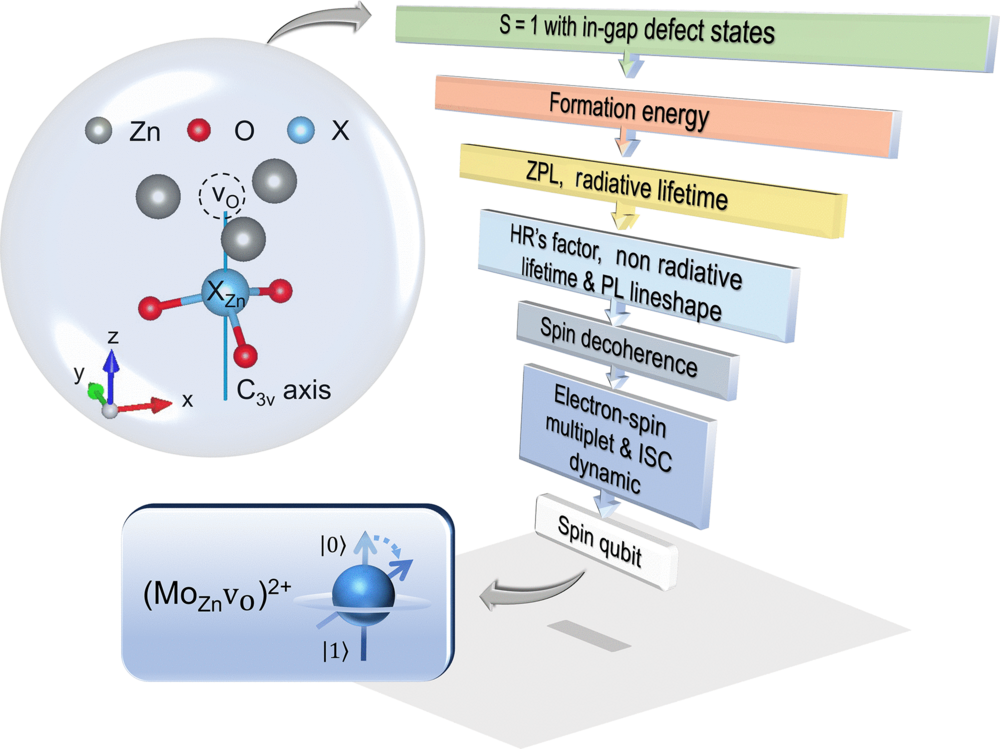
SKKU Researchers Identify Room-Temperature “Spin Qubit” Defect in Zinc Oxide Semiconductors
Researchers at Sungkyunkwan University, in collaboration with the University of Wisconsin-Madison and the University of Washington, have identified a novel defect in zinc oxide (ZnO) semiconductors, the molybdenum-oxygen-vacancy complex [(MoZnvO)2+], that functions as a robust, room-temperature “spin qubit.” This discovery, published in PRX Quantum, offers a scalable alternative to diamond-based qubits for quantum computing due to ZnO’s compatibility with existing manufacturing processes and its inherent magnetic quietness. The new defect exhibits superior thermal stability, suppressed phonon coupling, millisecond spin coherence, and high-fidelity single-shot readout, paving the way for integrated quantum networks and advanced quantum sensors.
-
Terra Quantum and Apex.AI Demonstrate Quantum-Safe Security for Edge-to-Cloud Intelligent Systems
Terra Quantum and Apex.AI have successfully integrated NIST-standardized post-quantum cryptography (PQC) into edge-to-cloud intelligent systems using Apex.OS. This advancement provides quantum-resistant security for autonomous vehicles and other long-lifecycle edge devices, addressing vulnerabilities from future quantum computers without requiring changes to existing software. The solution offers a practical and scalable approach to secure critical communication networks across various domains, ensuring long-term digital resilience.
-
News Archive 2026
June 30, 2026Crédit Agricole CIB and Pasqal Execute Strategic Production Roadmap for Neutral Atom Quantum Finance DeploysCrédit Agricole CIB and Pasqal have partnered to integrate quantum processing units into banking operations by 2028, moving from…
-
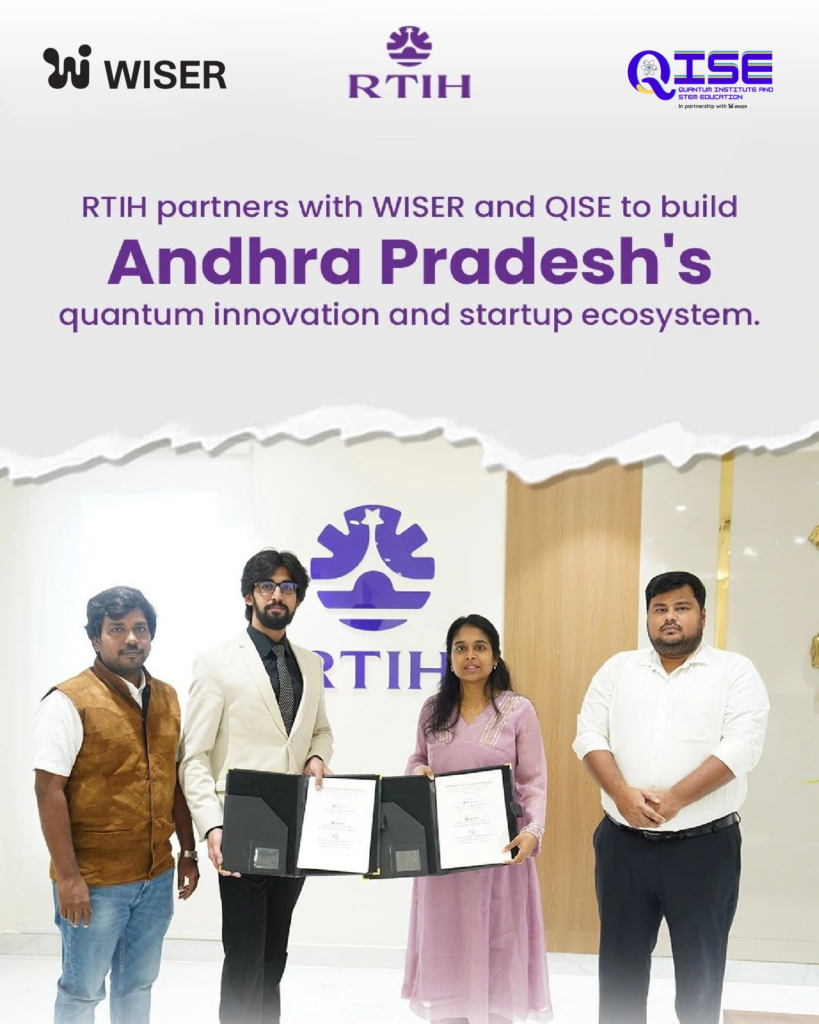
Ratan Tata Innovation Hub AP Partners with WISER and QISE to Build Andhra Pradesh Quantum Startup Ecosystem
The Ratan Tata Innovation Hub (RTIH) in Andhra Pradesh has partnered with The Washington Institute for STEM, Entrepreneurship and Research (WISER) and its Quantum Institute And STEM Education (QISE) division. This collaboration aims to boost deep-tech startup infrastructure, commercialize research, and develop talent in Andhra Pradesh, supporting the state’s Amaravati Quantum Valley strategy. The initiative will provide quantum education, startup incubation, and integrate local innovators with national and global quantum ecosystems.
-
WISER and E.ON Benchmark Quantum Machine Learning for Smart Grid Energy Forecasting
WISER and E.ON have successfully benchmarked hybrid quantum-classical machine learning (QML) for smart grid energy forecasting, utilizing IBM Quantum hardware with over 100 qubits. Their research demonstrated that QML models like QGP and KQRC-RM can significantly reduce forecasting errors for electricity demand, even on noisy intermediate-scale quantum devices. This advancement offers a scalable solution for real-time grid balancing and predictive load planning in decentralized energy grids.
-
-
-
IBM to Acquire HRL Laboratories to Expand Quantum Roadmap with Silicon-Spin Qubits
IBM is acquiring HRL Laboratories to enhance its quantum hardware strategy by incorporating HRL’s expertise in silicon-spin qubits, a parallel path to its superconducting qubit program. This acquisition will allow for shared learning in manufacturing, control electronics, and cryogenics, and will integrate HRL’s semiconductor quantum dot engineering with IBM’s Anderon Foundry. The deal, expected to close by late 2026, supports IBM’s long-term goal of achieving fault-tolerant quantum computing.
-
-
-
Galaxy Digital Launches $5 Million Bitcoin Quantum Readiness Initiative
Galaxy Digital has launched a $5 million Bitcoin Quantum Readiness Initiative to prepare the Bitcoin network against future quantum computing threats. This program will focus on upgrading Bitcoin’s cryptography through a developer grant program, research and policy publishing, and a quantum advisory council. The initiative seeks to proactively address potential vulnerabilities and encourages industry-wide collaboration.
-
Innolume Expands Quantum Dot Manufacturing Platform with Veeco GEN2000 MBE System
Innolume, a German photonics manufacturer, is expanding its production of gallium arsenide (GaAs)-based quantum dot (QD) lasers by acquiring a Veeco GEN2000 Molecular Beam Epitaxy (MBE) system. This expansion aims to increase capacity for QD lasers, comb lasers, distributed feedback (DFB) lasers, and semiconductor optical amplifiers (SOAs) to meet the growing demand from AI infrastructure, cloud data centers, and silicon photonics. Additionally, Innolume is preparing for the installation of two Riber MBE6000 production reactors in Q4 2026, further diversifying its equipment base and scaling 6-inch GaAs production.
-
Hewlett Foundation Launches $100M Initiative Targeting AI, Biotechnology, and Quantum Security
The Hewlett Foundation has launched a five-year, $100 million initiative to address policy, security, and governance challenges in emerging technologies like AI, biotechnology, and quantum computing. This program, allocating $20 million annually until 2031, will fund organizations to protect critical infrastructure from AI threats, mitigate quantum and bio vulnerabilities, and establish global governance norms for these dual-use technologies. The initiative aims to bridge the gap between rapid technological advancements and slower government regulation.
-
Rice University Joins DOE Quantum Science Center to Advance Real-Time Quantum Error Correction
Rice University has joined the U.S. Department of Energy’s Quantum Science Center, focusing on developing and optimizing quantum error-correction decoding algorithms to run on classical High-Performance Computing (HPC) supercomputing architectures. Led by Tirthak Patel, the team will work on hierarchical decoding frameworks, system-level bottleneck remediation, and multi-platform QEC evaluation. This collaboration aims to accelerate the deployment of hybrid Quantum-Accelerated High-Performance Computing (QHPC) platforms, supporting the DOE’s goal of a fault-tolerant quantum computing ecosystem by 2028.
-