
News
Company, funding, product and policy news from across the quantum industry, as it happens.
-
-
IQM Upsizes SPAC Merger PIPE Financing to $146 Million with Capital Commitment from Pension Insurer Ilmarinen
IQM Finland Oy and SPAC Real Asset Acquisition Corp. (Nasdaq: RAAQ) have upsized their PIPE financing to $146 million, driven by a new investment from Finnish pension insurer Ilmarinen. The transaction maintains IQM’s pre-money valuation at $1.8 billion as it prepares to go public via a reverse merger. The capital will fund IQM’s vertically integrated superconducting hardware fabrication and software deployment pipeline. Upon completion, the combined entity expects a cash balance of up to $477 million, making IQM the first European quantum hardware firm to secure a dual listing on the Nasdaq (IQMX) and Nasdaq Helsinki.
-
QuiX Quantum Installs Real-Time Feed-Forward Control Unit for Photonic Computing Architecture
QuiX Quantum has installed its Feed-Forward Control Unit (FFCU), a module that enables real-time adaptive operations within its photonic quantum computing stack by automating hardware reconfigurations at a deterministic 150-nanosecond latency. Combining a dual-FPGA processing bus with a 32×32 input/output routing matrix, the system converts single-photon detector inputs into instant phase modifications before the target photon can travel 30 meters. This breakthrough establishes the ultra-fast feedback loops required to scale measurement-based photonic quantum computers for integration with classical high-performance computing networks.
-
Microsoft Announces an Improved Majorana Qubit Design
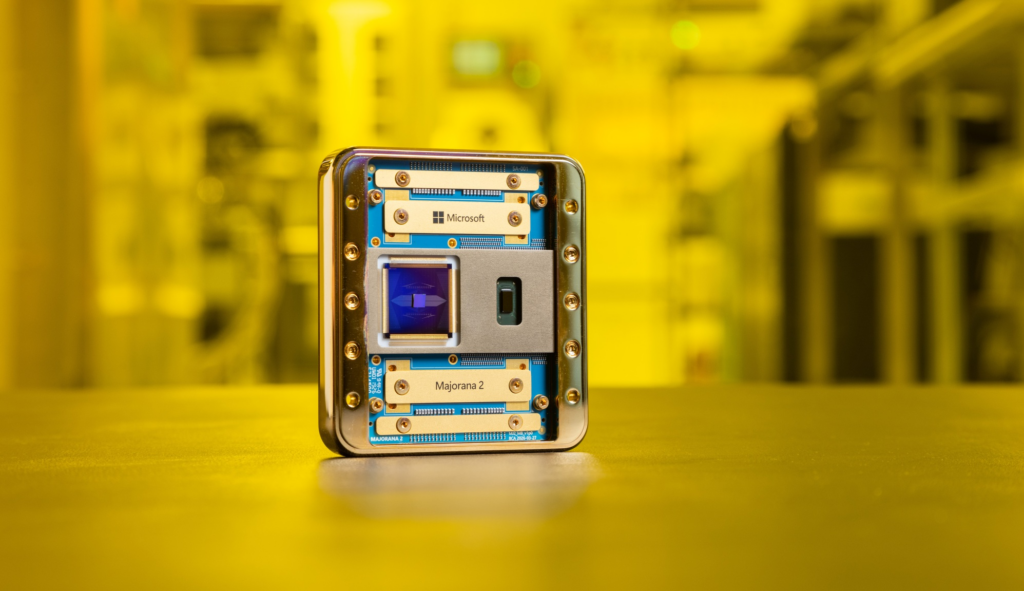
At its annual Build Conference, Microsoft announced major improvements to its Majorana qubit design, incorporated into its next-generation Majorana 2 chip. Developed with the help of agentic AI, the updated material stack (incorporating Lead and Antimony) increases the critical topological gap by over 2X, delivering a 20-second parity lifetime and a 1000x increase in switching time reliability. These performance milestones have accelerated Microsoft’s hardware roadmap, leading the company to project a scalable, topological-based quantum computer by 2029.
-
-
-
D-Wave Outlines Superconducting Gate-Model Roadmap Targeting 100 Logical Qubits
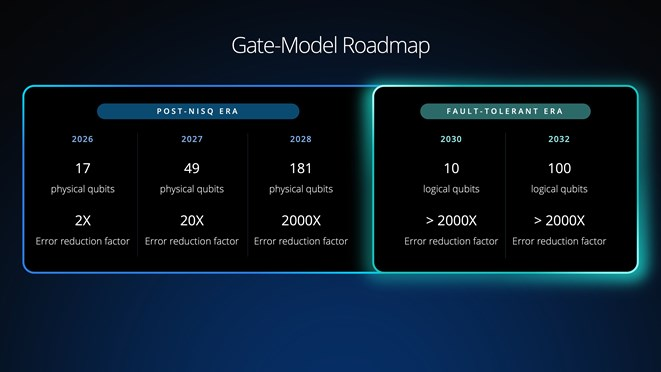
D-Wave Quantum Inc. has unveiled a gate-model development roadmap aiming for a 100-logical-qubit system by 2032, leveraging a specialized superconducting dual-rail qubit design with integrated quantum error correction. This approach focuses on hardware-level error reduction and targets a Lambda value of 10 for error suppression, significantly outperforming current multi-qubit platforms. The gate-model chips will be integrated into D-Wave’s Leap™ quantum cloud service, positioning the company as a dual-platform hardware provider for both optimization and gate-model workloads.
-
-
-
Who’s News: Strategic Leadership Appointments at Quandela, Zapata Quantum, Imperagen, and EigenQ
Quandela, Zapata Quantum, Imperagen, and EigenQ have all announced significant leadership appointments to drive growth and innovation in the quantum computing and biotechnology sectors. Notables include Cyril Dujardin as COO at Quandela, original co-founders Yudong Cao and Jonathan Olson returning to Zapata Quantum, Guy Levy-Yurista as CEO of Imperagen, and Natan Aronshtam joining EigenQ’s Board of Directors. These strategic moves aim to advance quantum hardware, software, biocatalysis platforms, and data verification infrastructure.
-
Pramatra Space Secures Pre-Seed Capital to Advance Space-Based Quantum Key Distribution Hardware
Pramatra Space, a Bengaluru-based quantum security company, has secured pre-seed funding from investors including Seafund Ventures, Rebalance, and Magnivia Ventures. This capital will be used to develop hardware for space-based Quantum Key Distribution (QKD), specifically focusing on flight-qualifying their proprietary Photonic Integrated Circuit (PIC) chip designed for entanglement-based QKD. The company aims to provide a QKD-as-a-Service framework, with an in-orbit demonstration mission scheduled for 2027.
-
-
-
Rigetti Simulates Plasma Wave Dispersion on Superconducting Ankaa-3 Processor Using Specialized Error Mitigation
Rigetti Computing, in collaboration with Lawrence Livermore National Laboratory and the University of Colorado, Boulder, successfully simulated plasma wave dispersion on their Ankaa-3 quantum computer. They used a nine-qubit cluster and dual error mitigation to accurately map electromagnetic wave behavior across varying plasma densities. This research, published in Physical Review Applied, establishes a framework for exploring complex quantum plasma dynamics.
-
Quantum Machines Achieves 99.5% Two-Qubit Gate Fidelity Operating Rigetti’s Novera QPU
Quantum Machines successfully operated Rigetti’s Novera QPU using their external control hardware and software, achieving a 99.5% median two-qubit gate fidelity, matching Rigetti’s internal metrics. This accomplishment, using the OPX1000 orchestration platform and QUAlibrate software, demonstrates that high-performance superconducting processors can maintain stable execution parameters independently of the developer’s proprietary control infrastructure. This decoupling simplifies operations for multi-vendor installations and enables open-architecture deployments for quantum research.
-
UK Quantum Biomedical Hub Secures £902,000 ($1.2 Million USD) Allocation to Develop Clinical Sensing and Imaging Hardware
The UK National Quantum Biomedical Research Hub (Q-BIOMED) received £902,000 ($1.2 million USD) to develop and integrate quantum sensing hardware into clinical medical environments. This funding, from the EPSRC’s Accelerating Capability Fund, supports six work packages focused on advancing quantum technologies for diagnostics, neuroimaging, and surgical applications within the NHS, aiming to bridge the gap between academic research and medical deployment.
-
University of Tennessee Launches Knoxville Quantum Accelerator to Anchor State Initiative
The University of Tennessee, Knoxville (UT) has launched the Knoxville Quantum Accelerator (K-Quantum) to advance quantum technology through research, hardware validation, and workforce training. This initiative, part of Tennessee’s $43 million Quantum Initiative, aims to translate foundational quantum mechanics into commercial tools by fostering public-private partnerships and developing infrastructure like a 100,000-square-foot quantum foundry and a hybrid classical-quantum computing node. K-Quantum will also recruit new faculty and incubate deep-tech startups to support a robust quantum ecosystem in East Tennessee.
-
Moth Launches Quantum Backrooms, a Quantum Game for Consumers
Moth, a London-based quantum software startup, has launched Quantum Backrooms, the world’s first consumer game powered by live quantum hardware. The game generates its levels and dynamics using real Quantum Processing Units (QPUs), with qubits determining game geography and entanglement dictating maze topology. This initiative aims to demystify quantum technology for the public, serving as a tangible proof-of-concept and showcasing Moth’s low-code/no-code platform for building quantum-native applications.
-
SEALSQ Deepens Strategic Commitment to EeroQ with Additional Investment and Lead Investor Role
SEALSQ has increased its strategic investment in EeroQ, becoming the lead investor in the quantum hardware startup’s upcoming financing round. This expanded partnership, building on previous investments, aims to develop an integrated Quantum Security Vertical Stack combining SEALSQ’s secure semiconductor hardware and PKI services with EeroQ’s “electrons on helium” quantum computing architecture. The collaboration seeks to bridge classical computing, post-quantum cryptography, and native quantum processing, with a demonstration planned at SEALSQ’s Quantum Center of Excellence in Geneva.
-
Infleqtion Establishes UK Quantum Innovation Centre and Manufacturing Hub in Oxford
Infleqtion has opened a new Quantum Innovation Centre and manufacturing hub in Oxford, expanding its UK operations to focus on producing neutral-atom quantum computing and sensing hardware. This move supports the UK’s National Quantum Strategy by providing a domestic supply chain for advanced quantum technologies, including a 100-qubit quantum computer for the NQCC and atom-based sensing platforms for defense.
-
Indian Institute of Science Establishes Wadhwani Innovation Centre to Accelerate Deep-Tech and Quantum Commercialization
The Indian Institute of Science (IISc) in Bengaluru launched the Wadhwani-IISc Innovation Centre on May 22, 2026, to boost deep-tech research and startup incubation. Funded by a collaborative Rs 1,400+ crore investment, the center provides infrastructure and the InQubate platform for quantum startup acceleration. This initiative, aligning with India’s National Quantum Mission, aims to commercialize intellectual property, streamline hardware development, and foster domestic technology manufacturing and workforce development.
-
Indian Institute of Science and Yaqumo Form Strategic Coalition to Deepen Indo-Japanese Neutral-Atom Quantum Hardware R&D
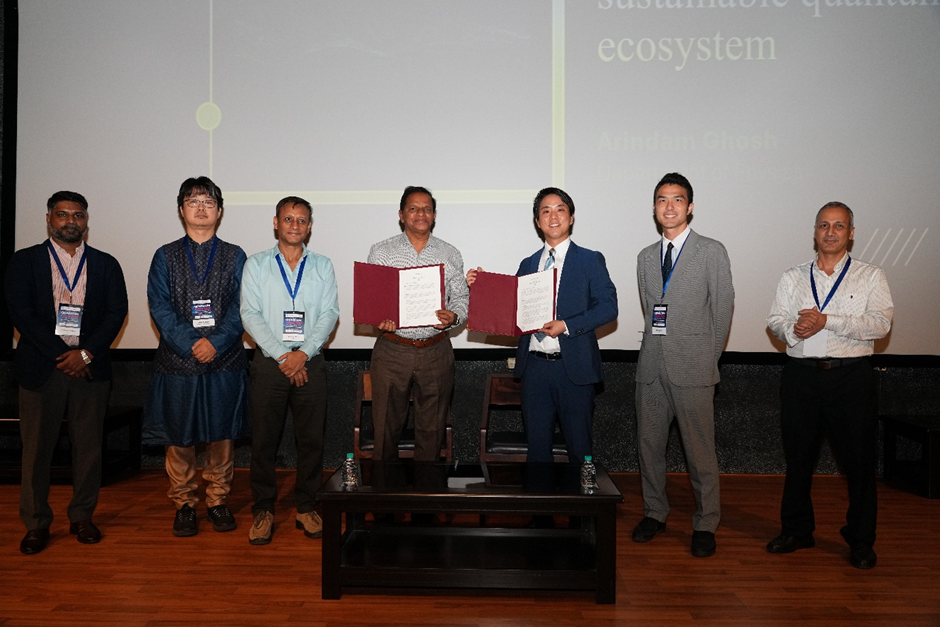
The Indian Institute of Science (IISc) and Tokyo-based startup Yaqumo Inc. have formed a strategic partnership to advance Indo-Japanese neutral-atom quantum hardware R&D. This collaboration, aligned with the India-Japan Digital Partnership 2.0 and India’s National Quantum Mission, focuses on developing scalable quantum computing frameworks using Yaqumo’s neutral-atom technology and IISc’s research capabilities. The goal is to accelerate the validation, demonstration, and industrial deployment of quantum computing, benefiting both nations in areas like materials science, pharmaceutical synthesis, and quantitative finance.
-
Quantonation Selects Neutral-Atom Hardware Developer Yaqumo for First Japanese Investment
Quantonation, a global quantum venture capital firm, has made its first Japanese investment by closing a $4.4 million Seed Extension funding round in Tokyo-based hardware developer Yaqumo Inc. Yaqumo, a deep-tech spinoff from Kyoto University, focuses on developing neutral-atom (cold atom) processing units, aiming to improve quantum computing scalability and fault tolerance. This investment will help Yaqumo expand its engineering team and accelerate hardware validation, fostering international partnerships and testing its processors against complex computational tasks.
-
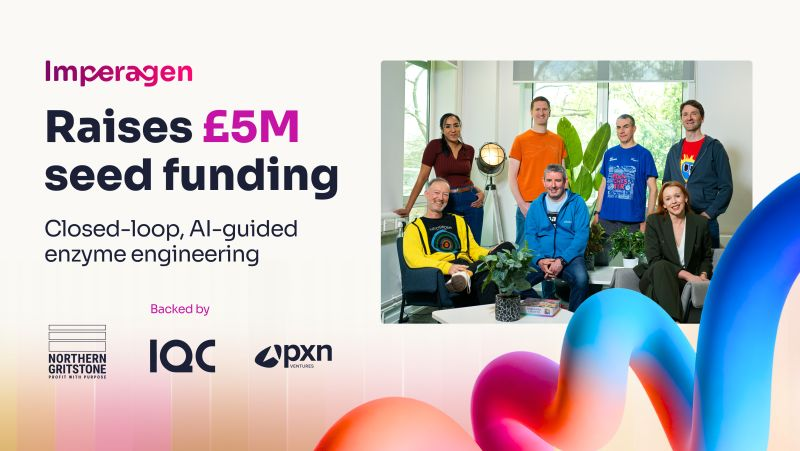
Manchester Techbio Spin-Out Imperagen Raises £5 Million (6.7 Million USD) Seed Round to Scale Closed-Loop Quantum Biocatalysis Platform
Manchester-based Imperagen, a techbio spin-out, has secured £5 million (6.7 million USD) in seed funding, bringing its total financing to £8.5 million ($11.44 million USD). The company specializes in accelerating industrial enzyme engineering through its closed-loop quantum biocatalysis platform, which integrates quantum mechanics, machine learning, and laboratory robotics. This technology has demonstrated significant productivity gains in enzyme optimization for industrial applications, and the new funding will be used to scale its operations and drive commercialization.
-
King’s College London Secures Early Access to Google’s Willow Quantum Processor for Computational Neuroscience Research
King’s College London has been granted early access to Google’s Willow quantum processor, a 105-qubit superconducting quantum processor, for computational neuroscience research. This partnership, the first between Google and a British government institution for quantum hardware, will enable King’s researchers to simulate complex many-body quantum mechanical interactions, including modeling biological neurons. The initiative aims to advance quantum simulation techniques, bridge computational neuroscience with physical chemistry, and contribute to the UK’s National Quantum Technologies Programme.
-
QUDORA Establishes Tokyo Subsidiary to Embed Trapped-Ion Hard Infrastructure Within Japan’s Core Industrial Sectors
QUDORA Technologies GmbH, a German quantum computing company, has launched Qudora Japan K.K. in Tokyo to expand its trapped-ion quantum systems across Asia. Their proprietary Near Field Quantum Control (NFQC®) technology, which uses microwave components instead of lasers, offers extended coherence times and industrial CMOS scale production. QUDORA has partnered with the Q-STAR Alliance, AHK Japan, and Fixstars Amplify to integrate its hardware and cloud platform into Japan’s industrial sectors and supercomputing infrastructure.
-
Massachusetts Commits $25 Million to Anchor MIT’s Landmark Quantum Systems Laboratory
Massachusetts has committed $25 million to establish the Quantum Systems Laboratory (QSL) at MIT, aiming to make Greater Boston a hub for quantum computing and sensing. This facility will integrate high-performance quantum computing with advanced sensors, fostering academic discovery, commercial innovation, and workforce development. The QSL will be accessible to external organizations and universities, strengthening the region’s entrepreneurial network and contributing significantly to the economy.
-
IBM Pledges $10 Billion Global Quantum Expansion to Deliver Fault-Tolerant Quantum Supercomputers by 2029
IBM is investing over $10 billion in its quantum computing division to develop a fault-tolerant quantum computer by 2029, a move outlined in an SEC filing. A key part of this strategy is the launch of Anderon, a new company and the first pure-play quantum chip foundry in the US, backed by a $1 billion CHIPS Act incentive and an equal investment from IBM. This initiative aims to accelerate the development of error-free quantum computing, surpassing current limitations and solidifying IBM’s leadership in the field.
-
-
-
Update on Quantinuum’s IPO Filing
Quantinuum has submitted an amended S-1A filing, revealing finalized IPO pricing between $45.00 and $50.00 per share, valuing the company at $11.43 to $12.70 billion. The filing also details a significant $100 million award from the U.S. government under the CHIPS Act, outlines a formally seated board of directors with U.S. Person qualification rules, updates executive compensation, and provides completed financial disclosures with finalized IPO expenses.
-
Qilimanjaro Deploys an Analog Quantum Computer at the Barcelona Supercomputing Center
Qilimanjaro Quantum Tech has launched a new analog quantum computer at the Barcelona Supercomputing Center (BSC-CNS), integrating it with existing digital quantum infrastructure and the MareNostrum 5 supercomputer to create MareNostrum-Ona, a hybrid computing environment. This 10-analog qubit system, part of the EuroQCS-Spain initiative, is designed for error-resilience and optimized for tasks in optimization, simulation, and AI, offering a comprehensive quantum toolkit to European researchers.
-
Q-CTRL Framework Outlines Path to Quantum Battlefield Information Dominance Across Four Defense Verticals
Q-CTRL’s new white paper, “Quantum Computing for Battlefield Information Dominance,” outlines how their AI-powered error-suppression software can accelerate quantum advantage for military applications by 2027. This technology, validated on IBM quantum hardware, optimizes defense logistics like convoy routing and strategic airlift, and enhances missile defense, integrating with Allied C4ISR and AUKUS frameworks. The company also develops quantum navigation systems, aiming to provide tactical overmatch and information dominance for allied defense networks.
-
-
-
Lastwall Secures $16 Million Investment to Expand Quantum-Resilient Cyber Defense Operations Across Canada
Lastwall, a cybersecurity company specializing in identity-first authentication and quantum-resilient software, has secured $16 million in Series A extension investment. This funding, led by the Business Development Bank of Canada, will be used to expand Lastwall’s quantum-resilient cyber defense operations across Canada, particularly within municipal utilities, defense infrastructure, and public sector cloud portals. The company’s technology uses behavioral telemetry and post-quantum cryptography to protect critical infrastructure from advanced cyber threats.
-