
News
Company, funding, product and policy news from across the quantum industry, as it happens.
-
-
Quantinuum and Aramco Execute Non-Binding MoU for Energy Sector Quantum R&D
Quantinuum and Aramco have signed a non-binding MoU to explore quantum computing applications in the energy sector. This collaboration involves Aramco gaining access to Quantinuum’s trapped-ion hardware and software stack to research fault-tolerant quantum computing for complex simulations in energy production and to integrate quantum solutions into their digital transformation. This partnership also expands Quantinuum’s presence in the Middle East.
-
Giesecke+Devrient Joins European uPQComing Consortium to Develop Quantum-Safe eID Operating Systems
Giesecke+Devrient (G+D) has joined the European uPQComing consortium, co-funded by the EU’s Chips Joint Undertaking, to develop quantum-safe eID operating systems. The project focuses on migrating critical public digital infrastructure and resource-constrained embedded secure elements to Post-Quantum Cryptography (PQC). G+D’s role involves integrating PQC algorithms into Java Card chip operating systems, designing crypto-agile architectures, and implementing hybrid key exchange and authentication schemes, building upon their previous work with Germany’s Bundesdruckerei to establish quantum-resistant digital identity architectures across the EU.
-
SEEQC Signs MoU with Taiwan Quantum Industry Technology Promotion Office to Build Cryo-Chip Supply Chain
SEEQC has signed an MoU with Taiwan’s QITPO to create a cross-border quantum technology and supply-chain partnership. This agreement, signed at SEMICON Taiwan 2026, focuses on leveraging Taiwan’s semiconductor infrastructure for the development, testing, and commercialization of quantum computing components, including cryo-CMOS and SFQ manufacturing, and advanced packaging for superconducting QPUs. This collaboration aims to integrate SEEQC’s IP with Taiwan’s foundry capabilities to establish a robust supply chain for commercial multi-qubit systems.
-
Classiq Expands in Taiwan via Go-to-Market Partnerships with Scientek and Kensho
Classiq Technologies has expanded into Taiwan through partnerships with Scientek Corporation and Kensho, strategically timed with SEMICON Taiwan 2026. These collaborations aim to integrate Classiq’s quantum software engineering platform into Taiwan’s semiconductor manufacturing, defense, material science, and academic research sectors. The partnerships will facilitate local distribution, customer enablement, and joint R&D, bridging quantum hardware infrastructure with Classiq’s AI synthesis engine and Qmod programming language.
-
SEALSQ Integrates wolfTPM Support into Post-Quantum Silicon Semiconductor Platform (QVault TPM)
SEALSQ and wolfSSL have integrated wolfTPM software support into SEALSQ’s QVault TPM, a post-quantum silicon semiconductor platform. This integration provides an open-source software layer for executing hardware-isolated post-quantum cryptography operations across embedded systems. The QVault TPM, featuring an 80 MHz 32-bit RISC-V secure core, ensures private keys for ML-DSA and ML-KEM are generated, stored, and executed within the hardware boundary, enhancing security. Sampling and general hardware availability for the QVault TPM are scheduled for November 2026.
-
George Mason University Partners with TreQ to Install $7.7M Open-Architecture Quantum QPU in Virginia
George Mason University is partnering with TreQ to install a $7.7 million open-architecture quantum computer at its Northern Virginia campus, supported by funding from the Virginia Innovation Partnership Corporation and GMU. This system, featuring TreQ’s Open Architecture Quantum (OAQ) framework, will be the first U.S. deployment of its kind, offering a modular and “built-to-evolve” platform for quantum research and development, and is expected to be operational by late summer 2027. The initiative, led by GMU President Gregory Washington and TreQ CEO Mandy Birch, aims to establish Northern Virginia as a key hub for quantum technology and workforce development.
-
-
-
Rigetti and Purdue University Demonstrate Quantum Preconditioning Framework for Constrained Optimization
Rigetti Computing and Purdue University have developed a quantum preconditioning framework that accelerates classical solvers for constrained optimization problems. By using shallow QAOA circuits to generate a correlation matrix that modifies the objective function, their method allows classical Mixed-Integer Programming solvers to find near-optimal solutions up to 100 times faster. This approach integrates quantum feature extraction with classical solvers, significantly improving performance on NP-hard problems like graph partitioning.
-
Pasqal and True Nexus Encode Protein Gelation Structures on Neutral-Atom QPUs
Pasqal and True Nexus have achieved a significant milestone in structural biology by encoding protein structures related to molecular gelation onto Pasqal’s neutral-atom quantum processors. This collaboration, supported by Saudi Arabia’s MCIT, aims to computationally design protein functionality, bypassing traditional trial-and-error methods in protein engineering. The project, aligned with Saudi Vision 2030, leverages quantum simulations to understand and design alternative proteins, with potential applications in plant-based and novel protein development.
-
Quobly Signs Dual Agreements with TNO and OrangeQS to Industrialize Silicon Spin Qubit Manufacturing
Quobly, a French silicon quantum computing developer, has signed agreements with TNO and OrangeQS in the Netherlands to advance silicon spin qubit manufacturing. These partnerships, formed during a Franco-Dutch state visit, focus on device characterization, metrology, and high-throughput screening of qubits on 300 mm FD-SOI CMOS wafers, integrating with Quobly’s existing manufacturing pipeline and aiming for cloud-based HPC deployment by late 2026.
-
IBM Releases Nighthawk r2 QPU Featuring Active Dissipative Qubit Reset and 25x Circuit Throughput
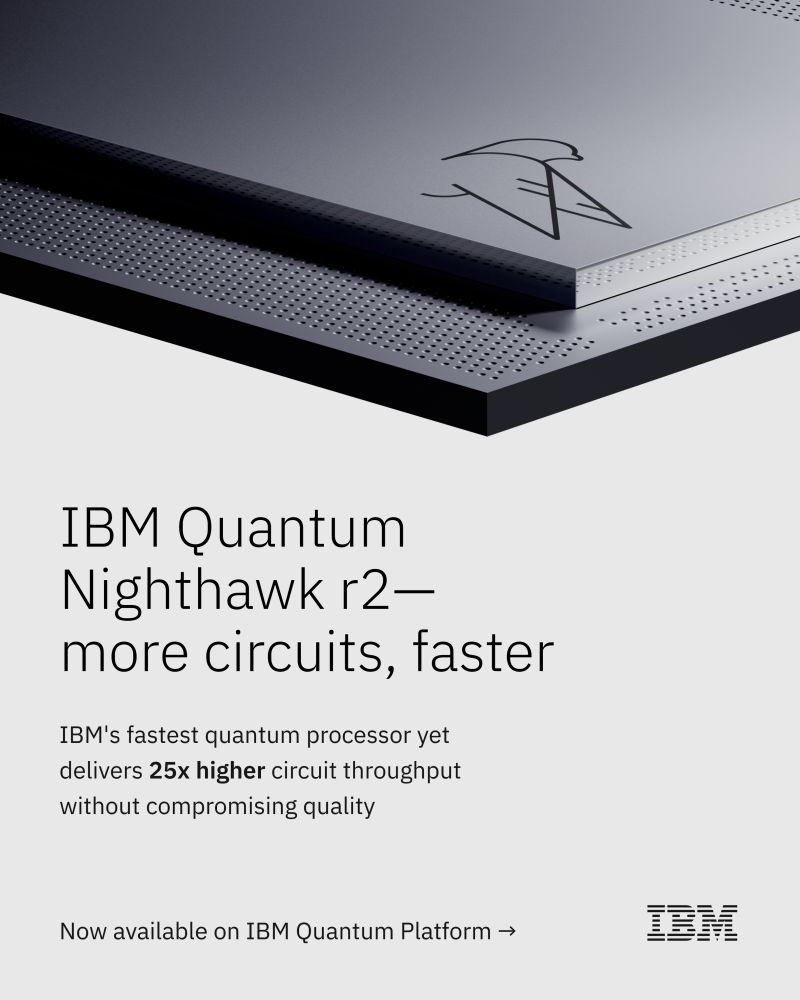
IBM Quantum has released Nighthawk r2, their fastest QPU to date, featuring a 120-qubit processor with a dissipative qubit reset framework that significantly reduces inter-circuit idle periods. This innovation allows for a maximum circuit throughput of over 100,000 circuits per second, a 25x speedup compared to the Heron QPU fleet. Nighthawk r2 has demonstrated accurate observable estimation on circuits with over 7,500 gates and achieved a 12x speedup for neutron-scattering simulations.
-
QuSecure Achieves TRL-7 at U.S. Army Project Convergence Capstone 6 for QuProtect R3
QuSecure’s QuProtect R3 cybersecurity platform achieved Technical Readiness Level 7 (TRL-7) at the U.S. Army’s Project Convergence Capstone 6, demonstrating its operational readiness in real-world combat conditions. This successful deployment at Fort Irwin establishes a path for post-quantum network defense within the Department of Defense. The platform offers quantum-resistant communications, cryptographic discovery, and zero-trust enforcement, assisting federal agencies in meeting upcoming PQC migration mandates ahead of schedule.
-
PsiQuantum and Brookhaven National Lab Partner to Develop Fault-Tolerant Algorithms on Construct Platform
PsiQuantum and Brookhaven National Laboratory are partnering to develop fault-tolerant quantum algorithms and scientific applications. Brookhaven scientists will use PsiQuantum’s Construct software platform to optimize quantum workloads, supporting the DOE’s Quantum Genesis initiative to achieve fault-tolerant quantum computing by 2028. This collaboration aims to bridge public sector research with commercial fault-tolerant software engineering, focusing on materials science, chemistry, high-energy physics, and quantum-safe cryptography.
-
-
-
Congressman Langworthy Introduces American Quantum Competitiveness Act (H.R. 10163)
The American Quantum Competitiveness Act (H.R. 10163), introduced by Congressman Nick Langworthy, designates the U.S. Department of Commerce as the lead agency for commercial quantum technology, manufacturing, and supply chain resilience. This bill directs the Secretary of Commerce to develop a national competitiveness strategy, protect domestic supply chains from foreign adversaries, and promote private sector investment in quantum computing, sensing, and communications technologies. The legislation is supported by the Quantum Industry Coalition and various regional innovation hubs and research universities.
-
IonQ, NVIDIA, and qBraid Demonstrate 54% Error Reduction in Mid-Circuit Quantum Simulations
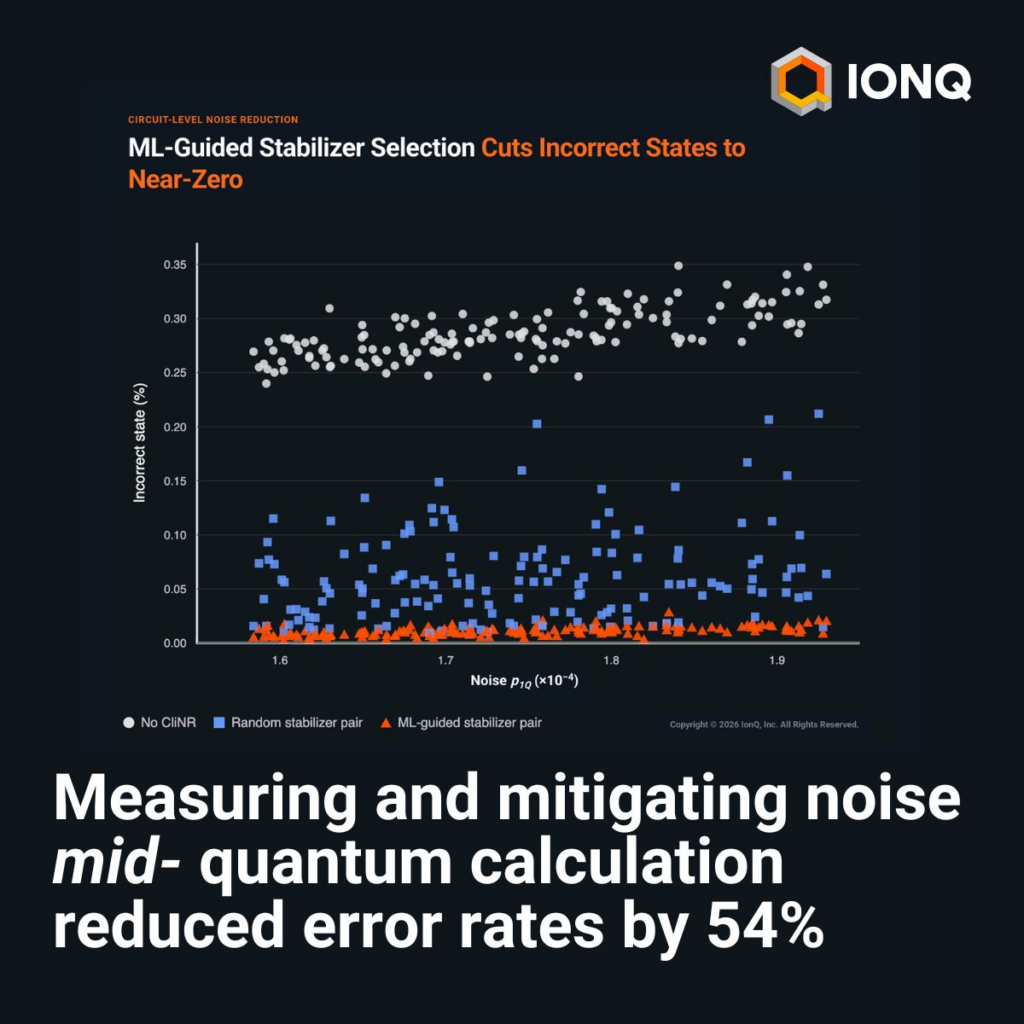
IonQ, NVIDIA, and qBraid collaborated on research demonstrating a 54% reduction in logical error rates for quantum simulations. They achieved this by using an application-native error mitigation framework on IonQ’s trapped-ion hardware and NVIDIA’s GPU-accelerated computing. The framework incorporates Generalized Superfast Encoding, Clifford Noise Reduction, and active Mid-Circuit Measurement to combat noise accumulation in deep Trotterized quantum chemistry simulations.
-
MIT Quantum Initiative Launches Gordon and Betty Moore Foundation-Backed Postdoctoral Fellowship
The MIT Quantum Initiative (QMIT) has launched a new postdoctoral fellowship program, supported by the Gordon and Betty Moore Foundation, to foster interdisciplinary quantum research and cultivate scientific leadership. The inaugural 2026 cohort comprises nine fellows from top universities, focusing on key interdisciplinary domains such as hardware-aware quantum error correction, neutral-atom tweezer arrays, and AI-driven topological materials. QMIT plans to open applications for its next academic cohort in Fall 2026.
-
Arqit, Es’hailSat, and AIEE Demonstrate Quantum-Safe Satellite Encryption
Arqit Quantum Inc., Es’hailSat, and AIEE successfully demonstrated quantum-safe encryption over existing satellite infrastructure using Es’hail-1. This trial, conducted at Es’hailSat’s Doha facility, proved that Arqit’s software-based post-quantum cryptography can be integrated into live satellite networks without hardware changes, offering a solution for securing critical data against future quantum threats. This paves the way for enhanced communication security across the MENA region.
-
QC Ware and IonQ Achieve Chemical Accuracy in Hybrid Quantum Chemistry Workflow for Drug Discovery
QC Ware and IonQ have achieved chemical accuracy in a hybrid quantum-classical chemistry workflow for drug discovery, utilizing QC Ware’s Promethium platform and the IonQ Forte quantum computer. This collaboration, executed via Amazon Braket, successfully calculated electrostatic interaction energy within 0.5 kcal/mol of classical benchmarks, demonstrating the potential for more reliable drug candidate ranking and early identification of metabolic or toxicity risks. The process involved GPU-accelerated classical preprocessing to isolate a 4-orbital active space mapped onto 8 qubits, and leveraged IonQ Forte’s all-to-all qubit connectivity for efficient quantum execution.
-
-
-
Yaqumo and SCREEN Holdings Partner on NEDO Project to Build Optical Modules for Neutral-Atom QPUs
Yaqumo Inc. and SCREEN Holdings Co., Ltd. are partnering on a NEDO project to develop and manufacture high-performance optical modules for neutral-atom quantum processors. The collaboration aims to overcome hardware limitations in neutral-atom quantum computing by creating high-speed spatial light modulators, multi-wavelength objective lenses, and robust optical sub-assemblies. This initiative also seeks to standardize optical interfaces and strengthen Japan’s quantum supply chain by linking academic research with commercial manufacturing.
-
Pasqal and KACST Partner to Advance Post-Quantum Cryptography in Saudi Arabia
Pasqal and Saudi Arabia’s KACST have partnered to advance quantum technology and post-quantum cryptography (PQC) readiness in the Kingdom, focusing on developing quantum-resistant encryption and integrating Pasqal’s hardware with Saudi research infrastructure. This collaboration, announced at LEAP 2026, supports Saudi Arabia’s Vision 2030 by transforming academic quantum research into commercial offerings for the Middle Eastern market, building on Pasqal’s existing regional presence.
-
Diffraqtion Caps Pre-Seed Round at $10M+ with Strategic Backing from Lockheed Martin and Presidio Ventures
Diffraqtion, a quantum-enabled optical sensing startup, has successfully closed an expanded pre-seed financing round exceeding $10 million, with strategic investments from Lockheed Martin Ventures and Presidio Ventures. The company, an MIT and University of Maryland spinout, develops sub-diffraction-limit quantum camera platforms that resolve details 20 times below the diffraction limit using passive quantum estimation and spatial light shaping. These newly secured funds will support the construction of Diffraqtion’s first fielded quantum camera, destined for orbital flight to enhance space domain awareness and defense reconnaissance missions.
-
QTREX Quantum to Unveil 17,280-Line Cryogenic Interconnect Architecture at IEEE Quantum Week 2026
QTREX Quantum will unveil a 17,280-line cryogenic interconnect architecture at IEEE Quantum Week 2026 in Toronto, Canada. This architecture, manufactured using Additively Manufactured Electronics (AME) technology, offers unprecedented wiring density and aims to replace conventional discrete coaxial cable assemblies. QTREX plans to offer structured configuration programs and commercial proposals to customers following the presentation.
-
Anyon Systems and Matrix Group Partner to Accelerate International Quantum Supercomputing Deployments
Anyon Systems has partnered with Matrix Group member KMT Technologies to expand the deployment of its quantum supercomputing hardware internationally. KMT will be the exclusive distributor and integration partner, focusing on delivering on-premises quantum hardware with HPC and AI infrastructure to national governments, defense organizations, and research supercomputing centers. This collaboration will also advance Anyon’s hardware roadmap, with plans to scale beyond its current 24-qubit MonarQ system to over 100 physical qubits.
-
Diraq to Deploy Eight-Qubit Silicon Quantum Computer at Equinix Sydney Data Center
Diraq and Equinix are collaborating to deploy the world’s first eight-qubit silicon spin quantum computer within a commercial data center in Sydney, Australia, by October 2026. This system is designed to integrate seamlessly with existing data center infrastructure, utilizing a standard server rack form factor and leveraging CMOS manufacturing for scalable qubit capacity. The initiative aims to validate performance, establish hybrid quantum-AI workflows, and provide enterprise access for testing applications in a secure environment.
-
Xanadu Unveils Technical Roadmap Targeting 1,000+ Logical Qubits by 2031
Xanadu has unveiled a detailed technical roadmap aiming for over 1,000 logical qubits by 2031, transitioning from current photonic chip manufacturing to networked, fault-tolerant quantum data centers. Key milestones include photon loss reduction, improved logical error rates, and the launch of a quantum data center by 2029-2030, supported by their Inception manufacturing hub. Alongside hardware development, their PennyLane software platform is gaining significant adoption, contributing to multiple monetization pathways, and the company is well-capitalized with US $686 million to fund operations through their commercialization targets.
-
S-Transistors Raises €2.6 Million ($3 Million USD) Pre-Seed Round to Build Superconducting Quantum Control Motherboards
Finnish deep-tech startup S-Transistors, a spin-off from VTT Technical Research Centre, has secured €2.6 million ($3M USD) in pre-seed funding. This capital will be used to establish a pilot manufacturing line, a dedicated cryogenic laboratory, develop product prototypes, and expand their team. S-Transistors is pioneering wafer-scale superconducting transistors designed for millikelvin temperatures to overcome the wiring and thermal limitations in large-scale quantum computers.
-